

After the Party: Assessing North Korean Coverage of Party Founding Celebrations
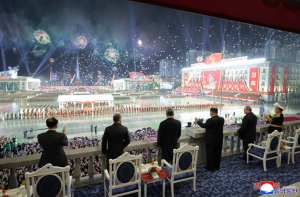
North Korea commemorated the 80th founding anniversary of the Workers’ Party of Korea (WPK) in vastly changed domestic and external environments than during the Party’s 75th birthday, just five years ago. The October 2020 celebrations were purely domestic, as North Korea maintained closed borders during the COVID-19 pandemic. In what may have been an unprecedented move for the country’s top leader, a teary-eyed Kim Jong Un apologized to his people at the military parade, stating he was “really sorry for” failing to live up to their trust amid “unexpected grave challenges and obstacles”—a reference to deteriorating economic conditions due to international sanctions and border closures, exacerbated by summer flooding.
The 2025 WPK founding celebrations presented a starkly different tableau. Kim Jong Un stood flanked by senior Chinese, Vietnamese, and Russian officials as he observed his soldiers and military hardware parade past—powerful symbolism of North Korea’s enhanced regional standing. With these three foreign dignitaries beside him, a confident Kim Jong Un declared that “the international prestige of our Republic as a faithful member of the socialist forces and a bulwark for independence and justice is further increasing with each passing day.”
Diplomatically, North Korea’s recent Party founding celebrations offer three takeaways. First, after signaling persistent distance despite initial steps toward restoring ties in September, Pyongyang appears to be warming toward China following Beijing’s dispatch of an unusually high-level delegation. Second, North Korean media coverage of the celebrations shows that Pyongyang continues to prioritize relations with Russia, evidenced by a highly uncommon Party-to-Party joint statement aligning the two countries more closely on regional and international issues. Third, Kim’s invitations to the top leaders of Vietnam and Laos signal ongoing efforts to buttress ties with Southeast Asian nations and diversify the North’s diplomatic partnerships beyond China and Russia.
Building on the Momentum with China …
North Korea’s handling of China following Kim’s summit with President Xi Jinping in early September seemed to suggest progress in ties, though not yet a full recovery. However, the participation of Chinese Premier Li Qiang—the highest-ranking Chinese official to ever attend a WPK anniversary military parade and the first premier to visit North Korea since Wen Jiabao in 2009—may be helping to bridge the distance signaled in North Korean media. For one, Pyongyang reciprocated Beijing’s rare diplomatic gesture by seating Li to Kim’s immediate right and Vietnam’s top leader, Tô Lâm, to his left during the celebrations, despite Tô Lâm outranking Li in both position and the formality of his visit.[1]
Analysis of meeting accounts shows a similar pattern. North Korean media cited Premier Pak Thae Song’s expression of support for China’s “core interests including the Taiwan issue” during his talks with Li. Although Pyongyang has explicitly and implicitly sided with Beijing’s position on Taiwan, it is extremely rare for state media to attribute such support to an authoritative figure in a report intended for both domestic and external audiences. North Korea’s coverage of the Kim-Xi summit in September—unlike the Chinese readout—omitted Kim’s explicit endorsement of China on Taiwan.[2]
Pak also told Li North Korea “would oppose hegemony and jointly defend fair international order and peace with the Chinese comrades.” This formulation is more specific than the language in the Kim-Xi summit report, which merely noted that the two leaders “referred to the issue of strengthening strategic cooperation and defending common interests in international and regional affairs.” More importantly, Pak’s remark appears to represent the strongest articulation of joint action with China on international issues in recent years, even compared with periods of close bilateral relations, and recalls North Korea’s rhetoric on international cooperation with Russia.
Reflecting these developments, Kim’s letter to Xi, sent shortly after Li’s recent visit, began with “Respected Comrade General Secretary.” The last time Kim opened a letter to Xi with “respected” was on the latter’s birthday in June 2023, before signs of strain emerged in their bilateral relationship.
It should be noted, however, that North Korea continues to avoid attributing to its officials any “important common understanding [중요한 공동인식]” reached by Kim and Xi. The closest formulation used by Pyongyang is Choe Son Hui’s reference to an “agreement [합의]” between the two leaders on strengthening bilateral ties. Furthermore, the more prominent language concerning cooperation on international issues has not been linked to Kim Jong Un himself. In contrast, North Korean media have directly cited Kim on building a “new order” or safeguarding “international justice” in cooperation with Russia.
… But Russia Still Comes Out on Top
Despite ongoing efforts to rebuild ties with China, there were clear indications that North Korea continued to prioritize its ties with Russia over China. Kim Jong Un skipped a Chinese performance but attended a Russian performance, both held on the eve of the Party founding anniversary, accompanied by Choe Son Hui and Kim Yo Jong. North Korean television also broadcast images of “Overseas Operations Units” marching in the military parade while carrying North Korean and Russian flags. A photo of these units was carried in the center of a page in the Party daily the following day.
Of particular significance were talks between Medvedev and Jo Yong Won, a Presidium member of the WPK Politburo, followed by an unprecedented “joint statement” between the WPK and the United Russia Party (URP)—moves that are consistent with ongoing efforts to institutionalize bilateral exchange and cooperation across all sectors and levels following the September 2023 Kim-Putin summit. The statement reflects a more explicit alignment between the two countries’ worldviews than before, with North Korea expressing support for Russia’s fight against the “revival of fascism and Nazi ideas and neocolonialist acts.” Notably, it represents the strongest declaration to date of Russian backing of North Korea’s defense buildup, presumably including its nuclear programs, as well as their joint efforts to counter what they view as acts of disturbance on the Korean Peninsula:
Both sides shared the views that the mounting political and military tension on the Eurasian continent and the rest of the world is, above all, directly linked to the aggressive politics of the West …
In this regard, the United Russia Party expressed firm support for the measures taken by the leadership of the Democratic People’s Republic of Korea to bolster up the country’s defence capabilities. …
Both sides reached a consensus of views on the common goal for jointly coping with the attempts to distort historical events and struggling against the forces disturbing peace and stability in Northeast Asia including the Korean peninsula, revival of fascism and Nazi ideas and neocolonialist acts persistently committed by the West.
It is necessary to defend and promote the establishment of a new world order in which the rights of all countries and peoples are reliably guaranteed without coercion from the West.
North Korean media have previously reported on Russia’s implicit backing of its defense development by citing Moscow’s “full support” for North Korea’s measures to “deter” the United States and “ensure regional peace and stability,” or its “firm support” for the North’s “just efforts for defending the security of the state and the sovereign right.” At a July 2025 press conference, Foreign Minister Sergei Lavrov said he “respects and understands” Pyongyang’s decision to develop nuclear weapons—language that nonetheless fell short of expressing “firm support.”
The reference to the “common goal” of “struggling against the forces disturbing peace and stability in Northeast Asia including the Korean peninsula” may merely be a nod to Articles 3 and 4 of the 2024 Treaty on Comprehensive Strategic Partnership, which outline provisions for consultations and mutual assistance in the event of an armed invasion. However, this language also goes beyond the previously reported agreement between the two sides to “deal with the regional situation through close cooperation and concerted action,” and Russia’s stance of “resolutely oppos[ing] any attempt to deny the present position of the DPRK as regards the situation on the Korean peninsula.”
Some have interpreted the seating arrangement during the celebrations—URP President Dmitry Medvedev sat two places to Kim’s left—as a sign of strain between Pyongyang and Moscow. However, this almost certainly reflects protocol, as the Vietnamese and Chinese officials outranked Medvedev.[3] This would seem to be supported by Kim Jong Un’s meeting with Medvedev, which mirrored his talks with the Chinese premier.
Beyond China and Russia
Unlike the Armistice Day celebrations in July 2023, which focused on Russia and China, North Korea hosted top leaders from Laos and Vietnam, as well as the Indonesian foreign minister, for the WPK’s 80th founding anniversary. The presence of Vietnam’s top leader alongside Chinese and Russian officials at the recent military parade reflected Pyongyang’s efforts to broaden its diplomatic engagement beyond its two great-power neighbors.
These visits build on North Korea’s initiative to reinvigorate ties with its traditional partners in Southeast Asia, particularly Laos and Vietnam, since 2024, when it was reemerging from a period of extended diplomatic isolation. Pyongyang’s outreach to Southeast Asian countries also aligns with the WPK’s policy of advancing relations with “friendly countries that respect the dignity and interests of the DPRK.” Vietnam, Laos, and Indonesia—countries with long-standing diplomatic relations with North Korea—would fit within that category.
Conclusion
Now that Party founding celebrations have concluded and foreign guests have departed, North Korea will turn its attention to completing the five-year plan outlined at the Eighth Party Congress in January 2021. If past practice holds, North Korea will launch a labor mobilization campaign ahead of the Ninth Party Congress to maximize economic output and start the event on a high note. North Korea conducted a “70-day campaign” and an “80-day campaign” in the run-up to the Seventh and Eighth Party Congresses in 2016 and 2021, respectively.
In the interim, it will be worth monitoring North Korean media coverage of China and Russia for any developments, major or subtle, in Pyongyang’s thinking on its bilateral relationships.
- [1]
Tô Lâm, Vietnam’s top-ranking leader, was in North Korea on a “state visit” at the invitation of Kim Jong Un himself, while Li Qiang, the second highest-level official in China, led a delegation of the Chinese Party and government for an “official goodwill visit” at the invitation of the North Korean Workers’ Party and government.
- [2]
North Korean coverage of Pak Thae Song’s meeting with Li Qiang and the recent Kim-Xi summit appeared in both domestic and external outlets. Domestic media are print and broadcast platforms accessible to the North Korean public, and external media are mainly Internet websites, which are unavailable to ordinary citizens. Foreign Ministry pronouncements and commentary on Taiwan are disseminated through the Foreign Ministry and Korean Central News Agency (KCNA) websites. While domestic media also publish reports related to Taiwan, they are generally less authoritative, and expressions of support tend to be implicit.
- [3]
Medvedev and his URP delegation were on a “visit” to North Korea at the invitation of the WPK, which is less formal than To Lam’s “state visit” or Li Qiang’s “official goodwill visit.”