

Tracking North Korea’s Ninth Party Congress Preparations
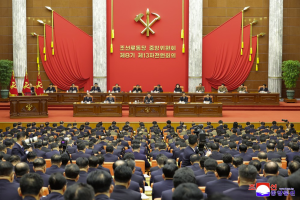
North Korea’s recent year-end Workers’ Party of Korea (WPK) plenary meeting offered a relatively bland readout of this year’s achievements and next year’s tasks—almost certainly to reserve details for the upcoming Ninth Party Congress.
One key issue at the latest plenum was whether North Korea would provide details about the highly anticipated Ninth Party Congress, including its timing. However, Pyongyang simply noted that pending issues required resolution, while also indicating that preparations were in early stages. Based on the Eighth Party Congress precedent, it could take several more weeks before the Party Congress convenes.
| What is the Party Congress?
According to the 2021 WPK Charter, the Party Congress is the “supreme leadership organ” of the Party, convened by the Party Central Committee (CC) quinquennially. The WPK Charter stipulates that the Party Congress: 1) reviews the work of the WPK CC; 2) revises or supplements Party programs and the Party Charter; 3) discusses and decides basic issues related to Party lines, policies, strategies and tactics; 4) elects the WPK CC; and 5) elects the general secretary of the WPK. North Korea has held eight Party Congresses: the first six (1946, 1948, 1956, 1961, 1970, and 1980) under Kim Il Sung, and the Seventh (2016) and Eighth (2021) under Kim Jong Un. Party meetings were near-defunct during Kim Jong Il’s tenure, revived only in his final years to facilitate a smooth power transition to Kim Jong Un. Regularized Party meetings have been a hallmark of Kim Jong Un’s leadership, and the Party Congress revival should be understood in that context. The Ninth Party Congress is expected to review the Party’s accomplishments over the past five years and present policy directions for the next five years. |
Not Yet Ready for Prime Time
From December 9 to 11, the WPK held an annual year-end plenary meeting to review the year’s achievements. This meeting was held roughly two weeks earlier than usual to address Ninth Party Congress preparations as an additional agenda item.
During its June plenary meeting, the WPK decided to convene the Ninth Party Congress, without providing date. The general assessment was that it would occur in early 2026, given that the Eighth Party Congress was held in early January 2021 and Party Congresses convene every five years.
Pyongyang did not report on congress preparations between June and the latest plenum—a notable contrast to the run-up to the Eighth Party Congress. The recent plenum also did not provide a timeframe, noting instead that unresolved issues must be addressed first:
He [Kim Jong Un] clarified the tasks for ensuring the successful holding of the Party Congress including the issue of completing pending major projects until the Ninth Congress of the Party, the issue for all sectors of properly setting the next five-year plans for qualitative development and proposing scientific and realistic ways for their implementation….
The report also outlined several preparatory steps required before the Party Congress:
Presented to the plenary meeting were a series of issues related to the preparations for successfully holding the Ninth Congress of the Party ….
The report referred to the issues including those of forming the preparatory committee for the Party Congress, organizing groups according to panels and sectors, drafting the amendments to the rules of the Party to be proposed for the approval of the Party Congress and reviewing the work of the leadership bodies of the Party committees at all levels, and to the method of electing the delegates to be sent to higher Party conferences and the Party Congress.
The Eighth Party Congress Example
While difficult to assess how long North Korea needs to resolve its outstanding issues, the 2020 timeline for the Eighth Party Congress suggests at least several weeks of preparations remain.
As the table below shows, four months elapsed from when the preparatory committee formed in late August 2020 to when the WPK Politburo approved the committee’s work in late December and announced the Congress would be held in “early” January. Even if the preparatory committee was not fully active between late August and late November, the period from late November – when Party meetings were already electing delegates — to late December—by which point delegates had been elected—suggests preparations require at least several weeks. The recent plenary meeting has only just discussed forming a preparatory committee and electing delegates.
Precedent also suggests North Korea may convene one or two Party meetings—possibly Political Bureau (PB) meetings—to report preparation progress and announce an approximate timeframe closer to the Ninth Party Congress.
Conclusion
North Korea can probably expedite preparations if necessary. The larger question is how quickly it can complete the tasks and resolve the issues Kim Jong Un raised during the recent plenary meeting. Conversely, Pyongyang can also pace itself if progress is slower than expected. While we cannot know why preparations remain at an early stage, the June announcement on the convening of the Party Congress and tracking which issues or projects North Korea emphasizes in the coming weeks may provide clues. In the meantime, we await updates, such as Politburo meetings.