

North Korea Steps up Reporting on People’s Livelihoods, Hints Party Congress To Provide More Detailed Economic Plan
This article is from the third edition (October-December 2025) of 38 North’s quarterly product, North Korea Briefing, that monitors key internal developments in North Korea. For the full series, click here.
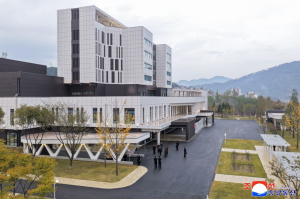
During the fourth quarter, North Korea held a national light industry products exhibition and completed major hospital construction projects. Both initiatives, aimed at improving people’s livelihoods, reflect the Kim regime’s push to maximize economic achievements before year-end and the Ninth Party Congress. However, North Korean media coverage of light industry in recent years—reinforced by reporting on the exhibition—suggests the country has made little progress in this sector, and regional disparities remain. At the December Party plenary meeting, Kim Jong Un declared that the current five-year plan had been fulfilled and that 2025 economic development goals had been attained. The meeting readout also suggests that the next five-year economic plan will present more concrete development targets and that Kim’s “pragmatism” remains alive.
Light Industry Products Exhibition Held
North Korea held a light industrial goods exhibition, “Development of Light Industry-2025,” in Pyongyang from October 9-24 to commemorate the Party’s 80th founding anniversary. According to North Korean media, the exhibition featured more than 68,000 daily necessity products, including shoes, cosmetics, and foodstuffs, produced by more than 580 units across the country. North Korea held the same light industry exhibition in 2023 to mark the 75th state founding anniversary.
In an opening ceremony, Party Secretary and Cabinet Premier Kim Tok Hun noted that production had been “revitalized to bring about a radical change in the material and cultural life of the regional people,” and expressed confidence that this exhibition would encourage sharing best practices and give momentum to further development of light industry.
Context and Implications
Over the past few years, North Korean media reports on Party plenary meetings and Supreme People’s Assembly (SPA) sessions have made relatively few references to light industry except in connection to the 20×10 policy for regional development, an initiative launched by Kim Jong Un in January 2024 to build industrial factories in 20 cities and counties per year over the next decade. Similarly, South Korea’s Bank of Korea estimates of North Korea’s gross domestic product indicate growth in light industry has been lackluster, with the exception of a rebound in 2022 following a previous sharp decline. Despite the North Korean cabinet premier’s claim of revitalized regional production, many of the factories featured at this exhibition include not only long-established enterprises, but also businesses in Pyongyang and major provincial cities, central government-owned enterprises, and food factories operated by major state-owned trading companies.[1] This suggests that factories built during the first two years of the 20×10 policy were concentrated in economically sound regions with greater central control, highlighting continued disparities in economic conditions between regions.
Since 2016, the tightening of international sanctions has made the import of production goods and raw materials more difficult, forcing North Korea to focus its efforts on research and development using domestic resources and technology. In light industry, limited access to raw materials and manufacturing equipment has likely also hindered new market entrants. However, reports from this exhibition suggest that further opening of the borders and increased trade and personnel exchanges are now necessary.
Opening of Hospitals
The Pyongyang General Hospital opened on November 3, 2025, after more than five years since the groundbreaking ceremony was held in March 2020. In a speech at the hospital’s inauguration ceremony the previous month, Kim Jong Un severely criticized the Ministry of Public Health and other relevant agencies for a lack of medical services for the people and said: “This is really one of the strongest wishes I have wanted to fulfil, something that has always been in the forefront of my mind.… Modern medical facilities are indispensable in ensuring that the working people enjoy the rights granted by the state.” According to Kim, the Party’s public health modernization strategy pursues simultaneous development across multiple fronts: constructing central hospitals and regional hospitals, building healthcare facilities and medical service infrastructures nationwide, and integrating medical treatment with personnel training and scientific research.
In a speech at Kangdong County Hospital’s inauguration ceremony in November, Kim Jong Un said: “This hospital has helped completely reversing the existing conception of a regional hospital; the course of its construction was exemplary and its operation will serve as an ideal model for the development of public health in the regions.” He added that two more regional hospitals and Wonsan-Kalma Coastal Tourist Area first-aid posts would be built in 2025. If all are completed, this would bring the total number of hospitals finished in 2025 to six. In the meantime, the cabinet daily reported that Pyongyang Medical University Hospital is vigorously imparting technical skills to local hospitals across the country.[2]
Context and Implications
North Korea has long-cited free compulsory education and free medical care as evidence of the superiority of its socialist system over capitalism, particularly that of the United States. However, as Kim Jong Un’s statements over the years have revealed, while schools remain tuition-free, the state has failed to adequately provide uniforms, school bags, and supplies—hardly a system showcase internationally.[3] Following improvements in educational content and standards, the regime seems to be now prioritizing the supply of school materials nationwide, not just for Pyongyang residents.
The 20×10 policy’s inclusion of rural hospital construction follows the same logic. For North Korean citizens, ensuring a baseline standard of medical services nationwide is essential to raising living standards. Kim Jong Un saw this when he formally incorporated hospitals into the 20×10 policy in December 2024 as one of the “three essential projects,” the other two being sci-tech dissemination centers and grain management facilities.[4]
Efforts to improve medical standards, even if initially driven by the COVID-19 pandemic, will likely strengthen the regime if sustained long term. Therefore, healthcare improvements should be viewed not only as public health measures but also as tools for enhancing North Korea’s resilience in inter-Korean competition.
Party Plenary Meeting Held
During the 13th Plenary Meeting of the Eighth Workers’ Party of Korea Central Committee’s enlarged meeting in December, Kim Jong Un concluded that “the five-year plan was carried out along with the achievement of the objectives of this year’s economic development,” citing major industrial sectors had carried out their production plans, the agricultural sector had recorded “higher grain yields over last year,” and “a lot” of major construction projects had been “successfully completed.” Kim also said the modernization of major sectors and the reinforcement of technical infrastructure had “reached the final stage” and “provided possibility and guarantee for more confidently entering into the fulfillment of the long-term goals for the next stage.”
On the other hand, Kim Jong Un outlined major tasks facing the Party, government, and state organs, including boosting agricultural production and accelerating rural development, such as enlarging wheat cultivation areas, reforming the distribution system, and strengthening the education sector’s material foundation.
Context and Implications
Kim declared the 2021-2025 five-year plan had been achieved without citing specific accomplishments. This reflects the plan’s primary objective of strengthening existing industrial infrastructure and restoring domestic supply chains. His comment that economic modernization and reinforcement provided the possibility of fulfilling long-term goals at the next stage suggests the next five-year plan (2026-2030) will present more concrete development goals.
Kim’s emphasis on regional development and wheat cultivation reflects the regime’s dual priorities: solidifying its power base by restoring livelihoods and restarting factories in post-pandemic North Korea, while addressing urban-rural disparities through locally driven economic revitalization.
Notably, Kim emphasized “the socialist principle of distribution” in rural areas, signaling that material incentives for labor, rather than communist distribution detached from reality, are key to boosting agricultural production. This suggests the “pragmatic” aspect of the Kim Jong Un regime is not yet completely dead.
- [1]
Those that participated in this year’s exhibition included the Wonsan Leather Shoes Factory, Pyongyang Hosiery Factory, Pyongyang Cosmetics Factory, Taedonggang Kumok Instant Boiled Rice Factory, Pyongyang Automation Appliances Factory, the Pyongyang Kim Jong Suk Textile Mill, and the Amnokgang General Foodstuff Factory.
- [2]
Kim Ryong Hun,“지방병원들에 대한 기술전습 힘있게 추진 [Vigorously Imparting Technical Skills to Regional Hospitals,” Minju Joson, October 29, 2025.
- [3]
“Kim Jong Un Gives Field Guidance to Newly-Built Pyongyang Bag Factory,” Korean Central News Agency (KCNA), January 5, 2017, http://www.kcna.co.jp/item/2017/201701/news05/20170105-01ee.html; “Respected Comrade Kim Jong Un Visits April 25 Hostel to Learn about Preparations for Education,” KCNA, August 17, 2024, http://www.kcna.co.jp/item/2024/202408/news17/20240817-02ee.html.
- [4]
The 20×10 policy involves only constructing facilities, leaving operations to local governments. It is likely that fewer than half of the regions where such facilities are built will successfully commercialize local products or align with market trends for profitable nationwide sales. Within a few years, the regime will likely launch a nationwide campaign to boost local economies, criticizing and dismissing ineffective local leaders while promoting successful regions as models. Through such trial and error, the regime likely intends to transform North Korea’s local political culture, which relies entirely on the central government and lacks initiative, by forcing leaders to overcome “unrealistic methods of management and old-fashioned laws” (from Kim Jong Un’s speech at the October 2025 Pyongyang General Hospital inaugural ceremony) through market mechanisms.