

A New Rocket Motor Further Muddles North Korea’s Solid-Propellant ICBM Outlook
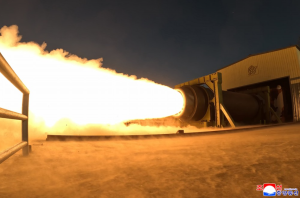
North Korea claims to have ground-tested a “newly upgraded” solid-propellant rocket motor about 20% more powerful than the new motor it revealed in September 2025. The source of the motor’s thrust increase is unclear, as is whether any Russian assistance was involved. Pyongyang associated the new motor with “strategic forces” but not a specific missile system; use as the first stage of an intercontinental ballistic missile (ICBM) is most likely. The advent of the new motor further muddles the outlook for the North’s future solid ICBM force, raising questions as to whether there will be yet another new system in addition to the as-yet-untested Hwasong-20 (HS-20) revealed last fall, and whether that new system would supplant the HS-20 or even the prior HS-19, which has only been flown once. For both the new motor and its predecessor, the most likely purpose of their increased thrust would be in boosting heavier payloads; the most strategically impactful such payload would be multiple warheads if the North can successfully develop them.
Information to Date
North Korean media on March 29 reported that Kim Jong Un had overseen an undated ground (static) test of a “newly upgraded,” “high-thrust,” solid-propellant rocket motor “using the composite carbon fiber material.” The motor was claimed to have 2,500 kilonewtons (kN) of thrust (about 562,000 lbs). Accompanying photographs show a composite-case motor (consistent with the use of carbon fiber) that appears roughly the same diameter as the first stage motors of the North’s previously revealed solid ICBMs, the Hwasong (HS) -18, -19, and -20. It is unclear how the new motor’s length compares to the first stage of the HS-20, which is assessed to be longer than that of the HS-19, which in turn, is probably longer than that of the HS-18.
Pyongyang did not ascribe the new motor to a particular missile system beyond saying it was related to “strategic strike” and “strategic forces.” The article said the test is part of the new five-year plan that “set[s] the steady upgrading of strategic strike means as a major goal… both in quality and quantity,” and was characterized by the introduction of “better components with superior economic and technical effectiveness” like the new motor.
Analysis and Implications
Motor capability. If North Korea’s claims are correct, the new motor has about 20% more thrust that the 1,960 kN claimed for the HS-20 first stage motor revealed in September 2025, which the North also said would be used in a new variant of the HS-19. (By way of comparison, the 1980s US Peacekeeper solid ICBM’s first stage had 2,200 kN of thrust.) The source of the claimed thrust increase is unclear; possibilities include a longer motor and/or a small diameter increase, more energetic solid propellants, and improved motor design. Whether any of these changes are due to any Russian technical assistance is unknown.
Missile system association. The “strategic” missile most likely to be associated with the new motor is an ICBM, although use in a new intermediate- or medium-range ballistic missile cannot be ruled out. Use in an ICBM-range submarine-launched ballistic missile (SLBM) is unlikely, since the height constraints of missile subs generally dictate shorter missiles with larger-diameter stages.
The advent of the new motor so soon after the unveiling of the HS-20-associated motor last fall further muddles the question of the evolution of the North’s solid ICBM force. Will the new motor go into yet another new ICBM beyond the not-yet-tested HS-20 and the recently announced (and also unflown) HS-19 variant? If the new motor is longer than that of the HS-20, will it be combined with longer upper stages into a missile able to fit on the longer, 12-axle road-mobile launcher chassis revealed in September 2024? Will the new motor replace the one unveiled in September 2024 in the HS-20, or will a new ICBM using the new motor supplant the HS-20, the HS-19 variant, or even the original HS-19 (which has only been flown once in October 2024)? More data in the future will be needed to answer these questions.
Military utility. The use of strong, lightweight carbon-carbon in the motor case (the heaviest part of the stage beyond the solid propellant itself) means that more of the new motor’s thrust would be available to loft larger payloads or increase the overall missile’s range. Because even the HS-18 is assessed to be able to reach targets throughout the continental US, increased range would not seem to be a necessary use of the new stage’s increased boost capacity. Instead, lofting a heavier payload to the same range appears to be the best use of that increased capacity.
A heavier (and thus larger-yield) single nuclear warhead or the addition of warhead decoys or other missile defense penetration aids are possible uses for increased payload capacity. But the most strategically impactful use would be in lofting the multiple warheads and post-boot vehicle (payload “bus”) associated with a multiple, independently-targetable reentry vehicle (MIRV) payload. The North revealed multiple-warhead missiles as a development goal in 2021, and conducted what it said was a MIRV payload flight-test in June 2024 (albeit unsuccessfully). If MIRVs can successfully be developed, likely requiring at least several successful flight tests over a minimum of a few years, the North could further complicate the task of allied missile defenses and increase the number of targets that its missile force can strike with a given number of missiles and launchers.