

North Korea Sees a New Solar Power Push
The recent opening of a new solar farm in Haeju, South Hwanghae province, marks a turning point in North Korea’s solar energy production. This facility has the highest capacity for a single installment—10 megawatts—in the country to date and is indicative of a larger trend.
North Korea’s solar energy sector is not only expanding at a greater scale than has been seen in recent years, the approach to solar is shifting. Several large-scale solar projects are under construction or have recently been completed. However, unlike past solar projects that were principally designed to provide electricity to the facilities where they were installed, these new projects are reportedly feeding into the larger electricity grid. As North Korea works to modernize its economy, large-scale solar energy production seems to be an important part of meeting growing energy demands.
North Korea’s Chronic Energy Shortages
North Korea has struggled with electricity shortages for decades. Escapees say that power outages are frequent, sometimes lasting days, especially in rural areas. Moreover, because the state prioritizes electricity supply for factories and the military, residences are often left literally in the dark.[1]
As the country pushes for the modernization of its economy and higher national living standards, the availability of a reliable electricity supply is becoming increasingly essential.
Things do appear to be improving. Nighttime satellite imagery shows Pyongyang has steadily gotten brighter at night over the last decade, which indicates that electricity supply is getting better.
Across the entire country, the rise is less pronounced but is still trending upwards.
Still, the supply of electricity is far from abundant. In March, when addressing delegates to the Supreme People’s Assembly, Kim Jong Un said that electricity production was one of two sectors of the economy under the greatest strain to match demand with supply. The other was coal production, which also influences power generation.
“As a matter of fact, the scope of growth of our economy can be said to be decided by the production results of the two sectors,” he said in a policy speech.
The Solar Factor
Typically in North Korea, calls to increase electricity production are mostly answered with new hydroelectric power plants. The latest of those, Tanchon Power Station numbers 1, 5 and 6, were inaugurated in mid-May after years of delays.
North Korea is well-suited to hydro power thanks to its mountainous terrain and hundreds of rivers, but hydro can’t be the only solution to satisfy growing demand. The country’s capacity to build new conventional power stations is limited, and building a nuclear energy industry, as the country often states as a goal, appears difficult. This has brought solar and wind power into greater focus to address this growing demand.
Thousands of solar panels already dot the North Korean landscape, but many appear to feed specific applications, such as powering cellular towers or providing additional electricity for administrative buildings.
Until recently, only a handful of installations have fed electricity into the power grid. The largest of those was the North Phyongan Provincial Power Distribution Station (평안북도송배전부에서). The plant was built in 2019 and consists of around 3,600 solar panels in a 1.3-kilometer line to the east of Sinuiju.
Haeju Solar Power Plant
The new plant in Haeju is significantly larger than those previously pursued. It currently consists of just over 16,000 solar panels in large 56 and 80-panel arrays.
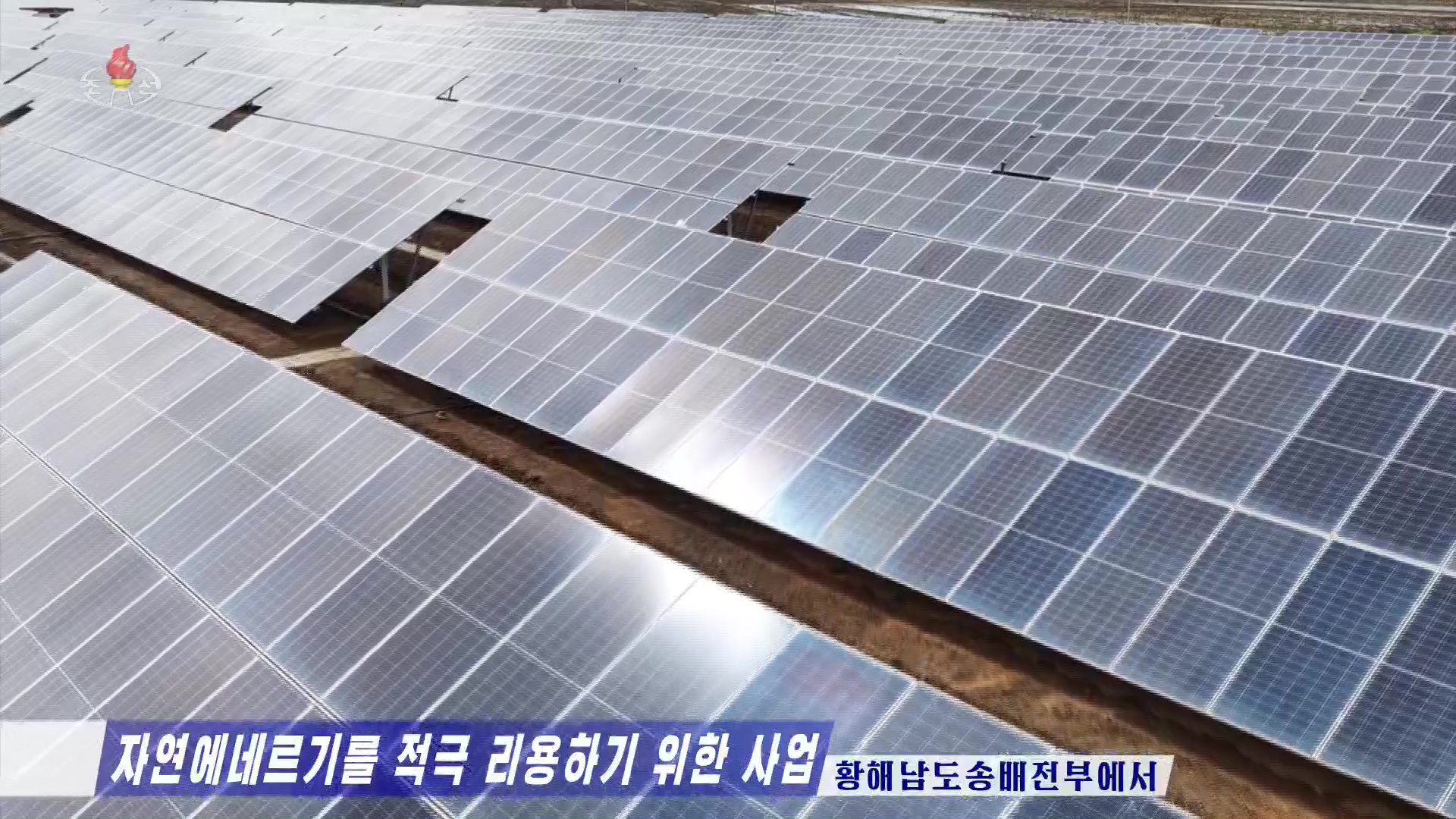
Construction began around November of last year and was completed in just six months on a plot to the west of the city. The plant is operated by the South Hwanghae Power Transmission and Distribution Department (황해남도송배전부) and is intended to serve as a model for other solar farms.[2]
The plant has a total output of 10,000 kilowatts, which is helped by bifacial solar panels that collect direct and reflected sunlight for a 30 percent energy boost per panel, according to North Korean media.
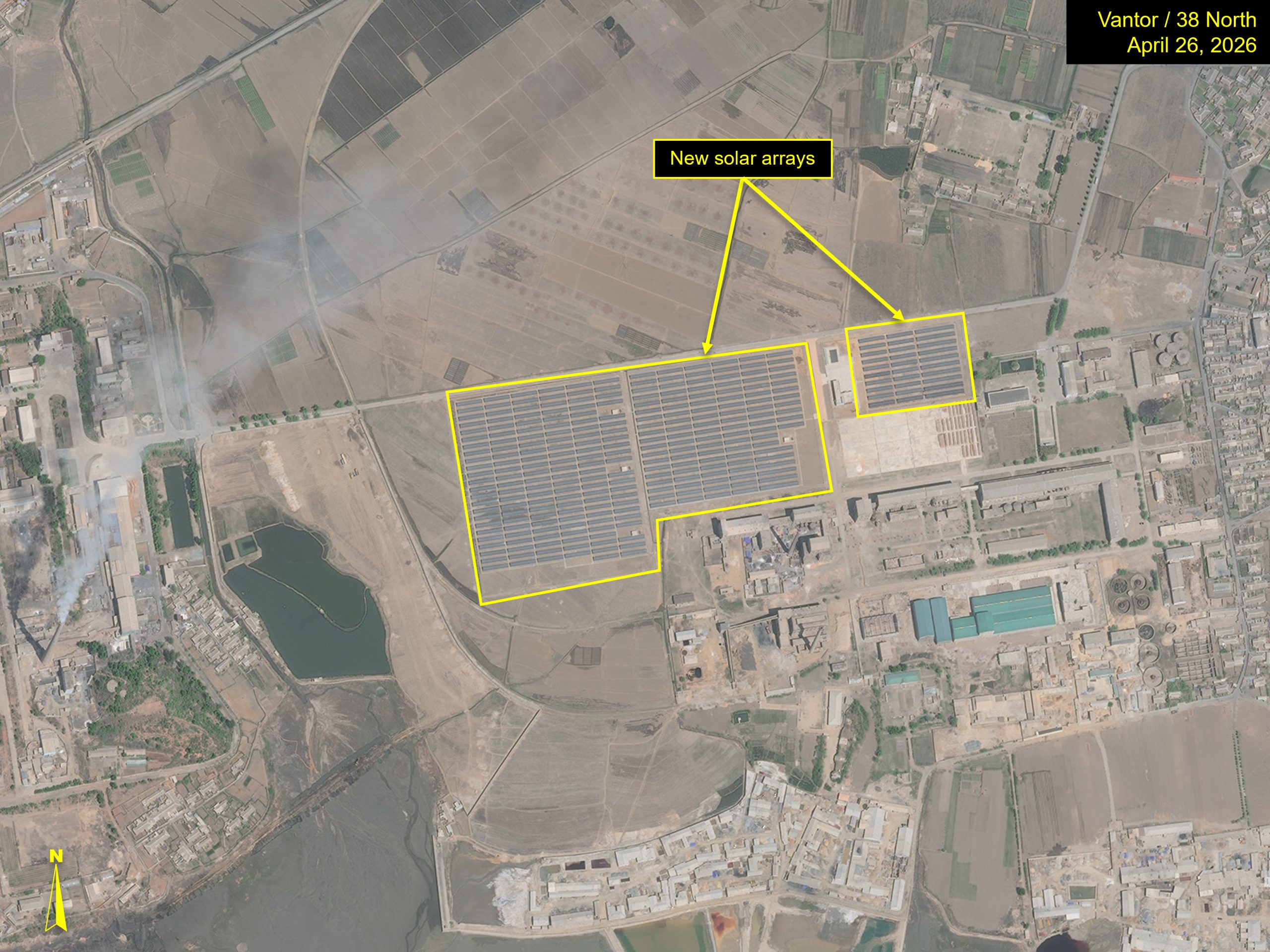
In addition to the Haeju plant, several other large-scale solar projects are underway in the country.
Phabal, Ryanggang
A new solar farm was built in Phabal, Ryanggang province, last year. The facility has a capacity of thousands of kilowatts. The province is now planning to build another solar power station with a capacity of “tens of thousands of kilowatts” in the province, according to state media. If the province succeeds, it could be larger than the Haeju plant.
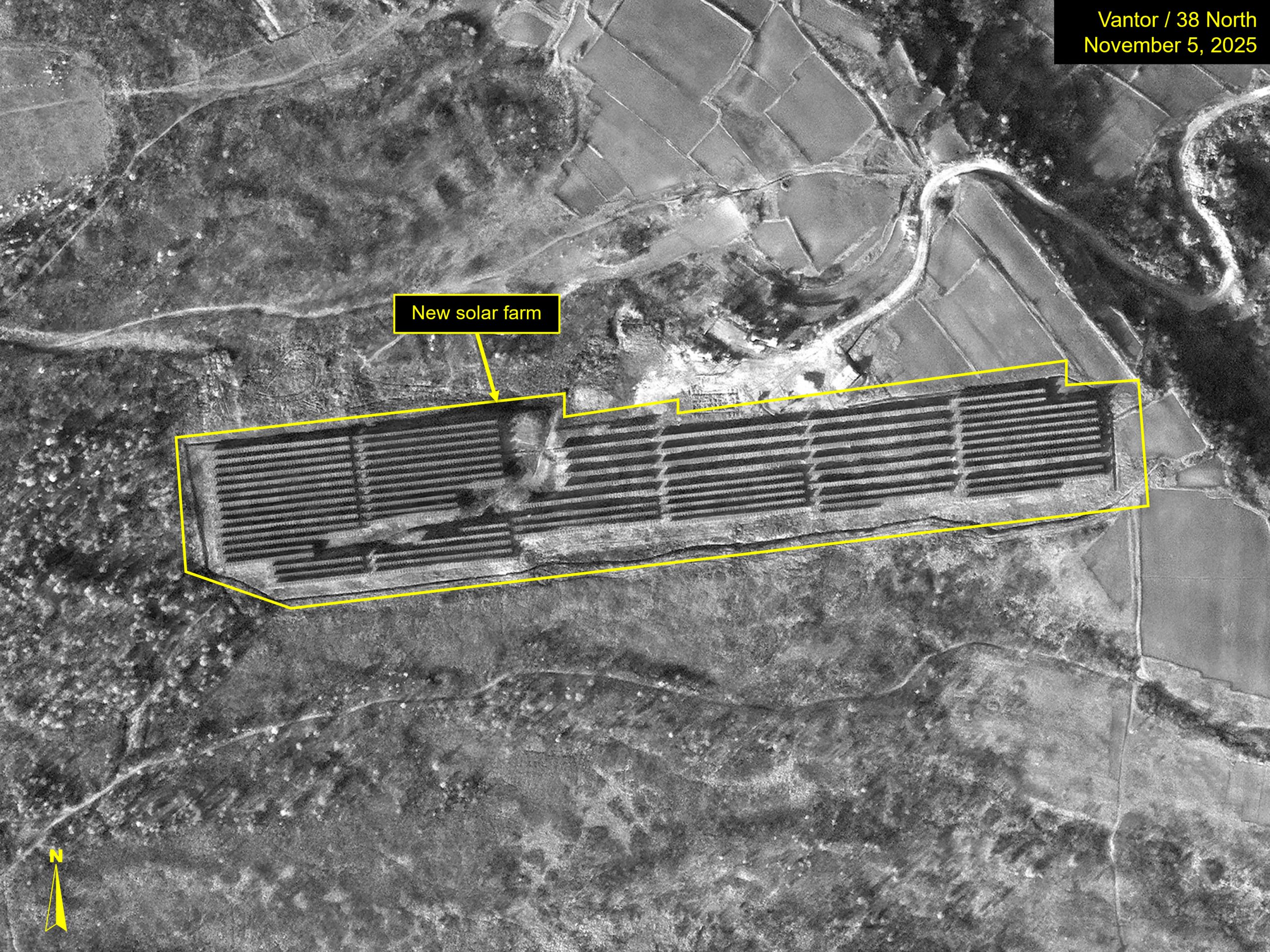
Samgwang Solar Farm
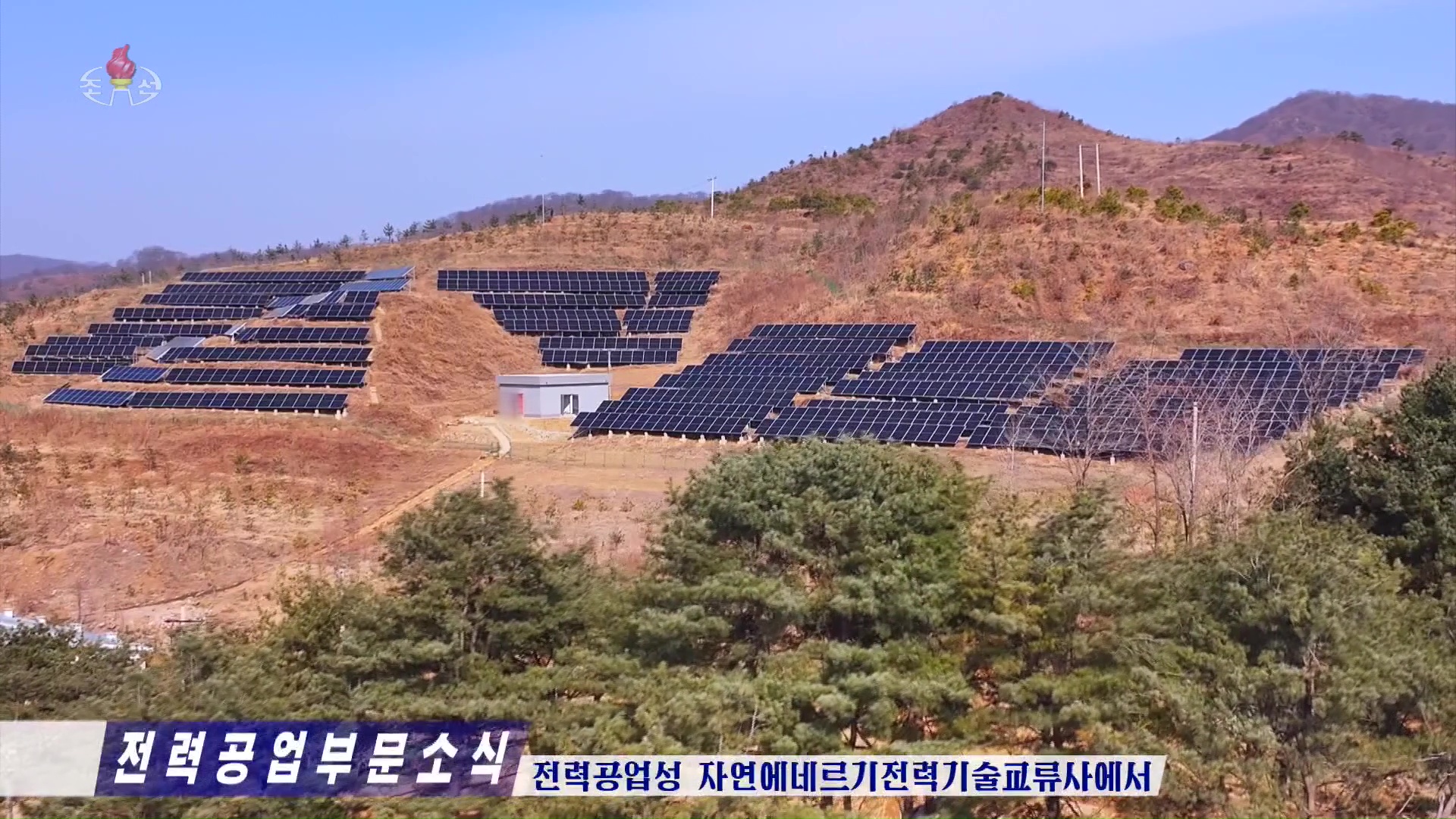
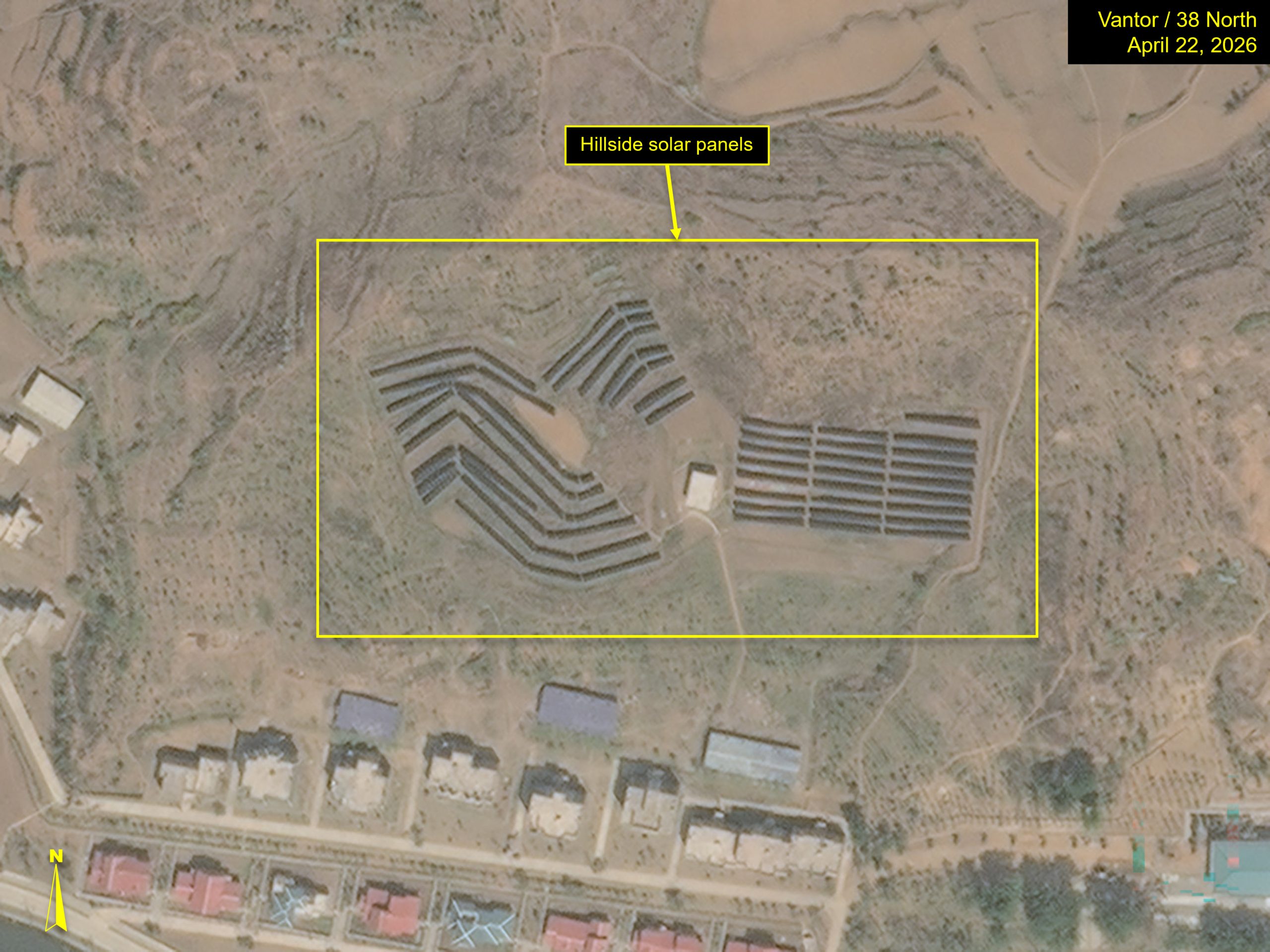
In Samgwang, Unjon County, North Phyongan province, a solar farm was constructed as part of an entire facelift of the village that included numerous new buildings and the establishment of a livestock farm. Approximately 800 panels are arranged on a hillside to the north of the town.
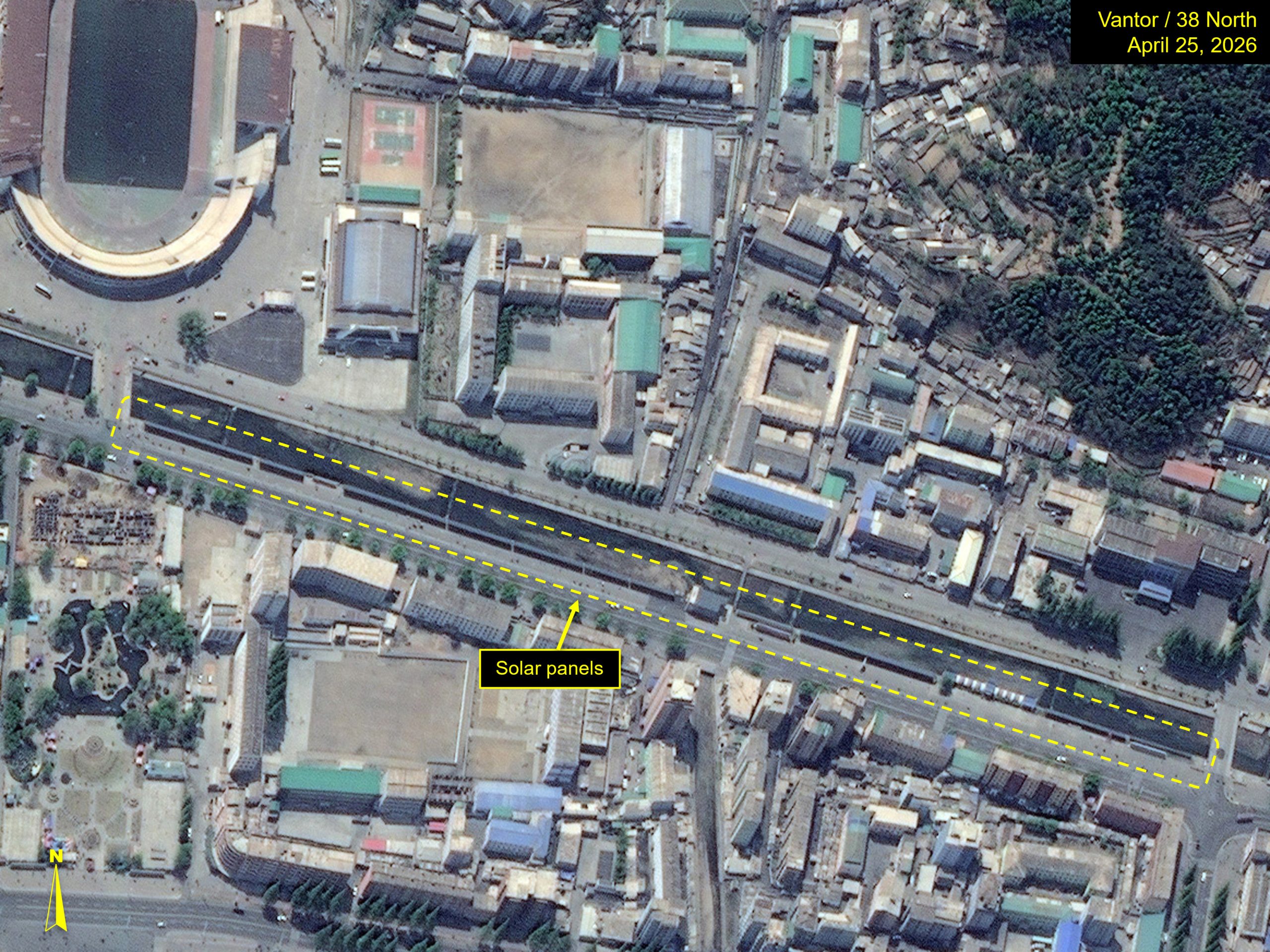
Pyongsong, South Phyongan
The South Phyongan Solar Power Plant (평안남도태양빛발전소) saw several hundred solar panels constructed along the riverbank in Pyongsong in mid-2024. Like Ryanggang, the project is seen as a step towards a larger future plant. In the case of South Phyongan, it will have a capacity of “thousands of kilowatts,” according to state media.
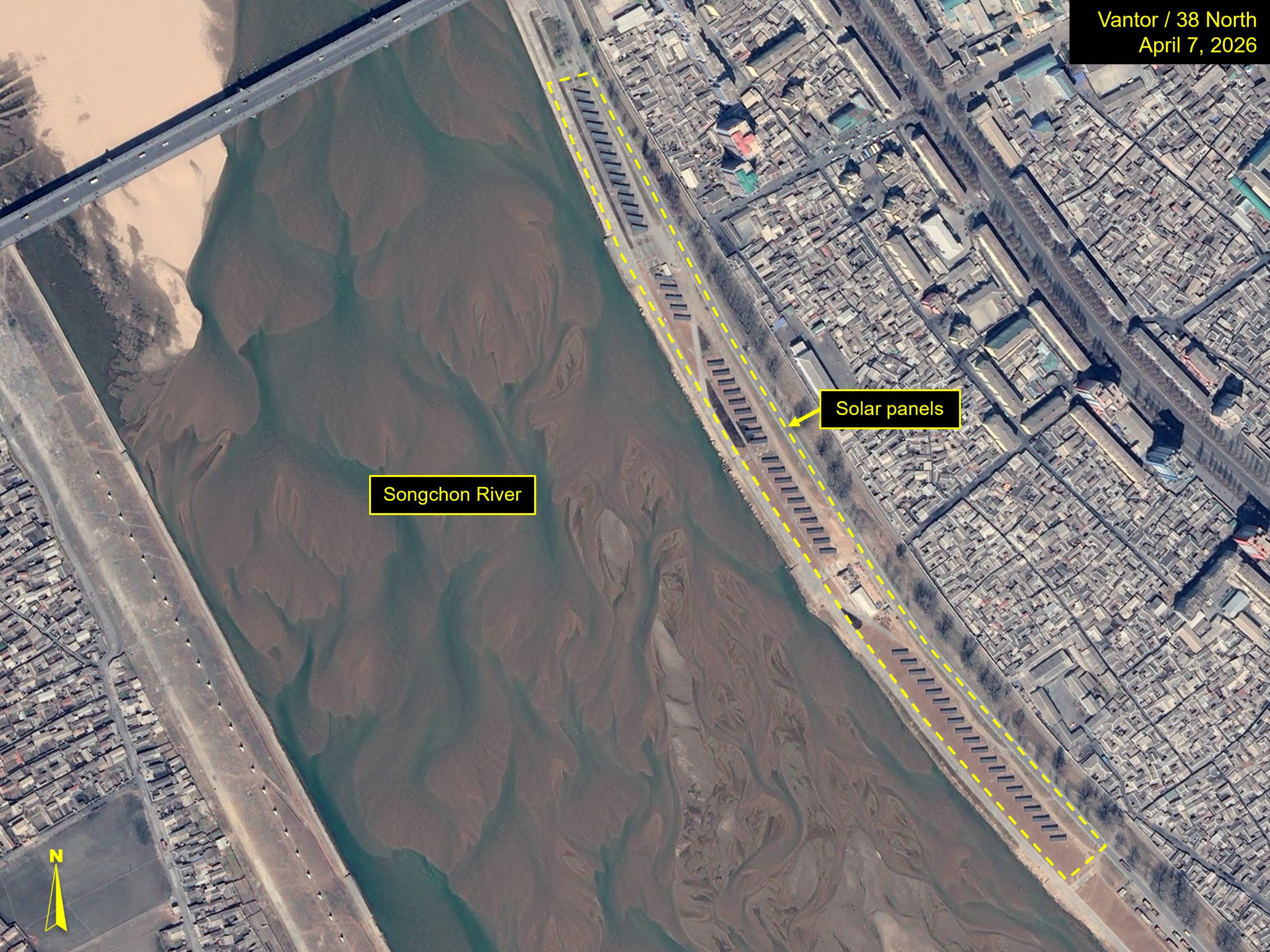
Hamhung, South Hamgyong
In Hamhung, a solar power station has been constructed along the bank of the River Songchon. The facility consists of 58 solar arrays along approximately 750 meters of the eastern riverbank.
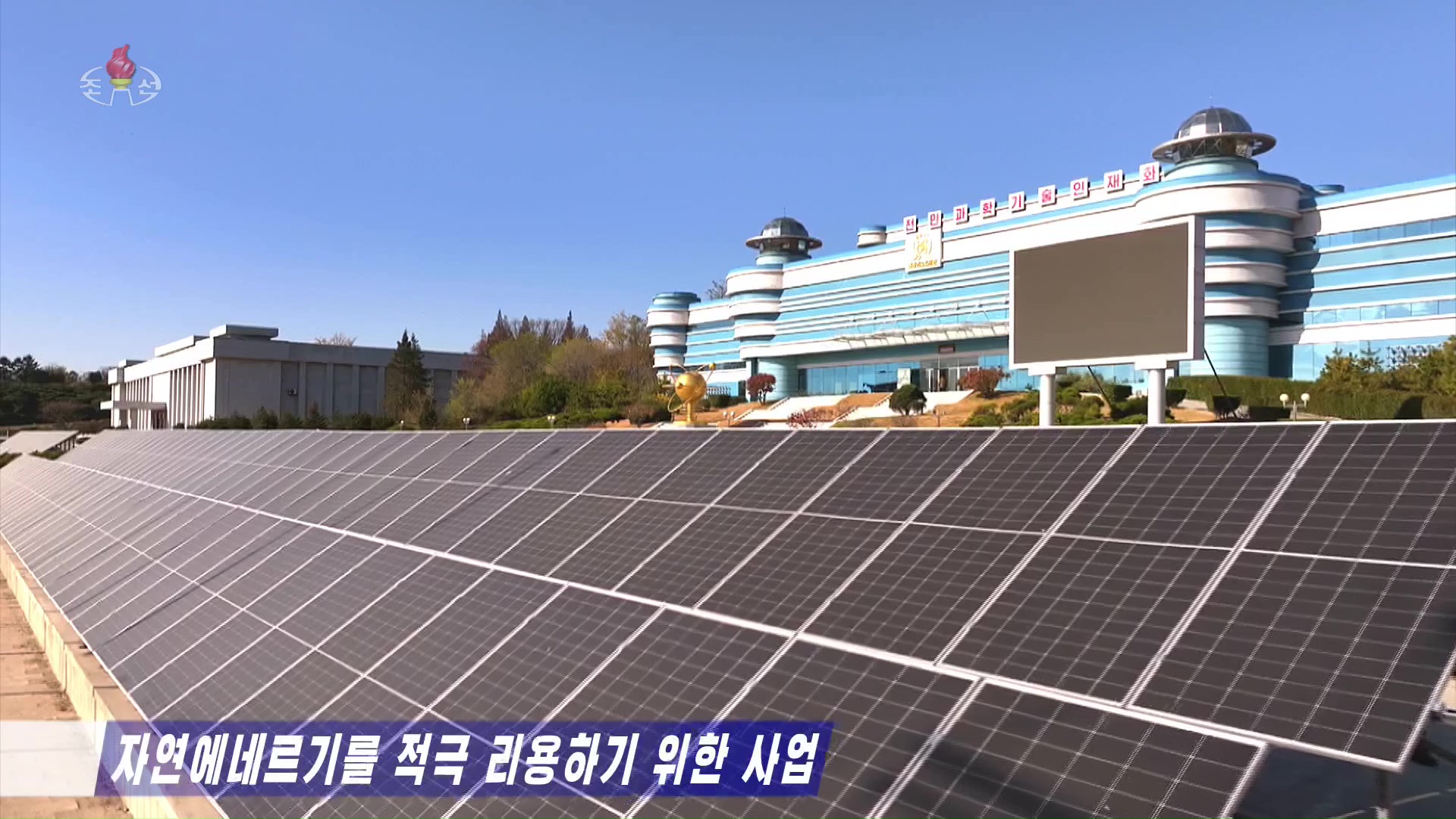
Nearby, two smaller solar power stations sit in front of the provincial sci-tech library and along the short in nearby Soho 1-dong. State media says the province is also adding solar to the Hamhung Youth Power Station No. 1, although to-date that does not appear to have happened.
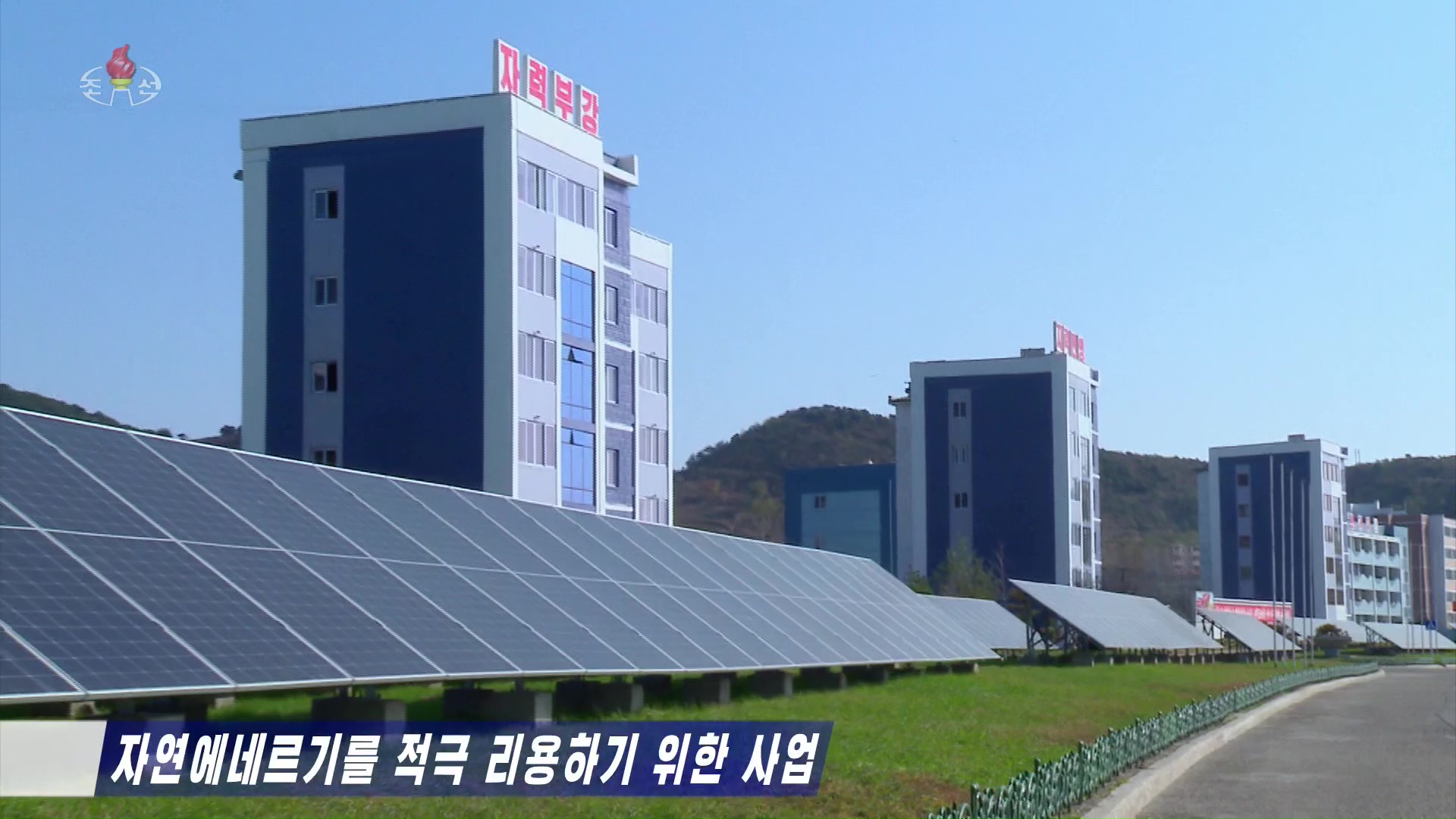
Future Grid-Attached Solar
On April 4, Rodong Sinmun, North Korea’s Party daily newspaper, carried an article highlighting ongoing work to develop grid-attached solar.[3]
It laid out several advantages to solar plants over current hydro and thermal plants, including that sunshine is the only fuel, and,once running, requires less upkeep than existing hydro and thermal plants because there are no moving parts.
However, the article did note that a key issue will be keeping the plants operating efficiently in the future.
As with most things in North Korea, the renewable energy projects were framed around an instruction from Kim Jong Un.
《풍력과 조수력, 생물질과 태양에네르기에 의한 전력생산을 늘이며 자연에네르기의 리용범위를 계속 확대하여야 합니다.》
“We must increase power generation from wind, tidal, biomass, and solar energy, and continue to expand the range of natural energy utilization.”
Kim delivered that instruction almost exactly a decade ago, in May 2016, so the work is well overdue.
The article also mentioned plans for a solar farm that will dwarf the Haeju plant, if constructed as planned. It said Kumhwa Mine in North Hwanghae province built a small-scale solar plant last year to provide lighting for buildings, very much in line with most previous solar installations. However, the mine is now planning to build a 100-kilowatt solar farm this year.
Conclusion
North Korea has been pursuing a more plentiful supply of electricity for years and appears to be having modest success in increasing supply. The new solar stations are a further step in that direction, although the country also needs to focus on efficient distribution of power through a modernized electricity grid.
Kim Jong Un was correct when he said that electricity supply is underpinning his ambitious goals to modernize the North Korean economy. As the state pushes digitization and as the service industry expands to give more citizens access to leisure activities, greater supply of power will be essential.
- [1]
Interviews with the author.
- [2]
News Broadcast, Korea Central Television, May 21. 2026.
- [3]
“태양빛과 풍력발전능력을 확대하자 잠재력은 얼마든지 있다,’ Rodong Sinmun, April 4, 2026.