

More Than Smartphones: How Digital Technology Is Changing North Korea
This article is from the fifth edition (April–June 2026) of 38 North’s quarterly product, North Korea Briefing, that monitors key internal developments in North Korea. For the full series, click here.
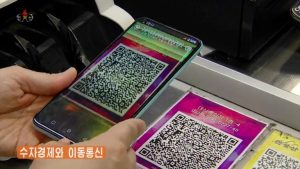
The growing digitization of North Korean life, epitomized by the spread of smartphones, is changing more than just how citizens stay in touch. In the second quarter of 2026, a foreign visitor provided new evidence of the widespread popularity of electronic wallets in Pyongyang; Kim Il Sung University’s law journal discussed electronic evidence; and a television program provided tips for people who spend too much time on their phones. Together, these developments are further evidence that smartphones are not just a useful tool for many North Koreans but are becoming integrated into their daily lives. If adoption of digital technology remains on its current trajectory, it could have a broader impact on North Korean society.
E-Payments
Last year, this author documented six different e-payment systems apparently in operation. A visit to Pyongyang by a foreign tour group in May 2026 revealed two more: the Huinnun (흰눈) and Saebyol (새별) digital wallets.
The tour group leader wrote that four apps are particularly common—Samhung (삼흥), Manmulsang (만물상), Huinnun and Jonsong (전성) — while Saebyol and Apnal (앞날) are less widely used.
These comments align with video shared by other tourists showing QR codes for e-payment on display at many Pyongyang retailers. Even street food stands and vegetable sellers accept electronic payments, suggesting the shift to digital wallets is real and is underway, at least in the capital.
The visitor, Stephen Zhang, wrote:
For transport, users can use E-Wallets to pay for buses and metro tickets, book taxis in a manner similar to Uber, and pay motorway toll fees. In daily life, users can top up mobile phone credit, order food delivery, exchange grain coupons, shop online, and reserve cinema or theatre tickets. E-Wallets also support sports lottery services, software downloads, and various intranet-based services.
One of the most interesting aspects of these digital wallets is their support for foreign currency. The Samhung and Narae apps show balances in local won (내화원) and foreign exchange won (외화원). The latter is a virtual currency used to represent foreign currencies; its use appears to be spreading through the e-wallets. The government-set rate is approximately 110 forex won to the US dollar and is independent of the market rate.
Users deposit foreign currency cash into their wallets through ATMs or at IT Service Centers where it is converted to forex won in the app. That balance is then available for use in both physical and online stores. The entire system is sanctioned by the state, which sells certain goods, such as medicines, directly to consumers in forex won. Forex won and domestic won are not interchangeable, and goods priced in the former cannot be purchased with the latter.
Context and Implications
The rise of electronic payment networks in North Korea ranks among the most striking digital developments of recent years. Electronic payments began around 2011, when the Foreign Trade Bank issued the Narae (나래) debit card. The Central Bank followed in 2015 with the Jonsong (전성) card, but accounts suggest both were relatively unpopular, attributed to public distrust of banks following the disastrous currency revaluation of 2009.
The key initiative that kick started change was the Electronic Payment Law (전자결제법) of 2021. It created a framework, overseen by the Central Bank, that allowed non-banking entities to create e-payment services. As a result, several of North Korea’s largest app developers launched their own e-payment services and began bundling additional services into the apps.
The adoption of electronic payments brings added convenience for users and tangible benefits for the state. Perhaps more importantly, it can facilitate tax collection from retailers as all electronic sales are recorded. It also enables the state to monitor pricing of goods.
For citizens, however, it can open the door to even greater surveillance. A digital purchase ties a person to a particular place and time, adding a further layer to their already heavily surveilled lives.
“Electronic Evidence”
The latest edition of the Journal of Kim Il Sung University (Jurisprudence) introduced the basic concept of “electronic evidence [전자증거].”[1] The article discussed the issue at a theoretical level, covering its definition and history, considerations for its collection and use in court, and its treatment in other jurisdictions, citing China’s approach in particular.
The article concluded:
As information technology develops rapidly, the data formats included in electronic evidence are also constantly changing.
We should have a broad understanding of electronic evidence and further deepen our research into it, thereby actively contributing to the satisfactory resolution of the theoretical and practical problems that arise in relation to electronic evidence.[2]
Context and Implications
This is not the first time North Korean academic journals have explored electronic evidence or digital forensics. As early as 2018, for example, a law journal article on criminal science and technology examined the subject.[3] What distinguishes the latest article is that it is the first devoted exclusively to the topic, suggesting it is gaining traction within the North Korean judiciary and that discussions may be underway regarding the use of digital evidence in criminal proceedings. North Korean law, as far as we know, currently contains no special provisions for electronic evidence.
This article is also the latest in a series in North Korean academic journals examining what must be new frontiers for the country’s legal system as society adopts more digital practices. Last year, for example, the same journal looked at legal issues arising from electronic contracts, electronic authentication systems, and e-government. [4] [5] [6]
Lifestyle Choices
On May 1, weary-eyed viewers of Korean Central Television (KCTV)’s regular “Health and Lifestyle (건강과 생활섭생)” feature were treated to advice on a very modern health problem: eye strain from overuse of smartphones or computers.[7] The program, which had aired four times as of June 22, offered advice for people experiencing dry or strained eyes from prolonged screen use.
It highlighted improvements in smartphone display technology to be easier on the eyes and recommended that users follow the 20-20-20 rule: every 20 minutes, look at something at least 20 feet away for 20 seconds. The program adjusted that to 6 meters while retaining the US measurement in parentheses so that the rule made sense.[8]
The program carried an interview with a doctor from Pyongyang’s Ryugyong Ophthalmology General Hospital, who said: “Eye fatigue … is appearing among people who work for long hours looking at computer and mobile phone screens.”
Context and Implications
The program presented no data on vision problems in North Korea, but its inclusion in a series focusing on societal health issues suggests the country is beginning to experience a similar rise in vision complaints linked to smartphone and computer overuse. For the millions of North Koreans who own a smartphone, it is probably their first sustained experience with a modern IT device, meaning many are staring at bright, small screens for hours for the first time.
Until recently, few North Koreans had access to computers, and smartphones were used primarily for calls and messaging. However, in recent years, the state has pushed workplace digitization, and smartphones have gained more entertainment and shopping apps, likely leading to significantly longer daily screen time. [9]
- [1]
Han Myong Ho, “전자증거에 대한 법률적리해 [Legal Understanding of Electronic Evidence],” Kim Il Sung Chonghaptaehakhakpo (Pomnyurhak) [Journal of Kim Il Sung University (Jurisprudence)], 2026 (No. 1).
- [2]
Translated from ibid.
- [3]
Kwon Yong Min, “형사과학기술에 대한 일반적리해 [General Understanding of Criminal Science and Technology],” Pomnyul Yongu [Legal Research], 2018 (No. 1).
- [4]
Choi Ju Kwang, “전자계약에 대한 리해에서 나서는 법률적문제 [Legal Issues Arising From the Understanding of Electronic Contracts],” Kim Il Sung Chonghaptaehakhakpo (Pomnyurhak) [Journal of Kim Il Sung University (Jurisprudence)], 2025 (No. 2).
- [5]
Jang Chol Jun, “전자인증과 그 실현에서 나서는 법률적문제연구 [A Study on Legal Issues Arising From Electronic Authentication and Its Implementation],” Kim Il Sung Chonghaptaehakhakpo (Pomnyurhak) [Journal of Kim Il Sung University (Jurisprudence)], 2025 (No. 3).
- [6]
Ko Yu Song, “전자정부실현과 관련하여 제기되는 법률적문제 [Legal Issues Raised in Relation to the Realization of Electronic Government],” Kim Il Sung Chonghaptaehakhakpo (Pomnyurhak) [Journal of Kim Il Sung University (Jurisprudence)], 2025 (No. 2).
- [7]
“눈보호에 좋은 생활습관 [Daily Habits Good for Eye Protection],” KCTV, May 1, 2026 (18:05 Pyongyang time).
- [8]
Although KCTV did not say so, the rule is credited to California optometrist Dr. Jeffrey Anshel, who developed it in 1991 in response to a rise in patients suffering eye strain from prolonged computer use.
- [9]
Author interviews with escapees.