

Alabuga: The Latest Destination for North Korea’s Drone Ambitions
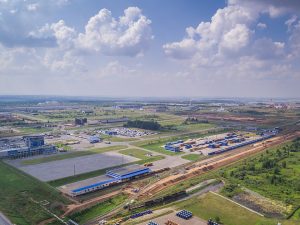
There is a new front in North Korea’s contributions to Russia’s war with Ukraine. From soldiers and construction workers, cooperation now appears to be expanding into drone manufacturing as well. Ukraine’s intelligence service (DIU) claims that North Korea plans to send 12,000 workers to manufacture drones at the Alabuga Special Economic Zone (SEZ). This echoes, albeit on a more realistic scale, a previous NHK report from June claiming that North Korea was considering dispatching 25,000 workers to the same region.[1] The Alabuga SEZ, located in the Republic of Tatarstan, is a known manufacturing hub for the Shahed and Albatross drones used in the war against Ukraine.
While not yet confirmed, the deployment of North Korean workers for drone manufacturing nestles neatly into the greater context of rapidly expanding economic collaboration between Russia and North Korea. North Korea has already sent thousands of construction and re-construction workers, soldiers, students, researchers, and even restaurant workers into Russia since the onset of the war in Ukraine. Combined with efforts to recruit foreign workers and expanded worker accommodations in the Alabuga SEZ, the circumstantial evidence lends further credibility to Ukraine’s reporting. If North Korea indeed ends up filling Russia’ drone manufacturing labor gap, the collaboration has massive implications for North Korea’s own drone manufacturing ambitions and the long-term security balance on the Korean Peninsula.
Who is Making Russia’s Drones Right Now?
As the drone manufacturing facility became a fixture of Russia’s arms industry, the complex has employed several (frequently) ethically dubious strategies to bring in the necessary labor. The polytechnic institute inside the SEZ operates as a feeder school and trains Russian students to work in drone production, in addition to running a number of “youth camps” (Alabuga Build, Alabuga Top) where young Russians are recruited as cheap labor in and around the factories.
In 2022, the Alabuga Start program expanded recruitment efforts beyond Russia’s borders, specifically targeting women between the ages of 18 and 22 and overwhelmingly from low-income nations in Africa and South America. With the help of local consulates and social media influencers alike, Alabuga Start advertises itself as a work-study program and offers the illusion that women can choose to work in a wide variety of fields, even though virtually all applicants appear to end up in drone production. While the work is not necessarily “forced labor,” it is highly deceptive in recruitment, involves frequent overtime, exposes workers to dangerous chemicals, and drags workers into a conflict without their consent. As a result, countries including Botswana and South Africa have launched investigations and are warning young women away from the Alabuga Start program.
Yet, the complex is still in need of labor to ramp up drone production. In July, the Institute for Science and International Security (ISIS) reported that the complex appeared to be rapidly expanding worker accommodations, likely enough to accommodate 41,000 workers. By contrast, the Global Initiative Against Transnational Organized Crime (GI-TOC)’s upper-bound estimates for the Alubaga Start program do not exceed 1,000 overseas workers, while the ISIS report indicated that new residences are not likely to be used for polytechnical students, who already have their own dorms.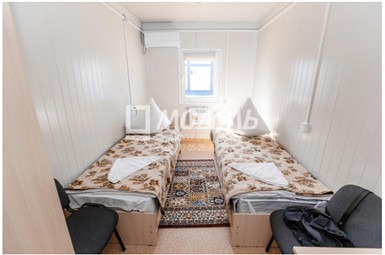
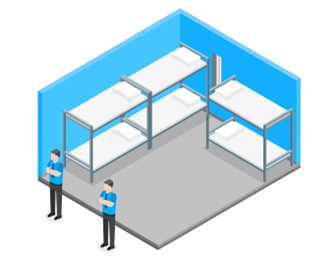
An image of the interior of a modular container bedroom produced by RPK Modul, was identified by ISIS to likely be similar in design to the pre-fabricated container buildings being assembled in May 2025. The extremely tight quarters and centralized building design bear similarities to dormitory set-ups for North Korean factory workers in China (pictured below).
Preparations to Expand the Live-In Labor Force
A closer look at the different housing types identified by the GI-TOC report includes plans for a “two-story complex hostel” with tiny rooms that are likely untenable for students or Alubaga Start workers. However, for North Korean overseas workers who are known to stay in barely furnished shipping containers or sleep six-to-a-room in factory dormitories, these would likely be considered reasonable long-term accommodations. The capacity aligns with Ukraine’s reports as well. Overall, ISIS estimates that the completed pre-fab dormitories will be able to host up to 13,840 workers. This aligns with the 12,000 workers projected in the DIU report, with room for additional technical and security personnel.
When these workers will arrive, who will be selected, and what sort of assignments they will be given are unclear. Based on the Alabuga Start program’s explicit preference for young women, it would not be unreasonable to expect that North Korean workers selected for the assignment will also be young women, potentially similar to those currently deployed to Chinese seafood, electronics, and textile factories. The original DIU report suggested that laborers would be contracted to work 12+ hour days for $2.50 an hour, conditions similar to those for female laborers in Chinese seafood factories.[2]
It is also likely that North Korea will not only send laborers but also technicians and researchers to learn about drone manufacturing and the improvements made to Russia’s Shahed 136 (Geran-2) drones. The company cited by Ukrainian intelligence as responsible for recruiting and deploying workers, Jihyang Technological Trade Company (also known as Green Pine Associated Corporation) is a known arms exporter on international sanctions lists and has established links to Iranian defense firms. If confirmed, this would be a further indicator that the workers are being deployed not only for foreign currency but also in direct connection with North Korea’s own arms manufacturing industry. The Ukraine War appears to have piqued Kim Jong Un’s interest in drone warfare, and Kim ordered North Korea to step up production of its own “suicide drones” in November 2024. Given that the Shahed drones manufactured in the Alabuga SEZ are generally used as single-use “suicide drones,” it appears highly likely that North Korea may be contributing workers to the project to build up expertise for production of similar UAVs back in North Korea.
Conclusion
The deployment of North Korean labor to Russia is neither new nor surprising. Instead, this development should be viewed as further evidence of just how closely North Korea is now involved in the Ukraine conflict. It also points to a new vector for proliferation. The Alabuga SEZ initially produced Shahed drones as a “franchise” deal with Iranian’s military entity Sahara Thunder, but has since established an independent production process and improved on initial designs; that expertise is now likely to be passed on to North Korean laborers and technicians deployed to the complex.
Both the Ukraine war and war in the Middle East have demonstrated the vital role of drones in modern warfare and raises important questions about what Pyongyang might be learning in terms of strategy and tactics. If North Korea boosts its domestic drone production in similar numbers to what it is allegedly deploying overseas, this could significantly change the dynamics of a future conflict on the Korean Peninsula.
- [1]
The English version of the NHK report is no longer directly available online, but is in Japanese and can be found here. The report was covered by several other major outlets, including the KBS article hyperlinked for reference.
- [2]
Based on testimony from “Exploitation, Control, and Responsibility Inside Chinese Seafood Packaging,” DailyNK AND Center, July 2025 (Report not currently publicly available online). All laborers in the study reported working at minimum 12 hours each day, six to seven days a week. A contract acquired from a seafood factory featured in the study stipulated a wage of 3,000 RMB per month (roughly 10 RMB or $1.40 an hour). The $2.50/hr figure from the DIU report would total ~$700 USD under similar work conditions, which is significantly higher than the $300-$500/month range reported by recent Alabuga Start participants. It is this author’s estimation that the actual contract wage for North Korean laborers would likely be closer to $400-$500 a month, of which laborers themselves might receive $50~$100.