

More Than a Destroyer: What Choe Hyon Reveals About North Korea’s Maritime Strategy
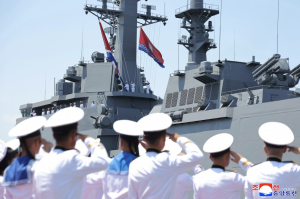
The Democratic People’s Republic of Korea (DPRK or North Korea) officially commissioned its new multipurpose destroyer, the Choe Hyon, at Nampo on June 23 and assigned the vessel to the West Sea (Yellow Sea) Fleet. According to North Korean media, the destroyer completed approximately 14 months of operational evaluations and sea trials before entering active service, and it will now undertake missions related to defense of the West Sea and wartime deterrence.
Naval build-up and modernization have been on Kim Jong Un’s agenda since the early days of his rule, but based on his public appearances, appears to have grown in priority since mid-2023. During the Choe Hyon’s commissioning ceremony, he acknowledged the navy’s relative weakness within the Korean People’s Army, and at the Ninth Plenary Meeting of the Eighth Workers’ Party of Korea (WPK) Central Committee in December 2023, he called for a “second revolution of the warship-building industry,” identifying naval construction as a national strategic priority. Kim reinforced these priorities at the Ninth Party Congress in February 2026, where he again emphasized naval modernization as a key component of the country’s five-year defense development plan, and at both the Party plenary meeting and the Choe Hyon commissioning ceremony in June, he called for building new naval bases.
Viewed in this broader context, the construction of new destroyers and modern naval facilities represents more than an effort to replace aging platforms; it reflects a broader attempt to strengthen the navy’s role within North Korea’s military strategy. The destroyer’s deployment also offers an opportunity to assess how the country’s maritime strategy is evolving, as the navy shifts from a force focused primarily on coastal defense toward one intended to support strategic deterrence, greater operational reach, and broader military objectives beyond the Korean Peninsula.
The Choe Hyon
At its launch ceremony in April 2025, Kim Jong Un claimed the Choe Hyon to be a multi-role combat platform equipped with missile systems supporting air-defense, anti-ship, anti-submarine, ballistic missile defense, and land-attack missions. At the ship’s commissioning ceremony, Kim described the destroyer as embodying the country’s overall economic strength and as the culmination of its defense science, technology, and weapons development and production capabilities.
Around its original launch, many observers questioned whether the vessel could deliver the operational capabilities Pyongyang claimed it possessed. Its formal commissioning, however, suggests that North Korea’s surface fleet modernization has moved beyond rhetoric into implementation.
Displacing approximately 5,000 tons, the class leader Choe Hyon is by far the largest surface combatant ever constructed by North Korea.[1] At roughly half the displacement of the Republic of Korea Navy’s 11,000-ton Sejong the Great-class destroyers and significantly smaller than the US Navy’s 9,000–10,000-ton Arleigh Burke-class destroyers, it nevertheless represents a dramatic increase in the size of North Korea’s surface fleet. The vessel is substantially larger than the frigates, corvettes, and missile craft that have traditionally formed the backbone of the Korean People’s Navy, reflecting Pyongyang’s effort to field larger multi-mission surface combatants capable of operating beyond its traditional coastal defense role.
Kim Jong Un also announced plans to expand production beyond a single ship, calling for the construction of two 5,000-ton-class destroyers annually while directing the development of an even larger 10,000-ton-class strategic cruiser.
Taken together, these developments suggest that assessments of North Korea’s naval modernization should move beyond a narrow focus on the Northern Limit Line (NLL). The more important question is how the Choe Hyon fits within Pyongyang’s evolving maritime strategy, encompassing maritime jurisdiction, naval modernization, integrated conventional-nuclear deterrence, and the long-term pursuit of greater operational reach.
The Maritime Dimension of North Korea’s “Hostile Two-State” Doctrine
One plausible explanation for the Choe Hyon’s deployment to the West Sea is that it is intended to help implement North Korea’s “hostile two-state” doctrine at sea.[2] Since formally abandoning the goal of peaceful reunification, Pyongyang has increasingly sought to redefine inter-Korean relations as those between two separate sovereign states. Applying this logic to the maritime domain necessitates Pyongyang’s strengthening of its operational control over contested waters and reinforcing North Korea’s maritime claims through a more capable naval presence.
Recent North Korean rhetoric is consistent with such an objective. Unlike the Military Demarcation Line (MDL) on land, the NLL was not stipulated in the 1953 Armistice Agreement or established through an inter-Korean agreement. While South Korea has maintained the NLL as the de facto maritime boundary, North Korea has long rejected its legitimacy and advanced alternative maritime claims. Under Kim Jong Un, criticism of the NLL has become increasingly explicit. Kim has dismissed it as a “ghost” line, and during the launch ceremony of Choe Hyon in April 2025, he introduced the new term “waters of middle demarcation lines,” apparently seeking to recast its maritime claims using language closely associated with international maritime law. This shift suggests that Pyongyang is attempting not only to reject the existing maritime boundary but also to promote its own alternative conceptual framework.
In this context, the Choe Hyon may best be understood as a strategic platform that could support North Korea’s effort to extend its “hostile two-state” doctrine from land into the maritime domain while reinforcing Pyongyang’s claims regarding maritime jurisdiction and a revised regional maritime order. Under this scenario, the ship could support more frequent patrols and military operations near the NLL, gradually normalizing North Korean activities in contested waters. Such operations would inevitably compel South Korea to strengthen its surveillance, reconnaissance, and operational posture around the NLL, increasing the risk of accidental military encounters and sustaining persistent tension in the West Sea.
At the same time, interpreting the deployment solely through the prism of the NLL would be incomplete. Any unilateral attempt by North Korea to impose a new maritime boundary through military means would generate significant diplomatic costs and international criticism. Pyongyang also appears well aware that deliberate escalation near the NLL could invite US involvement and create risks extending well beyond its original objectives.
For this reason, North Korea is more likely to rely on gray-zone tactics than direct military confrontation. Repeated patrols, calibrated demonstrations of force, and the gradual introduction of new maritime boundary concepts allow Pyongyang to challenge the political and legal legitimacy of the NLL without crossing the threshold into large-scale armed conflict. Such an approach would enable North Korea to reshape the strategic environment incrementally while limiting the risks associated with outright escalation. The Choe Hyon should therefore be viewed as one component of a broader effort to strengthen North Korea’s ability to contest the existing maritime status quo.
Changing Environment in the West Sea
The deployment of the Choe Hyon should also be understood within the changing strategic environment of the West Sea itself. The region is increasingly becoming more than an arena of inter-Korean confrontation—it is evolving into a broader theater of maritime jurisdictional competition involving neighboring powers.
Recent developments involving China’s maritime activities also reflect the changing strategic environment in the West Sea. Beyond the expansion of Chinese fishing operations and a more visible China Coast Guard presence, Beijing has sought to strengthen its maritime presence through the installation of three maritime structures within the Korea-China Provisional Measures Zone (PMZ). These developments demonstrate that competition over maritime jurisdiction and maritime order in the West Sea is becoming progressively more pronounced.
Although there is no public evidence that Chinese activity directly influenced the deployment decision, the expanding maritime presence of neighboring states forms part of the broader regional environment in which Pyongyang appears to be pursuing a more capable navy. These developments may also increase the strategic relevance of North Korea’s naval modernization. As neighboring states expand their maritime presence, Pyongyang also has incentives to strengthen its ability to protect and assert its own maritime claims. The deployment of the Choe Hyon therefore may reflect not only military considerations involving South Korea but also North Korea’s broader adaptation to a changing regional maritime environment.
Regional naval dynamics further reinforce this trend. China and Russia have continued to conduct regular joint naval exercises, including the “Joint Sea-2026” exercise near Qingdao and the previous year’s drills near Vladivostok. From North Korea’s perspective, coordinated Chinese and Russian naval activities are now taking place on both its western and eastern maritime approaches.
This does not necessarily imply that North Korea will soon participate in trilateral naval operations with China and Russia. Nevertheless, a changing regional security environment increases the value of possessing a more capable navy and may gradually expand Pyongyang’s strategic options for future maritime security cooperation.
From Coastal Defense to Maritime Power Projection
North Korean statements surrounding the Choe Hyon indicate that Pyongyang increasingly envisions naval missions extending beyond coastal defense and inter-Korean contingencies. As such, the new destroyer represents the first major platform in North Korea’s transition toward a force capable of conducting operations beyond its immediate waters, enabling greater maritime power projection. During the commissioning ceremony, Kim Jong Un stated that the navy’s status, missions, operational waters, and expected outcomes had changed, adding that the era in which the navy existed primarily as a coastal defense force had passed. During his visit to the Choe Hyon in October 2025, Kim further stated that “the tremendous ability of our navy should be exercised in the vast ocean to thoroughly deter or counter and punish the enemy’s provocations,” explicitly linking future naval development to blue water operations.
North Korea has also continued efforts to expand its naval capabilities, including the commissioning of the Kang Kon (the second Choe Hyon-class destroyer) and the development of larger surface combatants and advanced underwater weapon systems. Although economic and industrial constraints make the near-term realization of such a fleet unlikely, despite its stated construction plans, the significance of these plans lies in the strategic direction they reveal. Taken together, these initiatives suggest that Pyongyang increasingly views naval power as an instrument for expanding operational flexibility and strategic influence.
If this modernization effort continues, the East Sea Fleet may assume a more prominent role in North Korea’s evolving naval strategy, complementing rather than replacing its traditional emphasis on operations in the West Sea. While the West Sea will remain central to inter-Korean maritime competition, its shallow waters, geographic constraints, and persistent tensions surrounding the NLL limit the operational employment of larger surface combatants. By contrast, the eastern sea provides deeper waters with direct access to the North Pacific, offering greater opportunities for sustained operations by larger warships and submarines. Geographic proximity to Russia’s Far Eastern waters may also offer additional strategic advantages should Pyongyang seek to expand its maritime reach over the longer term.
The aforementioned regional naval dynamics reinforce the significance of where the North Korean maritime strategy is headed. While full-scale naval cooperation among Pyongyang, Beijing, and Moscow remains unlikely in the near future, a more competitive regional maritime landscape increases the value of possessing a capable navy and provides North Korea with broader strategic options.
Strategic Implications
North Korea’s naval modernization reflects a broader transformation in its maritime strategy. As its naval capabilities expand, Pyongyang’s strategic intentions are becoming increasingly multifaceted. The deployment of the Choe Hyon to the West Sea should therefore not be interpreted through a single analytical lens. It may simultaneously serve as an instrument for challenging the political legitimacy of the NLL under the “hostile two-state” doctrine while also functioning as the first step in a longer-term strategy aimed at developing a navy capable of operating well beyond the Korean Peninsula.
For the foreseeable future, North Korea is unlikely to formalize a new maritime boundary through constitutional revision or other legal measures. Instead, it will probably continue relying on gray-zone tactics—including sustained naval patrols, calibrated military demonstrations, and the gradual promotion of alternative maritime boundary concepts—to weaken the status quo while avoiding the costs and risks associated with large-scale military confrontation.
Ultimately, however, how the Choe Hyon and its successor destroyers are employed will reveal whether North Korea remains focused on gray-zone competition around the NLL or is instead laying the foundations for a broader maritime strategy centered on blue-water operations.
- [1]
In this article, Choe Hyon refers to the lead ship of the class, whereas Choe Hyon-class refers to the class of destroyers, including Kang Kon and subsequent ships.
- [2]
During the Choe Hyon launch ceremony in April 2025, Kim Jong Un presented the naval ensign to the commanders of the East Sea Fleet, which suggested that the vessel would be deployed to the East Sea (Sea of Japan) rather than the West Sea.