

On a Mission From General Affairs Department
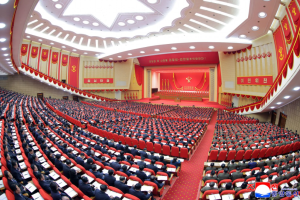
One significant outcome from North Korea’s Ninth Party Congress was the appointment of Kim Yo Jong, sister of Kim Jong Un, as director of the Workers’ Party of Korea (WPK) General Affairs Department (GAD) and elevation of the GAD itself. General Affairs has been a stable but low-key Central Committee institution for decades. Its basic function is document delivery, logistics, and support services in the Central Committee apparatus. The Party Congress, however, transformed the GAD’s role from a logistical support institution into a core unit buttressing information, strategic communication and decision-making. As part of that transformation, the leader’s sister was installed as the incumbent director.
The GAD Director now also has Political Bureau status, which has not been the case since the early 2010s. This elevates the GAD in the WPK’s formal hierarchy. It is unlikely that the GAD position was merely a pretext to reinstall Kim Yo Jong as an alternate Political Bureau member. She is a member of the Kim Family and as supreme leader, Kim Jong Un has a degree of flexibility in making personnel appointments to party power organizations. Instead, the GAD is likely now critical in providing administrative and operational support in North Korean decision-making. Appointing Kim Yo Jong as GAD Director vests it with the prestige of the Kim Family, establishing the department’s authority as a key institution.
Given the policy ambitions of the Ninth Party Congress, it is reasonable that Kim Jong Un would revamp the administrative hub of information control, reporting lines and decision-making. Elevating the GAD consolidates and summarizes the information he uses to interact with North Korean elites, thus streamlining decision-making processes. This can avoid problems at the policymaking and policy execution phase, a chronic concern of his and something he alluded to when dismissing former DPRK Vice Premier Yang Sung Ho.[1]
GADs in Comparison
The broad, overall responsibilities of the WPK General Affairs Department are found in executive government bodies all over the world—executive offices for the Presidents of the United States and France have general affairs-type offices, South Korea and Japan have a Cabinet Secretariat. In fact, in Japan, the Cabinet Secretariat has a General Affairs division. The key difference in the DPRK is that the executive-level General Affairs Department is part of the party apparatus; it goes through a political party, not a government and/or civil service.
Two of the WPK’s fraternal parties, the Communist Party of China (CPC) and the Communist Party of Vietnam (CPV) have GAD equivalents. The CPC has the General Office and the CPV has the Central Committee Central Office. Both find their antecedents in the Russian CPSU’s General Department.[2] The CPSU General Department was “the central nervous system of the party” and Stalin placed his chancellery in it as his mechanism for the “circular flow of power.”
These general/central administrative offices all have a shared, basic structure. Combining available literature on the CPV, CPSU, and on DPRK administration and information channels, can provide insights into how the GAD is structured and its role and function in the regime.[3]
General Affairs: The Basics
The WPK GAD is responsible for the production, classification and dissemination of documents within the Central Committee apparatus. It also manages a variety of technical and logistical support services in the Central Committee office complex—office assistants, materials supply, housekeeping and building maintenance.
Kim Yo Jong’s March 10, 2026, statement on US-ROK military exercises revealed, post-party congress, that GAD has a strategic communication function.[4] This appears to be an authoritative high-level public-facing role for the North’s power center, between Political Bureau meetings, Central Committee plena, or statements directly attributed to Kim Jong Un. This change leverages Kim Yo Jong’s previous role issuing communique on foreign affairs, establishing her as a kind of presidential spokesperson on specific foreign policy issues.
The Ninth Party Congress upgraded and enhanced other GAD functions and roles. Based on the number of Central Committee Department Directors appointed during the congress, the Party Archives Department likely merged with the GAD. Prior to this change, and opposed to the CPSU and CPV, the WPK’s general affairs and document archives units were separate entities with separate leadership. After the Ninth Party Congress, the GAD appears to now consolidate control over current/recent documents and retrospective/historical information (via the party archives). It is highly probable that GAD has a dedicated unit to store classified documents and plans from other North Korean institutions as well.
The GAD’s overall function has been the preparation and distribution of meeting agendas and documents for Political Bureau and Central Committee meetings. In the CPSU General Department, this was called the Politburo Secretariat. The administrative mechanics for this process likely involves gathering reports from across the wider regime—the government, the military, defense industry, internal security and party organizations—sanitizing information and distributing reports and briefings for a given meeting.
The Party Congress raised the headcount on the WPK Secretariat while concurrently revising and/or expanding the number of issues formally addressed at the Secretariat level, dividing some domestic economic policy areas (economic planning, heavy industry, construction) and external affairs. Given this expansion, the GAD will likely oversee the technical preparation of all Secretariat meeting materials, including meeting agendas, policy documents and issue briefings. However, getting Kim Jong Un’s approval for a final agenda is more likely handled through the Personal Secretariat, demonstrating a separation of power and elite interaction.
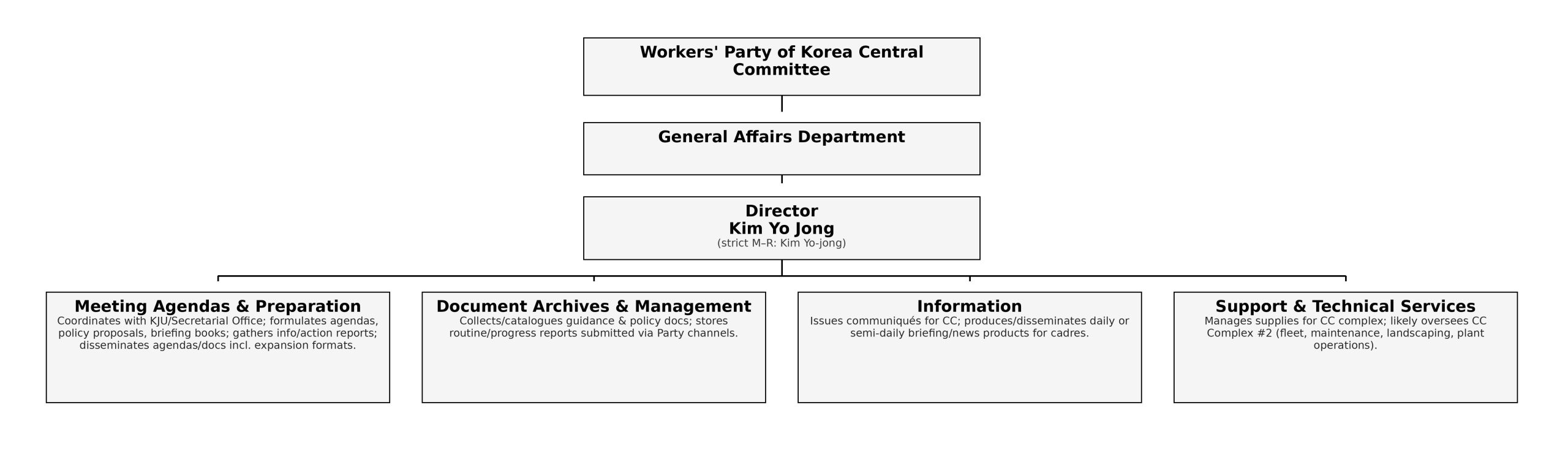
Notionally, then, the GAD’s role and functions are likely broken down into four areas, based on how other general departments function:
- Coordinating meeting agendas and preparation. Likely done in coordination with either Kim Jong Un or his secretarial office, this includes formulating agendas, policy proposals and relevant briefing documents for meetings of the Central Committee, the Secretariat and the Political Bureau. It requires the GAD to gather informational and action reports from North Korean organizations across the regime, either through direct requests or from routine reporting in the Party Archives. It also disseminates meeting agendas and documents to relevant WPK organization members and other personnel invited as observers for meetings held in expansion formats, as well as records and prepares meeting transcripts;
- Managing document archives. The GAD collects and catalogues party guidance and policy documents; collects, catalogues and stores routine and progress reports submitted via party channels from across the regime;
- Managing special documents and information. The GAD collects, catalogues and categorizes confidential documents. It issues information and communiques on behalf of the Central Committee; and produces and disseminates daily or semi-daily briefing and news products for cadres in the Central Committee apparatus;
- Providing logistical support and technical services. The GAD manages supply distribution (furniture, stationary, office supplies) in the Central Committee complex. It also most likely manages WPK Central Committee Complex #2 which is responsible for vehicle fleet management, building maintenance, landscaping, and janitorial service in the Central Committee Office Complex.
General Affairs: Expansion Pack
Since the Ninth Party Congress, the General Affairs Department has been elevated and strengthened as a core department. Although there is a clearer idea of the GAD’s support role in the Central Committee and policy decision-making process, questions remain as to its role in wider leadership reporting channels and the nature of its support role in the Central Committee.
Lower-level networking: Some North Korean institutions such as the Cabinet Secretariat, the KPA General Political Bureau and the Second Economic Committee have subordinate General or Administrative Affairs sections. However, similar to the CPC, have general affairs sections been established in other North Korean institutions and, if so, does this represent a new or revamped reporting channel? Are GAD reporting lines an add-on to pre-existing channels intended to consolidate reporting across the regimes tradition three lines (institutional-political-security)? If general affairs units have not been established across regime organizations, does GAD reporting take a form similar to an e-mail CC line which includes GAD?
One aspect of lower-level General Affairs units might also include tracking correspondence and complaints to identify popular sentiment and viewpoints of local populations, at the institutional and geographical levels. Does the new GAD have a mechanism to do this? Or might they be working toward such a capability?
Gatekeeping: The GAD is the Central Committee’s bureaucratic traffic cop; the degree to which it exerts its authority is unclear. The post-Stalin CPSU General Department had a wide latitude to rubberstamp simple action reports and decisions. Kim Jong Un’s Personal Secretariat had a Consolidation Unit which collated and summarized documents and action reports. Has General Affairs become a fusion center with Kim Jong Un’s personal secretariat and the State Affairs Committee (SAC) Secretariat? Fusing GAD with the personal secretariat and the SAC Secretariat would establish General Affairs as the regime’s front office for administrative affairs across the party, state and army.
Moreover, does GAD’s writ extend to monitoring DPRK elites? The Personal Secretariat’s Consolidation Unit compiled and consolidated surveillance reporting from across internal and security agencies outside of OGD’s network. Has this function essentially been absorbed into the GAD?
Finance and accounting: The CPV Central Office manages CPV accounting and finances and even controls several trading companies. The general affairs section of the Japanese Cabinet Office has finance and accounting units. The WPK’s finance and accounting institutions have been subjected to at least three consolidations and separations during the last 20 years; sometimes Office #38 and Office #39 are part of the same department, sometimes Office #38 is subordinate to the WPK Finance and Accounting Department.
Reorganization of some of these finance organizations was announced at the Ninth Party Congress and possibly disbanded the WPK Finance and Accounting Department. If that is the case, were some party finance units transferred to the GAD? Does the GAD now control a bulk of party accounting and financial audits, outside those under the Guard Command and Personal Secretariat which support Kim Jong Un’s residential and family life?
Conclusion
The Ninth Party Congress and Central Committee ushered in major changes to the processes and mechanics of how North Korean leadership deliberates and decides on strategic policy. While we do not yet know all the details of what that looks like, there are some general conclusions we can draw. First, revamping the GAD means that Kim Jong Un has added a layer of protocol and protection in the information he consumes as leader and his interactions with the wider leadership. Second, elevating the significance and authority of General Affairs checks and offsets the bureaucratic gatekeeping power of the Organization Guidance Department (OGD), with additional reporting and communication lines centered in General Affairs and away from OGD. The basic bureaucratic mechanism likely provides clearer divisions between the GAD and OGD, with the GAD managing policy and information flow, and OGD enforcing political discipline and personnel management.
For Kim Yo Jong, her appointment as General Affairs Department Director is, by superficial metrics, a double promotion (deputy to senior deputy to department director). According to one account, she has hit the ground running—implementing personnel changes within GAD and rejecting a very high number of documents.[5] More substantively, this is the first known position to which she’s been appointed under her brother where she will be formally involved in domestic policy. While we will learn more about how leading General Affairs affects North Korean elites in time, we can be assured she will work to keep them on the same page.
- [1]
“Respected Comrade Kim Jong Un Makes Speech at Inaugural Ceremony for First-Stage Modernization Project of Ryongsong Machine Complex,” Korea Central News Agency, January 20, 2026.
- [2]
Medvedev, Zhores. Andropov (New York: Penguin Books, 1984); “General Department of the CPSU,” infor24RU.
- [3]
Gause, Ken North Korea’s House of Cards (Washington, DC: HRNK, 2015); Collins, Robert North Korea’s Organization and Guidance Department (Washington, DC: HRNK, 2019).
- [4]
“Press Statement of Kim Yo Jong, Department Director of C.C., WPK,” KCNA, March 10, 2026 kcna.kp/en/article/q/273bb98acafca11358995dde785ec157.kcmsf.
- [5]
Discussion with US-based Pyongyang watcher.