

Consolidating Kim’s Rule: Constitutional Revisions, Ideological Reinforcement, and Elite Management
This article is from the fifth edition (April–June 2026) of 38 North’s quarterly product, North Korea Briefing, that monitors key internal developments in North Korea. For the full series, click here.
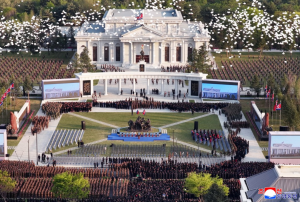
During the second quarter of 2026, the South Korean government released North Korea’s latest constitution, while North Korea itself held some significant political events. The constitutional amendments were designed to further strengthen Kim Jong Un’s monolithic leadership. Kim’s speeches at the inauguration of the Memorial Museum of Combat Feats at the Overseas Military Operations and the ceremony commemorating the 80th anniversary of the Central Cadres Training School of the Workers’ Party of Korea (WPK) both underscored the importance of absolute loyalty to Kim Jong Un and the Party. At the June Party plenary meeting, North Korea replaced the director of the Party’s Organization and Guidance Department (OGD) after just four months in the role. Taken together, these developments indicate that Kim Jong Un is consolidating his rule through institutional, ideological, and organizational mechanisms simultaneously.
Political Revisions in the Newly Released Constitution
On May 6, 2026, South Korea’s Ministry of Unification released the full text of North Korea’s latest constitution. As this is the first publicly available version since Pyongyang’s September 2023 revision, it incorporates three subsequent rounds of constitutional amendments.[1]
The revised constitution institutionalizes Kim Jong Un’s steadily expanding absolute authority since the Eighth Party Congress in 2021. Unlike the previous constitution, Chapter 6 (“State Organs”) places the “State Affairs Commission (SAC) Chairman” before the “Supreme People’s Assembly (SPA).”[2] In doing so, it elevates the office, held by Kim Jong Un, above the constitutionally designated supreme organ of state power.
The constitution also redesignates the SAC chairman from the “supreme leader” to the “head of state.” New powers under Article 90 include the SAC chairman’s authority to require the resignation of SPA deputies; veto laws, decrees, decisions, and directives adopted by the SPA or its Standing Committee; confer state honors; receive ambassadors’ credentials; and appoint or dismiss “important state cadres”—including the SPA chairman and cabinet premier—while the SPA is in recess.
The amendments further strengthen Kim Jong Un’s cult of personality and his monolithic leadership system. The preamble removes all references glorifying Kim Il Sung’s and Kim Jong Il’s achievements in state-building and revolution. In their place, it adds provisions institutionalizing Kim Jong Un’s absolute authority and requiring unconditional obedience to his leadership, such as the “establishment of the leader’s monolithic leadership system,” the “organization of all state affairs according to the leader’s ideas and intentions,” and the “resolute defense of the leader’s state-building ideas and accomplishments.” The constitution also formalizes Kim’s “people-first principle” as the fundamental guiding principle of state activities.
Context and Implications
Under the revised constitution, Kim’s authority clearly supersedes both the Party and the state. The amendments codify his authority across the legislative, judicial, and executive branches while eliminating the SPA’s power to recall the SAC chairman, further diminishing the authority of what is nominally the state’s highest organ of power.
More broadly, the revised constitution aligns the SAC chairman’s powers with those Kim has exercised as WPK general secretary. Under the 2023 constitution, the SAC chairman could appoint or dismiss “important state cadres,” but the provision did not explicitly include the SPA chairman or the cabinet premier. The revised constitution removes this ambiguity by expressly authorizing the SAC chairman, while the SPA is in recess, to suspend, appoint, or dismiss both officials. In doing so, it resolves a potential conflict between the SAC chairman’s personnel authority and the SPA’s constitutional powers.
The amendments are also significant symbolically. By removing references to Kim Il Sung and Kim Jong Il while strengthening provisions centered on Kim Jong Un’s monolithic leadership system, the constitution institutionalizes the transformation of what had long been presented as Kim Il Sung’s and Kim Jong Il’s state into Kim Jong Un’s state.
This mirrors a broader trend in North Korean propaganda. In recent years, official narratives have shifted away from the glorification of Kim Il Sung and Kim Jong Il and increasingly centered on Kim Jong Un’s own achievements and ideology. Their signature policies have likewise given way to Kim Jong Un’s own priorities, such as nuclear force expansion, regional development, and the two Koreas policy.
Russia War Memorial and Party Cadre Training: Reinforcing Loyalty
In April, Kim Jong Un delivered speeches at the inauguration of the Memorial Museum of Combat Feats at the Overseas Military Operations for North Korean soldiers killed in the Russia-Ukraine war and at the ceremony marking the 80th anniversary of Party Central Cadres Training School.
At the memorial’s inauguration, attended by senior Russian officials, Kim emphasized that DPRK-Russia friendship had been “written in blood.” He argued that North Korean forces fighting alongside Russian troops had helped thwart US and Western “hegemonic forces’ ambition for a war,” justifying Pyongyang’s military deployment to Russia. He also portrayed the fallen soldiers as heroes whose sacrifice exemplified absolute loyalty to the leader and the Party. At the Party Central Cadres Training School anniversary ceremony, Kim stressed the importance of training Party cadres and outlined the school’s future educational priorities.
Context and Implications
Although different in purpose, both events reinforced loyalty to the leader and the Party.
Kim personally oversaw construction of the museum over the past year, underscoring its political importance. Beyond serving as a memorial to North Korean soldiers killed in the Russia-Ukraine war, it reflects the regime’s effort to legitimize Pyongyang’s military involvement and elevate the fallen as exemplars of loyalty and sacrifice.
Kim’s speech at the Party Central Cadres Training School highlighted the institution’s role in cultivating the Party’s elite. The school graduates only about 200 carefully selected cadres each year, many of whom go on to occupy senior positions within the Party. Kim stressed that cadre training is inseparable from the Party’s survival and development, and reaffirmed the school’s mission of cultivating officials who embody the Party’s ideology, uphold its monolithic leadership system, and implement Party policies with absolute loyalty under all circumstances.
Party Leadership Reshuffle and Jo Yong Won’s Return
The June plenary meeting reviewed implementation of Party and state policies during the first half of 2026, discussed measures to develop the coal industry, and conducted personnel changes within the Party leadership. In his concluding remarks, Kim Jong Un outlined both short- and long-term priorities for the Party.
The most notable political development was the dismissal of Kim Jae Ryong as Party Secretary for Organization and director of the Party’s OGD after only four months in office. He was replaced by his predecessor, Jo Yong Won, who had held the position since June 2022, before Jo was elected chairman of the SPA Standing Committee at the SPA session in March.
Context and Implications
The plenary meeting report did not disclose the reason for Kim Jae Ryong’s dismissal. However, it did say the vice director for organizational affairs of the Korean People’s Army’s General Political Bureau, an office overseen by the OGD, will be investigated on corruption charges. Kim Jae Ryong was therefore likely held accountable for shortcomings in organizational oversight. By returning Jo to head the OGD so soon after his transfer to the state apparatus, Kim signaled continued confidence in his ability to oversee the Party’s most powerful and politically sensitive organization.
The director of the OGD, the Party’s most powerful department responsible for organizing, guiding, and inspecting all lower-level Party and state organizations, is in effect North Korea’s actual second-in-command. Kim Jae Ryong’s sudden dismissal is a clear illustration of how pervasive the laxity of discipline among Party cadres in North Korea has become, including abuse of power, bureaucratism, corruption, and illicit wealth accumulation.
This chapter was originally drafted in Korean. The initial translation was produced using AI tools and subsequently reviewed word-for-word and refined by a bilingual subject-matter expert to ensure accuracy and readability.
- [1]
The North Korean parliament, the Supreme People’s Assembly, amended the constitution in October 2024, January 2025, and March 2026.
- [2]
“State Affairs Commission chairman” is a literal translation of the Korean. North Korea’s official English rendering is “President of the State Affairs.”