

North Korea Continues to Improve Nuclear Posture
This article is from the first edition (April-June 2025) of 38 North’s new quarterly product, North Korea Briefing, that monitors key internal developments in North Korea. For the full series, click here.
Activities during the second quarter were dominated by steps to improve nuclear posture. These include a probable expansion of fissile material production for nuclear warheads; possible increased capacity to build rocket engines for strategic missiles that carry such warheads; the unveiling of new launch platforms for nuclear missiles; and proficiency training for nuclear missile launch units and command-and-control.
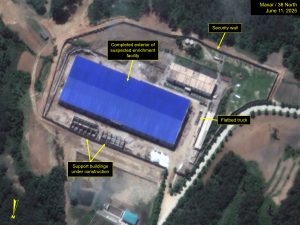
Probable New Uranium Enrichment Building
On June 9, the International Atomic Energy Agency (IAEA) reported that “the Agency is monitoring the construction of a new building at Yongbyon which has dimensions and features similar to the Kangson enrichment plant.” Analysis of commercial imagery by the James Martin Center for Nonproliferation Studies (CNS), the Institute for Science and International Security (ISIS), and 38 North has probably identified the building. Construction began in December 2024 and it appeared externally complete by May 26, 2025. All three sets of analysts agree the new building resembles the assessed enrichment building at Kangson and that its layout is suitable for a centrifuge facility, but that function has yet to be confirmed.
Context and Implications
In December 2022, Kim Jong Un called for “an exponential increase of the country’s nuclear arsenal” in the context of “the importance and necessity of a mass-producing of tactical nuclear weapons.” If the new building is for enrichment, it would be the second known expansion of assessed enrichment facilities since Kim’s speech (after one at Kangson), not including a Yongbyon expansion completed in May 2022. CNS and ISIS estimate the existing facilities at Yongbyon and Kangson are capable of producing some 215-232 kg of highly enriched uranium (HEU) per year, enough for at least eight-to-nine all-HEU nuclear weapons. According to CNS, the new Yongbyon facility could add another 73-98 kg of HEU per year, enough for at least three-to-four such weapons. It is quite possible that additional, as-yet undiscovered enrichment facilities also exist that might have been expanded over time.
Expansion at Assessed Liquid-Propellant Rocket Engine Plant
The Thaesong Machine Factory near Pyongyang is assessed to produce liquid-propellant rocket engines and perform the final assembly (production) of liquid-propellant intermediate-range and intercontinental ballistic missiles (IRBMs and ICBMs) and space-launch vehicles (SLVs). Expansion of the rocket engine production facility there began in July 2024, but halted in December. It was reported in April 2025 that the expansion work had resumed in mid-March, and now includes another cluster of buildings.
Context and Implications
The purpose of the construction remains unclear, but it might be for future series production of an upgraded SLV engine using liquid oxygen that North Korea launched unsuccessfully in May 2024, or expanded production of engines for liquid ballistic missiles. The North probably remains committed to liquids in addition to its growing solid-propellant strategic missile force, not only because of its substantial sunk investment in liquid systems but because liquid propellants pound-for-pound have more energy, permitting heavier payloads to be carried to a given range.
New Destroyers Carry Nuclear-Capable Missiles
On April 25, North Korea launched the Choe Hyon, the first of a new class of “multi-mission destroyers.” According to Kim Jong Un, the ship will carry “anti-air, anti-ship, anti-submarine and anti-ballistic missile capability” as well as “weapon systems for the most effective ground striking operations, like hypersonic strategic cruise missile, tactical ballistic missile and other means of strike.” (A sister ship, the Kang Kon, was relaunched on June 12 after a failed launch attempt on May 21 and a hurried effort to right, refloat, and restore it. Kim said the North will build two destroyers per year.) North Korean photos of the ship, and of a test of its weapons on April 28-29, indicate the destroyer is intended to carry 10 KN-23/Hwasong-11S short-range ballistic missile (SRBMs) in large vertical launch tubes aft, and some eight Hwasal land-attack cruise missiles (LACMs), probably in a slanted superstructure amidships. It also will carry some of the new “hypersonic strategic cruise missile” (also called a “supersonic cruise missile”) seen for the first time in photos of the test, probably fired from one of the eight medium-sized vertical launch tubes mounted aft.
Context and Implications
All of these missiles are capable of carrying nuclear or conventional warheads. Arming the new destroyers with nuclear-capable missiles carries forward the “policy of expanding the tactical nuclear weapons operation” and of making the navy “a component of the state nuclear deterrence” announced by Kim in August 2023. It is also consistent with earlier launches of LACMs from the smaller Amnok-class corvette in August 2023. Deploying nuclear missiles on surface combatants diversifies North Korean nuclear basing and further complicates Alliance targeting of the North’s nuclear force, adding to overall nuclear force survivability. Based on the photos, the new cruise missile is almost certainly not “hypersonic” (i.e., capable of Mach 5+ speed), and its speed and other aspects of performance cannot be confirmed.
Tactical Nuclear Counterattack Drill Held
On May 8, North Korea conducted SRBM launches in what its media termed a “joint striking drill” using the “national combined nuclear weapons management system” that it called “Haekpangasoe” (“Nuclear Trigger”). Based on North Korean photos of the event and South Korean military reporting, some five to eight KN-25s were launched and at least one KN-23/Hwasong-11A. This was the first detected KN-23 launch in North Korea since April 2023.
Context and Implications
The North first announced a “combined tactical drill simulating a nuclear counterattack by the units for the operation of tactical nukes” and involving the “nuclear weapons management system” in March 2023. The 2025 iteration allows Pyongyang to underscore the credibility of its retaliatory capability, both in terms of weapons and command-and-control, as well as its “tactical nuke” threat against South Korea. While Russian launches of North Korean-made KN-23s against Ukraine provide plenty of opportunities for the North to assess the capability and reliability of the missile system, it does not exercise Pyongyang’s own launch units and support infrastructure. Occasional launches by North Korean KN-23 units are the best way to maintain operational readiness.