

One Year In: Contextualizing 20×10 Policy for Regional Development
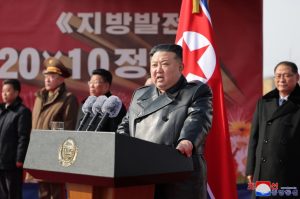
In February 2025, North Korean media reported on “successfully completing” the first year of Kim Jong Un’s signature national economic project, the “20×10 policy for regional development.”[1] All first-year construction projects were completed in less than 12 months from the time they began. Kim personally gave speeches at the inaugural and completion ceremonies in Songchon County, where the first 20×10 construction projects were launched, underscoring the importance the leader himself attaches to this initiative.
This project makes sense on multiple levels. To start, economic improvement is one of the Kim regime’s top two priorities (the other being defense development). For that reason, North Korea has launched a series of economic projects in recent years, for example the rural development initiative and a Pyongyang apartment construction project. Second, local economic development has been a staple theme in North Korean propaganda since Kim Il Sung proposed developing local industries at the Changsong Joint Conference in 1962. Third, progress in the 20×10 policy would help North Korea celebrate the 80th founding anniversary of the Workers Party of Korea (WPK) this October and open the Ninth Party Congress in 2026 on a high note. Last but not least, large-scale economic projects feed into state media’s “people-first principle” narrative.
However, economic improvement is unlikely the only motive at play. Given the timing of this grand project’s launch and North Korea’s broader domestic and foreign policy trends, the 20×10 initiative likely serves broader political and defense-oriented purposes. While officially economic in nature, it is political at heart and likely meant to help mitigate perceived internal threats caused by widening inequality between Pyongyang and the rest of the country. Given how commonly North Korea builds dual-use facilities, it is possible that the light industry factories built as part of the 20×10 plan may be converted to decentralized munitions factories in the future if or when needed. This would fall in line with the country’s ongoing efforts to revitalize the munitions and defense industries, buoyed by its improved relations with Russia, and its overall prioritization of defense over the civilian economy.
Tour d’Horizon
Kim Jong Un first announced the 20×10 policy at the Supreme People’s Assembly (SPA) in January 2024 and fleshed it out at a follow-on WPK Politburo meeting later that month. The policy mandates building industrial factories in 20 cities and counties per year over the next decade to raise the people’s living standards in local provinces, the ultimate goal being revitalizing local industries and making each region economically self-sufficient. It should be noted that North Korea did not announce the 20×10 policy at the Party’s policy review meeting in December 2023 (the annual year-end party plenum), which would have been the normal platform to use, but at an SPA session just two weeks later. Kim’s remarks at the SPA and the Politburo meeting—that “some policy leadership departments of the Party” took a “passive attitude” toward taking on another national economic project in the current economic situation—indicated he was forging ahead with the new regional development policy despite concerns from his top associates.
The 20×10 policy was initially focused on building food and consumer goods factories. However, North Korea started to expand its scope from economic production to welfare, culture, and education as the first-year construction projects progressed. In July 2024, Kim included the construction of aquaculture bases in the 20×10 policy.[2] Kim went further during the country’s first “consultative meeting for regional development project” the following month, announcing a Party decision to build “advanced public health facilities, sci-tech dissemination centres and grain management facilities” across the country in parallel to light industry factories. At an annual party plenum in December 2024, Kim proposed formally incorporating these, which he called “three essential projects,” into the 20×10 policy.[3] He later elaborated on the significance of this expansion as closing the gap in “cultural and intellectual levels between the citizens of the capital city and regional people and between the urban and rural dwellers” for a “balanced development of all fields and all regions.”
According to a South Korean economic institute, most of the first-year projects occurred in medium-sized counties, or those with a population of 50,000 to 200,000, where industrial bases have already been established or where agricultural, forestry, and fishery resources are abundant.[4] This shows North Korea undertook first-year construction projects where it had some level of confidence in success.
The Politics of It
While billed as an economic project, the 20×10 policy, like all North Korean economic initiatives, is essentially political.
At the Party plenary meeting in December 2023, the North Korean leader claimed that the “12 goals for the national economic development were all attained” in 2023 and the country’s gross domestic product grew by 40 percent compared to 2020. Relatedly, South Korea’s Bank of Korea estimated that the North Korean economy grew by 3.1 percent in 2023, representing the first year of growth since 2020, when North Korea closed borders during the pandemic.
Despite his glowing review of national economic growth, Kim Jong Un announced the 20×10 policy just weeks later, defining the “failure to satisfactorily provide the people in local areas with basic living necessities” as a “serious political issue.” Moreover, Kim characterized the new policy as an effort to “realize the long-cherished desire of regional people,” previously a rarely used term that reflected regime concern about the political implications of the growing divide between Pyongyang and the local provinces.
Kim’s first National Day speech in September 2024 best captures the essence of the political motive behind the 20×10 policy: preserving the people’s loyalty to socialism, a life-or-death matter for regime stability. He stated:
… [T]he socialist system, if it is to remain consolidated under any circumstances, must be solid in its foundations of the people’s conviction in its advantages, enjoy active empathy of all the people which they have got through their actual life, and rely on the unanimous will of the people to share their destiny with socialism to the last and defend it through generations. … Like this, regional development has risen as a matter of faith in socialism, instead of a simple economic and businesslike issue, and a very important and urgent matter that has a direct bearing on the future of our revolution.
A recent South Korean Unification Ministry report supports the North Korean leader’s fear. According to surveys of more than 6,000 North Korean defectors, conducted between 2013 and 2022, Pyongyang residents enjoy better access to daily necessities like food, clothing, and shelter; they have “significantly more” access to health care than those in other regions.[5] Approximately 90 percent of the respondents said the gap between the rich and the poor had widened.[6] The report assesses that these regional disparities show the regime’s uneven control over Pyongyang and other regions.”
The Security of It… And the Russia Factor
The timing of the 20×10 initiative’s launch in January 2024 is notable: Kim announced the new policy some months after the North Korea-Russia relationship had reached new heights. A Russian military delegation led by then-Russian Defense Minister Sergei Shoigu visited Pyongyang in July 2023 to celebrate Armistice Day and was fêted by Kim Jong Un himself. (China also sent a delegation, but it did not receive nearly the same level of treatment as the Russians.) It was remarkable for a Russian delegation to be at the center of this occasion at all, a military one no less: historically, China was the key partner in these celebrations given its decisive role in preventing North Korea’s collapse during the Korean War. In September, Kim traveled to the Russian Far East, his first overseas destination after the country started reopening its borders, for a summit with Vladimir Putin.
The additional income from its weapons exports and troop dispatch to Russia may have given Kim Jong Un confidence to start the ambitious 10-year regional development project. Although we cannot independently verify the scale of North Korea’s economic benefits from Russia thus far, estimates have ranged from $5.5 billion to more than $20 billion. On the trade front, Russian officials have said its bilateral trade with North Korea increased ninefold in 2023 and “reached a record” in 2024. North Korea-China trade volume decreased by 3.7 percent in 2024, but some of that may have been offset by North Korea’s increased trade with Russia.[7]
It is also worth noting that there has been a significant uptick in Kim’s visits to munitions and defense factories since August 2023, shortly after Kim showed Shoigu North Korea’s “new-type weapons and equipment” at a weapons exhibition in Pyongyang. Between August 2023 and June 30, 2025, Kim Jong Un made 21 visits to such factories, which stands in stark contrast to the one “munitions factory” visit he made prior to that time frame.[8]
The 20×10 policy may dovetail with the North Korean leader’s renewed interest in the munitions and defense industries. Dual-use factories are prevalent in North Korea. The South Korean government estimates that North Korea is operating approximately 300 munitions factories, including weapons production facilities with cover names (e.g., Pyongyang Pig Farm and the Kumsong Tractor and Sungni Automobile Factories) and 100 civilian factories that can be quickly converted to wartime munitions production sites.[9] In that vein, it is possible that North Korea intends to use the light industry factories being built as part of the 20×10 initiative for munitions and defense production if and when needed.
This would also help to support Kim’s consistent calls for “war preparations” since early 2023.[10] Relatedly, it may be useful to remind ourselves that in the same speech to the SPA where he announced the 20×10 policy, Kim called on all institutions and units, including economic, to prioritize contributions to strengthening the military. He said:
As the work for strengthening the country’s defence capabilities and military muscle is a nationwide undertaking both in name and reality, all institutions, enterprises, organizations and citizens in the territory of the Republic should have a correct view of military affairs and regard it as an immutable iron rule to provide everything needed for strengthening the military capability on the top-priority basis and in the highest quality.
The people’s government organs at all levels should take thoroughgoing measures to immediately switch over to the wartime system in case of emergency and make full material preparations for all-people resistance.
Defense Development Remains the Priority
Between January 2024, when Kim announced the 20×10 policy, and June 30, 2025, he made roughly 79 public appearances related to the military and the munitions and defense sectors as opposed to the roughly 44 visits he made to economic sites.[11] This significant gap shows that the regime prioritizes national defense over the civilian economy despite the heavy concentration of state media coverage of economic projects, including the 20×10 policy.
Similar to his speech to the SPA in January 2024, Kim in his National Day speech first started with the importance of the 20×10 initiative but ended with emphasis on bolstering national defense. He said: “Strong power–this just means a genuine peace and an absolute guarantee for the development of our state. Steadily enhancing the capabilities of our army for fighting a war … is the most important of the state affairs of our Party and government and the primary task of the revolution.” Kim’s implied message seemed to be that, while the 20×10 policy is crucial, it will have to give way to national defense in order to ensure economic development (the “development of our state”).
North Korea in recent years has consistently emphasized the importance of prioritizing national defense despite economic difficulties, as exemplified by a carefully choreographed media campaign in the lead-up to Kim’s first publicized uranium enrichment facility visit in September 2024. A more recent example is a front-page Party daily published on June 25, 2025, underscoring the importance of bolstering national defense to prevent another Korean War.[12]
Looking Ahead
There are lingering questions about whether the 20×10 policy is sustainable over the next nine remaining years, especially as North Korea has expanded, and may continue to broaden, the scope of the project. According to the South Korean Unification’s defectors survey, the duration of the daily power supply in, and the actual daily operating hours of North Korean enterprises have decreased, particularly since Kim Jong Un took power.[13] The same survey says the procurement of raw materials remains a top obstacle in the country.[14] Building more factories to operate in spite of the already weak infrastructure, therefore, does not inspire much confidence.
In an unusual move, Kim Jong Un personally took responsibility for the new initiative, in part to underscore how the 20×10 policy is different from his forefathers’ failed regional development initiatives. Kim’s close association with the project, coupled with heavy propaganda playing it up, likely has raised the people’s expectations. This could potentially increase the political risks if this project falls short of completion or fails to improve the people’s livelihoods as Kim has promised.
For that reason alone the 20×10 policy is still worth monitoring, as is how the project continues to evolve. How North Korea balances its hefty domestic construction projects, where military personnel play a vital role, with its dispatch of additional troops, workers, and construction corps to Russia is another interesting question, to which the Ninth Party Congress in 2026 may provide an answer.
- [1]
This piece wraps up 38 North’s satellite imagery series on the 20×10 policy. See https://www.38north.org/2025/02/kim-jong-uns-20×10-project-achieves-year-one-successes/, https://www.38north.org/2025/03/the-20×10-project-begins-songchon-and-yonthan/, https://www.38north.org/2025/05/the-20×10-initiative-brings-factories-at-the-cost-of-agricultural-land/, and https://www.38north.org/2025/06/20×10-factories-different-locations-similar-products/.
- [2]
Sinpho City Offshore Farm was completed in December 2024, per Kim’s call in July that year to build the first offshore farm in Sinpho.
- [3]
Specifically, Kim called for the construction of “advanced public health facilities, scientific, educational and leisure facilities [cultural complexes] and grain management facilities.”
- [4]
Kang Song-hyeon and Lee Hae-jeong, “북한의 ‘지방발전 20×10 정책’ 분석과 전망 [North Korea’s “20×10 Policy for Regional Development”: Analysis and Prospects],” Kyongje Jupyong, No. 936 (Hyundai Research Institute), March 22, 2024, pp 9-10.
- [5]
Report on North Korea’s Economy and Society as Perceived by 6,351 Defectors, South Korean Ministry of Unification, August 2024, pp 10, 17, and 216-249, https://www.unikorea.go.kr/eng_unikorea/news/Publications/nk_realities/.
- [6]
Ibid., p. 10.
- [7]
Lee Jongkyu, “총괄: 북한경제 2024년 평가 및 2025년 전망 [Overview: Assessment of the North Korean Economy in 2024 and Prospects for 2025],” KDI Review of the North Korean Economy, Vol. 27, No. 1 (January 2025), p. 7; and Kim Kyoochul, “2024년 북한의 대외 경제 평가와 향후 전망: 중⋅북 무역과 러⋅북 경제협력을 중심으로 [Assessment of North Korea’s International Economy in 2024 and Future Prospects: As Seen From China-North Korea Trade and Russia-North Korea Economic Cooperation],” KDI Review of the North Korean Economy, Vol. 27, No. 1 (January 2025), p. 33.
- [8]
This tabulation is based on data from the South Korean Unification Ministry website’s “김정은 위원장 공개활동 동향 [Trends of Chairman Kim Jong Un’s Public Activities]” page at https://nkinfo.unikorea.go.kr/nkp/kje/view.do. The author tabulated Kim’s visits to sites that were specifically identified by North Korean media as “munitions factories [군수공장],” “munitions enterprises [군수기업소],” “defense industrial enterprises [국방공업기업소],” or “munitions industrial enterprises [군수공업기업소].” The tabulation does not include Kim’s appearances at tests of weapons developed by any of these entities, nor does it include factories that have been linked to weapons production but have not been identified by state media as any of the three above. For example, Kim Jong Un in early June 2019 paid back-to-back visits to tractor and machine factories that have been linked to weapons production, but the author’s tabulation does not account for these visits. Even if such visits were accounted for, it would not change the heavy concentration of Kim’s visits to munitions and defense factories starting in August 2023.
- [9]
“군수공업 [Munitions Industry],” North Korea Information Portal, ROK Ministry of Unification, https://nkinfo.unikorea.go.kr/nkp/pge/view.do;jsessionid=lIxq24H67Lx54YWTdjy-3EtWvoLqxMEcG-t9757K.ins12?menuId=EC212; and 2022 Defense White Paper, ROK Ministry of National Defense, June 2023, pp 32-33, https://www.mnd.go.kr/cop/pblictn/selectPublicationUser.do?siteId=mndEN&componentId=51&categoryId=0&publicationSeq=1057&pageIndex=1&id=mndEN_031300000000.
- [10]
For example, see “Respected Comrade Kim Jong Un Visits Flying Group of Guards 1st Air Wing of Korean People’s Army and Guides Drills,” KCNA, May 17, 2025, http://kcna.kp/en/article/q/2cd0c8b82e9e239dbed6e59eae1181c3.kcmsf; and “On Prevailing Situation and Tasks of Battalion Commanders and Political Instructors of Armed Forces of the Republic: Respected Comrade Kim Jong Un Makes Speech Before Those Attending Fourth Conference of Battalion Commanders and Political Instructors of Korean People’s Army,” KCNA, November 18, 2024, http://kcna.kp/en/article/q/5fd4f86a73bfaaafcff0f49d89c1e325.kcmsf.
- [11]
This tabulation is based on data from the South Korean Unification Ministry website’s “김정은 위원장 공개활동 동향 [Trends of Chairman Kim Jong Un’s Public Activities]” page at https://nkinfo.unikorea.go.kr/nkp/kje/view.do. In addition to military- and defense-related and economic visits, Kim during the same period made roughly 62 appearances that did not fit either category. These include diplomatic activities, such as meetings with visiting Russian officials; attendance in Party and SPA meetings; and visits to flood-stricken regions.
- [12]
Rim Jong Ho, “<6.25가 다시금 새겨주는 철리> 강해지고 또 강해져야 한다 [The Lesson June 25 Reminds Us of Again: [We] Must Become Strong and Even Stronger],” Rodong Sinmun, June 25, 2025.
- [13]
Report on North Korea’s Economy and Society as Perceived by 6,351 Defectors, South Korean Ministry of Unification, August 2024, p. 91, https://www.unikorea.go.kr/eng_unikorea/news/Publications/nk_realities/.
- [14]
Report on North Korea’s Economy and Society as Perceived by 6,351 Defectors, South Korean Ministry of Unification, August 2024, p. 95, https://www.unikorea.go.kr/eng_unikorea/news/Publications/nk_realities/.