

North Korea’s Subdued Signaling Toward China During Treaty Anniversary
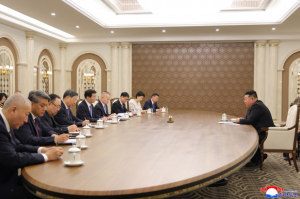
As anticipated by Kim Jong Un and Xi Jinping’s June agreement, North Korea and China gave unusual prominence to the 65th anniversary of their defense treaty—formally known as the Treaty of Friendship, Cooperation and Mutual Assistance–an occasion that had not garnered much attention from either country in years. The commemoration included successive high-level exchanges: Cabinet Premier Pak Thae Song led a Party and government delegation to China from July 10 to 12; three days after Pak’s return home, Wang Huning, chairman of the National Committee of the Chinese People’s Political Consultative Conference (CPPCC), led a Chinese Party and government delegation to North Korea from July 15 to 17.
Given the unusual burst of North Korea-China engagements since the Kim-Xi Beijing summit in September 2025, expectations for a particularly robust public commemoration of the treaty anniversary were high. Despite the unusually high-profile reciprocal exchanges surrounding the anniversary, North Korea’s public messaging toward China remained subdued. Moreover, as the event approached, North Korea published back-to-back nuclear-themed reports that both reiterated its nuclear permanence and appeared intended, at least in part, for China.
This contrast between the intensity of recent high-level diplomacy and Pyongyang’s more measured rhetoric toward Beijing does not necessarily indicate a lack of progress in or a deterioration of relations. However, the subtler signals from North Korean state media suggest that these diplomatic exchanges and the conventionally positive language accompanying them may overstate the degree of closeness or alignment between the two countries, particularly on North Korea’s nuclear status.
A Nuclear Prelude to Pak’s Beijing Visit
Pyongyang entered the treaty anniversary period with a sequence of two nuclear-themed messages that appeared intended, at least in part, for Beijing. On July 9, the same day North Korea announced Pak Thae Song’s China visit, a section chief at the Institute of Enemy State Studies issued a “commentary” on Japan-South Korea military cooperation. The following day, state media reported that Kim Jong Un had convened the first publicized “enlarged meeting” of the Party Central Military Commission (CMC) in more than a year.
The low-level institute commentary belatedly criticized steps Japan and South Korea had taken since early 2026 to strengthen trilateral security cooperation with Washington, broadly aligning with Beijing’s own concerns. It concluded that North Korea’s “continuous development of nuclear force and thorough exercise of its position as a nuclear weapons state are the only way to … defend peace and security in the Korean peninsula and the region.”
Neither North Korea’s pledge to continue expanding its nuclear forces nor its justification for retaining nuclear status in a deteriorating security environment was new. What was notable was the timing and framing, as well as the vehicle of the message. Issued on the eve of Pak’s China visit, the commentary suggested that China, while not the only target audience, was an important one. By linking North Korea’s nuclear deterrent not only to its own security but also to regional peace, it appeared to frame North Korea’s nuclear status as a guarantor rather than an obstacle to regional security, echoing language from the June Kim-Xi summit about jointly defending regional peace and development. Because the commentary carried relatively little authority, it enabled Pyongyang to modulate its nuclear argument on the eve of the anniversary, while the rarity of the institute’s public profile—this was only the second time state media had mentioned it since November 2024—was still enough to draw attention.
The subsequent CMC meeting elevated the message by reaffirming the policy of quantitatively and qualitatively expanding the country’s nuclear forces. The decision was not made in a vacuum: it followed a late-June Party plenary meeting that had already called for “steadily expand[ing] and strengthen[ing] the nuclear forces” and “thoroughly exercise[ing] the position of a nuclear weapons state.” Even so, the timing of a Kim-led meeting on the eve of the treaty anniversary and Pak’s China visit is difficult to dismiss as entirely incidental.
North Korea has shown a similar pattern ahead of previous high-level engagements with China. Just before Kim traveled to Beijing in September 2025 for World War II anniversary commemorations and a summit with Xi, he visited an institute developing a “new-type solid-fuel engine” for next-generation intercontinental ballistic missiles, seemingly underscoring that denuclearization would not be on the agenda. In the days leading up to Xi’s June 2026 visit to Pyongyang, Kim made back-to-back nuclear-related appearances, while Kim Yo Jong rejected a US assertion that China had agreed to pursue North Korea’s denuclearization—messages that likewise appeared directed primarily at Beijing.
This behavior apparently reflects the perception that China’s position on denuclearization has not fundamentally changed despite its public omission of that terminology after July 2023. Although China’s own readout of the May 2026 Trump-Xi summit omitted denuclearization, Beijing did not dispute the White House’s subsequent statement that the two leaders had confirmed a shared goal of denuclearizing North Korea, even when directly asked about the discrepancy. This may have reinforced Pyongyang’s concern and helps explain why it has repeatedly underscored the permanence of its nuclear status around high-level diplomacy with China.
Muted Messaging Amid High-Profile Diplomacy
At a glance, North Korea seemed to have played its part in observing the treaty’s 65th anniversary: state media published letters exchanged between Kim and Xi and the two countries’ foreign ministers, Choe Son Hui and Wang Yi, and reported on Pak’s and Wang’s visits; the Party daily also carried an editorial and an article penned by the Chinese ambassador to North Korea.
Yet, on the day of the treaty anniversary, North Korea’s authoritative Party daily, Rodong Sinmun, gave front-page coverage to the previous day’s highly unusual joint Party-government-military meeting on corruption cases in the military, pushing anniversary-related reporting—including Pak’s meeting with Xi—to the second and third pages. That editorial choice seemed to undercut the prominence otherwise accorded to the occasion. Without speculating on why the meeting was convened when it was, the editorial priority was clear: restoring military discipline took precedence. This may have been understandable in any other year, but the contrast between North Korea’s apparent deemphasis of the anniversary and the high-level diplomacy unfolding in Beijing was striking. The Party daily afforded front-page coverage to Wang’s Pyongyang visit, although its greater prominence may have reflected, at least in part, North Korea’s role as host.
Pyongyang’s relative restraint was also evident in Kim’s letter to Xi on the treaty anniversary, as well as its reports on the high-level meetings during Pak’s and Wang’s respective visits to China and North Korea. These readouts carried over many of the positive formulations from Kim’s April 2026 talks with Chinese Foreign Minister Wang Yi and his June summit with Xi, such as raising bilateral ties to a new “strategic” level or opening a new chapter. However, there were notable omissions and less emphatic language, suggesting that, at least from Pyongyang’s viewpoint, the relationship still may not have returned to the level of warmth seen before bilateral ties began to cool in 2023, despite what the recent surge in high-level diplomacy might suggest.
One notable omission was “blood-forged friendship,” a formulation that North Korea has traditionally used to underscore the two countries’ shared revolutionary history. Kim’s recent letter to Xi referred to a friendship formed in a “bloody struggle for independence against imperialism,” stopping short of the more direct “blood-forged friendship” used in his 2021 letter. State media did not once attribute “blood-forged friendship” to a North Korean official during the remainder of the treaty anniversary period—a contrast with Chinese officials’ repeated references to “militant friendship sealed in blood,” including Xi in his treaty anniversary letter to Kim and during his talks with Pak.
Similarly, North Korean reports of bilateral meetings were less detailed on areas of cooperation and omitted expressions of support for Chinese interests. For example, the readout of Pak’s meeting with his Chinese counterpart, Li Qiang, noted only that Pyongyang “would make positive efforts to steadily strengthen the DPRK-China friendship and solidarity,” without elaboration. According to Xinhua, however, Pak reaffirmed North Korea’s commitment to “intensify high-level exchanges and strategic communication, expand exchanges and cooperation in sectors including economy and trade, science and technology, and people-to-people and cultural sectors, strengthen international coordination ….”
During his talks with Wang Huning, Kim Jong Un offered North Korea’s standard support for China’s “socialist cause,” in contrast with his pledge to Wang Yi in April that Pyongyang would “fully support all the internal and external policies of the Chinese party and government for realizing the territorial integrity of the country on the basis of the ‘one-China’ principle and building a fair and just multi-polar world.” Kim also reiterated support for Beijing’s “one-China” principle during his June summit with Xi, making the absence of similarly explicit support for Chinese interests and policies in July more conspicuous given the intensified high-level diplomacy between the two countries. Similarly, North Korean coverage of Pak’s talks with Xi and Li omitted expressions of support for Chinese interests altogether, even though, according to Xinhua, Pak had told both leaders that North Korea “firmly supports China in safeguarding its core interests,” including Taiwan.[1]
The pattern of rhetorical restraint was already evident in Kim Jong Un’s July 1 letter to Xi marking the Chinese Communist Party’s 105th founding anniversary. Compared with 2021, the last time Kim sent Xi a letter on the same occasion, the language was more measured, reiterating the will to strengthen ties without using formulations such as “militant friendship and bonds of kinship” or “the true comrades and the comrades-in-arms that have shared life and death in the protracted struggle for opposing imperialism and building socialism.”
Conclusion
Viewed individually, many of the observations discussed here could be dismissed as editorial choices or seemingly minor details. Collectively, however, they point to a contrast between the intensity of recent high-level diplomacy and Pyongyang’s more measured public messaging regarding the relationship.
This relative restraint does not automatically translate into a lack of progress in or a deterioration of relations, but it suggests that the frequency and level of diplomatic exchanges—and the conventionally positive rhetoric repeatedly accompanying them—may overstate how close to or aligned with China Pyongyang considers itself. North Korea’s repeated emphasis on the permanence of its nuclear status around high-level engagements with China, for example, suggests that denuclearization remains, and likely will continue to be, a point of tension, despite China’s public silence on denuclearization in recent years.
The trajectory of the relationship will become clearer over time. For now, the treaty anniversary is a reminder that high-level exchanges and familiar expressions of friendship should not alone be taken as measures of closeness. The subtler but no less important signals Pyongyang sends, whether through omission, emphasis, or prioritization, can be equally revealing.
- [1]
“Update: Xi calls on China, DPRK to keep advancing socialist cause, modernization,” Xinhua, July 11, 2026, https://english.news.cn/20260711/e587770a2e0641959713a47d95c1b575/c.html; “Chinese premier holds talks with premier of DPRK cabinet,” Xinhua, July 11, 2026, https://english.news.cn/20260711/a801206ff4dc4396b2d38858da023659/c.html.