

Keeping the Door Open: How China Uses the CPPCC to Conduct “United Front Diplomacy” with North Korea
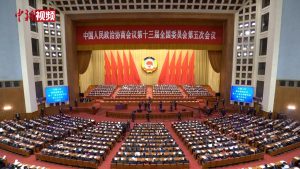
On New Year’s Day 2024, China’s General Secretary Xi Jinping and North Korea’s Supreme Leader Kim Jong Un marked the 75th anniversary of the two countries’ diplomatic relations by designating 2024 as the “China-DPRK Friendship Year.” Many international experts expected that a Xi-Kim summit would take place that year, but none materialized. The overall lack of recent high-level public exchanges between China and North Korea (Democratic People’s Republic of Korea or DPRK) both last year and this year has left analysts at odds over whether the relationship has deteriorated, remained static, or evolved in some way to better suit China’s broader strategic ambitions. As this analysis shows, however, Beijing is using alternative mechanisms to pursue diplomacy with Pyongyang. These little-studied channels include “united front diplomacy,” with the Chinese People’s Political Consultative Conference (CPPCC) playing a central role in these exchanges.
The CPPCC’s involvement in China-North Korea relations reflects a broader shift in Beijing’s diplomatic strategy. While the CPPCC traditionally focuses on domestic united front work, its international exchanges have expanded significantly in both scope and frequency in recent years. Its engagement with North Korea draws on longstanding institutional linkages between the two countries’ united front organizations and aligns with China’s wider efforts to improve its international public opinion and strengthen subnational ties abroad. Since 2019, CPPCC officials have increased their outreach to North Korean counterparts, particularly as formal party and state channels have become less conspicuous. The methods they employ, including elite capture and public diplomacy, closely mirror those used in domestic united front work. It is these characteristics, rather than alignment on foreign policy objectives, that define Beijing’s approach to North Korea as united front diplomacy.
China’s influence in North Korea has long been an underlying assumption among US policymakers, prompting debate whenever the pace or nature of China-North Korea diplomacy shifts. Developing a deeper understanding of the mechanisms Beijing uses to communicate with North Korea, such as the CPPCC’s united front diplomacy, offers a lens through which analysts can more accurately assess China-North Korea relations, Beijing’s strategic use of alternative diplomatic channels, and opportunities for US policymakers to pursue cooperation on shared interests on the Korean Peninsula.
Why United Front Diplomacy?
China’s diplomatic relations with North Korea have traditionally been conducted using two main approaches: (1) party-to-party diplomacy via the International Department of the Chinese Communist Party (CCP) and high-level military exchanges and (2) state-to-state relations via China’s Ministry of Foreign Affairs. Although united front diplomacy has not been a formal component of the official bilateral relationship, the CPPCC has played an increasingly active role in facilitating China-North Korea exchanges throughout Kim Jong Un’s leadership. The CPPCC is China’s highest-ranking united front organization and is led by a chairman who, since 1993, has concurrently held a seat on the CCP’s Politburo Standing Committee—China’s core leadership body. This high-level oversight by China’s central leadership, combined with the two countries’ long history of relations under the united front umbrella that dates to the Korean War, underscores the significance of the CPPCC’s efforts to engage North Korea.
Despite the mutual distrust that characterizes the China-North Korea relationship, the CPPCC has played a consistent historical role in facilitating cooperation. In the early years of the bilateral relationship, the CPPCC actively issued public statements of solidarity and coordinated materiel support for the Korean War.[1] At home, these efforts allowed the newly-established People’s Republic of China to develop the CPPCC’s role and consolidate domestic support under its auspices. This early cooperation has become an important element of the Chinese narrative on China-North Korea ties in the Cold War’s opening years, and North Korea continues to commemorate the Chinese People’s Volunteers at the highest levels.
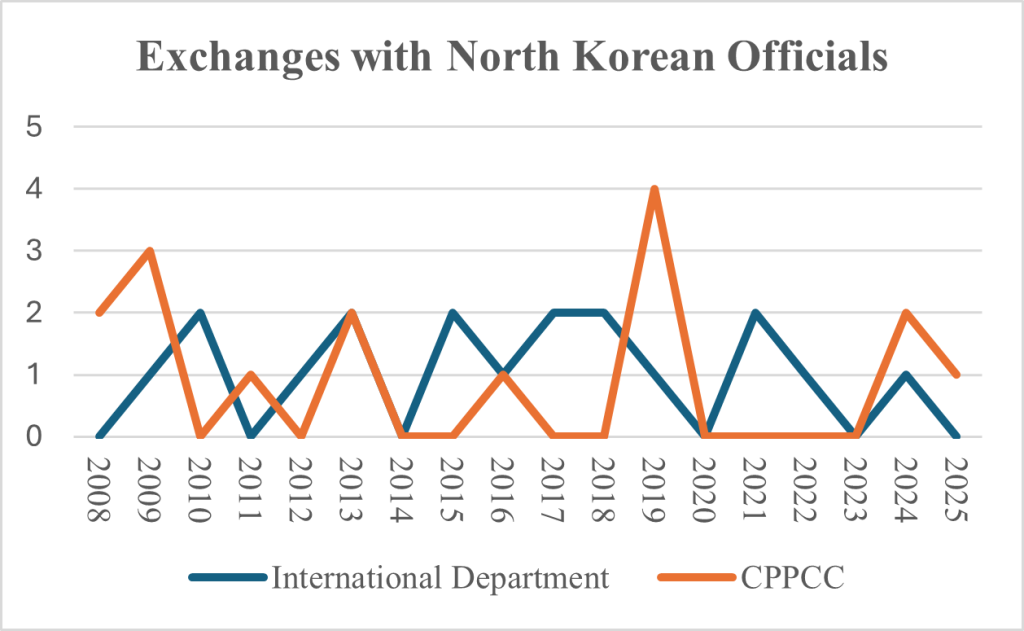
Mao Zedong’s political campaigns and purges, particularly during the later years of his leadership, curtailed united front work, and it was not until China’s reform era in the 1980s that the CPPCC resumed outreach to Pyongyang by establishing ties with the Democratic Front for the Reunification of Korea (조국통일민주주의전선, DFRK), North Korea’s main united front body. Charting these visits over time reveals a generally inverse correlation between CPPCC and International Department exchanges.[2]
A Comparison of International Department and CPPCC Exchanges with North Korean Officials
This pattern suggests that when geopolitical developments directly impact China’s national security, the CCP’s International Department tends to lead engagement with North Korea. Between 2016 and 2018, a period marked by heightened tensions over North Korea’s nuclear weapons development, the head of the International Department, Song Tao (宋涛), met with North Korean officials five times. During that same period, the CPPCC conducted only one exchange, in May 2016, led by Wang Jiarui (王家瑞), who had stepped down as head of the International Department less than a year earlier. This visit occurred merely two weeks before Song Tao first welcomed a North Korean delegation to Beijing in his official capacity, suggesting that Wang’s exchange likely reflected a period of knowledge transfer and institutional continuity rather than a shift in diplomatic strategy.
However, the CPPCC becomes more active when inter-Korean relations deteriorate. For instance, after South Korean President Lee Myung-bak abandoned the “Sunshine Policy” in 2008, the CPPCC met with North Korean officials five times between 2008 – 2009. Broadly speaking, united front diplomacy aligns with Beijing’s preference for preserving the status quo on the Korean Peninsula. During periods of inter-Korean tensions, the CPPCC can direct its efforts toward strengthening its networks and subnational ties within North Korea, reinforcing Beijing’s influence while avoiding high-level party-to-party or state-to-state engagement that may jeopardize its relationship with Seoul and provoke escalation.
United Front Diplomacy in the Kim Jong Un Era
The most notable year for the CPPCC’s engagement with North Korea was 2019. This surge in exchanges coincided with two key developments: (1) the rapid deterioration of inter-Korean relations following the stalled 2018 summit diplomacy between Kim Jong Un and South Korean President Moon Jae-in and (2) the publication of extensive literature within China on the CPPCC’s role in diplomacy from academic, non-governmental, and official CPPCC sources.[3] These analyses argue that three characteristics of the CPPCC make it an effective organization to conduct public diplomacy: (1) its flexibility and scalability from the grassroots to the national level, (2) its access to specialized subject matter expertise, and (3) its high-level coordination due to the CPPCC chairman’s seat on the Standing Committee of the CCP Politburo.
Beijing may be leveraging the CPPCC as a diplomatic channel due to Pyongyang’s familiarity with it as a long-time united front counterpart organization. As detailed below, this history likely provides the CPPCC rare access to segments within North Korean society that are otherwise difficult to reach—particularly amid the growing distrust between the two national governments. Even after North Korea abandoned its reunification policy and appears to have disbanded the DFRK in 2024, China continues to leverage the CPPCC’s united front diplomacy as the primary method to engage with North Korean delegations. Rather than the ideologically motivated cooperation of the past, these activities resemble Track II diplomacy that tap into existing interpersonal networks and subject matter expertise to advance Beijing’s diplomatic objectives in its relationship with Pyongyang.
CPPCC Outreach in Action
Recent CPPCC engagements with North Korea across various segments of government and society illustrate how united front diplomacy works in practice.
Research Cooperation: Han Fangming (韩方明), China’s leading scholar of public diplomacy, led the Charhar Institute’s visit to North Korea in 2016, which resulted in the establishment of the first joint think tank cooperation between China and North Korea. This link became known as the “Charhar Channel.” During the 70th anniversary of China-North Korea diplomatic relations in 2019 and during Han’s tenure as a vice-chairman of the CPPCC Foreign Affairs Committee, two professors from North Korea’s Kim Il Sung University were appointed as senior research fellows at the Charhar Institute. Additionally in 2019, Han attended the 70th anniversary celebration at the Chinese embassy in North Korea where several North Korean officials at the vice-chairman level, including former Premier Pak Pong Ju, appeared. While the Charhar Institute is a non-governmental think tank, Han leveraged these working relationships to facilitate flexible and scalable Track II dialogues as a CPPCC vice-chairman during a period of warming China-North Korea relations.
Media Engagement: He Ping (何平), a vice-chairman of the CPPCC Foreign Affairs Committee and President and Secretary of the Party Leadership Group of Xinhua News Agency, attended the 2024 anniversary celebration of the China-DPRK Treaty of Friendship, Cooperation and Mutual Assistance at the North Korean embassy where he met Ambassador Ri Ryong Nam. In January, the People’s Daily published a story on the 2025 Chinese and Foreign Press Spring Festival Friendship Meeting (2025年中外新闻界新春联谊会) attended by officials from the North Korean embassy. The event was hosted by the All-China Journalists Association (中华人民新闻工作者协会), of which He is the chairman. Although Xinhua has not resumed full pre-pandemic operations in North Korea, People’s Daily and China Media Group, the parent company of China Central Television, dispatched correspondents to North Korea in March. Despite the disruptions in resuming large-scale border crossings between China and North Korea, such as the cancellation of tourist visas in North Korea just weeks after reopening, this development suggests the CPPCC is using He’s media background and subject-matter expertise to reopen information-sharing channels from within North Korea.
Personal Diplomacy: Zhou Qiang (周强) is currently a vice-chairman of the CPPCC National Committee. In 2010 while Zhou was the Provincial Party Secretary of Hunan, a North Korean National Tourism Administration delegation visited his province. Prior to assuming his role in the CPPCC, Zhou served as the President of the Supreme People’s Court (中华人民共和国最高人民法院). In 2019, Zhou met with the president of North Korea’s Central Court, Kang Yun-sok. Zhou was reported to have given a speech at the North Korean embassy in China in commemoration of Kim Jong Il’s 83rd birthday in February. The celebration was attended by Ambassador Ri Ryong Nam and Li Ruohong (李若弘), President of the Beijing International Peace Culture Foundation. This organization is an official UNESCO partner committed to “facilitating cooperation in economic, social, scientific, technological, and cultural domains” with other countries, suggesting that the CPPCC seeks to expand cooperation with North Korea in these areas. Therefore, Zhou’s involvement in a seemingly routine celebration suggests a strong likelihood of the CPPCC’s united front diplomacy tactics in practice, in which personal ties are used to complement higher-level, coordinated objectives.
Business Ventures: The CPPCC also appears to be leveraging its member groups to work through Chinese commercial and cultural organizations that connect with DPRK state-owned enterprises. The individual members of these groups maintain ties to political and cultural institutions in North Korea, such as the Chinse directors of the Kim Il Sung-Kim Jong Il Foundation (KKF) Cui Tongwen (崔同文), Sai Tiejun (赛铁军), and Jin Xian (金仙).[4] Cui worked as the General Manager of Dandong Wanjing Trading Co., Ltd. (丹东万景贸易有限公司) and was appointed as an honorary chairman of the Beijing Federation of Returned Overseas Chinese from Korea (北京侨联朝鲜归侨联谊会) during its 2020 annual meeting. This organization is a municipal-level affiliate of the All-China Federation of Returned Overseas Chinese (中国全国归国华侨联合会), a CCP people’s organization which holds 26 seats in the CPPCC National Committee. North Korean escapee Hyunseung Lee, who previously worked in China to facilitate shipping and mining trade, explained that cross-border commerce often benefits subnational actors—particularly North Korean businesspeople operating in both the state-owned enterprises and the informal market.[5] Therefore, this expansion of business ties facilitates the CPPCC’s access to segments within North Korea society that might otherwise be difficult to reach through conventional diplomatic channels.
Conclusion
Both historical precedent and practical considerations offer the CPPCC unique opportunities to conduct united front diplomacy and create space for engagement within North Korea’s tightly controlled political system. North Korea continues to value its united front legacy with China, as reflected in a statement by its Ministry of Foreign Affairs on the seventh anniversary of Kim Jong Un’s 2018 visit to China. The statement emphasized that the bilateral relationship “has maintained its original character despite all ordeals of history, true to the noble intentions of the preceding leaders.” Although shared ideology does not seem to be driving China-North Korea relations these days, these institutional linkages remain useful tools for Beijing to pursue its evolving strategic objectives. As CPPCC-led efforts, which began in earnest in 2019, indicate that Beijing sought to expand subnational contacts outside the core elite in Pyongyang, the CPPCC’s growing engagement with North Korea over the past year serves as a reminder that China’s diplomacy with North Korea is more complex than assumed. While party-to-party and state-to-state relations typically involve high-profile exchanges, analyzing the CPPCC’s united front diplomacy as a third channel reveals how China sustains low-profile engagement to help stabilize the relationship even amid tensions over strategic issues.
- [1]
On October 24, 1950, Zhou Enlai delivered a reported titled “Resisting U.S. Aggression and Aiding Korea, Defending Peace” at a session of the First CPPCC National Committee. One year later at a subsequent session, Mao Zedong called for strengthened resistance efforts, increased production, and rationing to support the war effort. During this session, the CPPCC passed the “Resolution on the Work of Resisting U.S. Aggression and Aiding Korea.” The Central Committee of the China Democratic League established a “Patriotic Weapons Donation Committee,” and CPPCC members parties also sent delegations to North Korea. For example, Huang Dingchen (黄鼎臣), chairman of the Zhi Gong Party, organized and led a medical team to the front.
- [2]
Official press releases from the ID and the CPPCC National Committee record exchanges with North Korean officials only from 2008 onward, and most of the CPPCC exchanges were conducted with representatives of the DFRK.
- [3]
In 2019, the CPPCC hosted its first publicly known multilateral meeting with the united front organizations of Vietnam, Laos, and North Korea under the theme of “concentrating hearts and minds and enhancing consensus.” Discussions focused on understanding the roles and mechanisms of different organizations within each country’s political system. Notably, the official CPPCC report of the event included a question posed to the DFRK delegation: “In addition to the ruling party, what other parties are there in composition of the DFRK? How do they participate in nation-building and decision-making?” Such a question indicates that Beijing may have been seeking to expand subnational contacts beyond the core Korean Workers’ Party elite in Pyongyang to better understand local conditions. See: Wu Yin and Zhao Yu, “交流·互鉴·共识——中国、朝鲜、越南、老挝统一战线组织专题研讨会侧记 [Exchange, Mutual Learning, Consensus—Notes on the Seminar of the United Front Organizations of China, North Korea, Vietnam, and Laos],” Special Report of the Chinese People’s Political Consultative Conference (2019).
- [4]
The KFF raises funds for maintenance of the Kumsusan Palace of the Sun, the mausoleum of deceased North Korean leaders Kim Il Sung and Kim Jong Il. Based on North Korean state media reports, it appears that Cui Tongwen has facilitated access to North Korea for several Chinese companies across a variety of sectors. The number of representatives from Chinese companies who presented floral baskets to statues of the North Korean leaders increased dramatically since late December 2024. See Korean Central News Agency, “Respected Comrade Kim Jong Un Receives Flower Baskets from Abroad,” KCNA Watch, April 12, 2025, https://kcnawatch.org/newstream/1744516218-645214751/respected-comrade-kim-jong-un-receives-flower-baskets-from-abroad; Korean Central News Agency, “Floral Baskets Sent to Statues of Great Leaders from Abroad,” KCNA Watch, December 29, 2024, https://kcnawatch.app/newstream/1744729459-944940802/floral-baskets-sent-to-bronze-statues-of-great-leaders-kim-il-sung-and-kim-jong-il-from-abroad.
- [5]
Interview with Hyunseung Lee, interview by the author, Washington, DC, March 28, 2025.