

Kim Jong Un’s Apparent Last-Minute Beijing Visit
This article is from the second edition (July-September 2025) of 38 North’s new quarterly product, North Korea Briefing, that monitors key internal developments in North Korea. For the full series, click here.
Kim Jong Un’s (KJU) apparent last-minute decision to visit Beijing probably caused some drama for the Chinese hosts, but showed unusual efficiency for travel on KJU’s part, suggesting a possible shift in his foreign travel style. The presence of Ju Chang Il, head of the Party’s Propaganda and Agitation Department, alongside KJU in Beijing highlights Ju’s growing influence and involvement in strategic decision-making. Kim Jae Ryong, head of the Party’s discipline department, also accompanied Kim Jong Un to China, becoming the second Party official involved in personnel affairs to make an overseas trip this year. Deploying party personnel managers abroad appears aimed at ensuring effective execution of agreements with China and Russia and may suggest Pyongyang is adjusting its network of overseas managers to ensure effective bilateral ties with these countries.
Was Kim Jong Un a Last-Minute Guest in Beijing?
Kim Jong Un was treated like a star attraction at the 80th Victory Day celebrations in Beijing. Circumstantial evidence, such as his accommodation and meeting arrangements with President Putin in Beijing, suggests KJU decided to visit China at the last possible minute. North Korea’s official Korean Central News Agency (KCNA) announced the trip on August 28, five days before he arrived.
Instead of staying at Diaoyutai or another state guesthouse or hotel, KJU stayed at the DPRK Embassy in Beijing. This could have been due to privacy concerns for him and his daughter Kim Ju Ae. On the other hand, if KJU was a last-minute guest, the North Koreans may have decided not to trouble their Chinese hosts by compelling them to find KJU and his travel party last-minute accommodations.
KJU’s meeting with Putin following the Victory Day parade was scheduled only after the North Korean delegation arrived in China. After KJU’s trip was announced, a Putin adviser told Russian media on August 29 that KJU had been invited for a bilateral meeting with Putin. After KJU arrived, the Russian delegation was still waiting on a reply. North Korea typically likes to keep foreign leadership in suspense about meeting the leader, but this dynamic has only been evident in Pyongyang, not a foreign visit. KJU and the delegation also may have been waiting on Xi Jinping’s availability before finalizing details for the bilateral meeting with Putin.
Context and Implications
This strongly suggests that, aside from some Victory Day events, KJU’s decision to visit Beijing was made last-minute and he left Pyongyang with an open-ended itinerary. KJU’s late RSVP to China was a subtle power flex which foreshadows increased flexibility in how the leader travels outside North Korea.
KJU and his advisers may have slow-walked the decision to go on the trip, perhaps deliberating on messaging, the geopolitical landscape, and impact. KJU’s last-minute decision probably created a degree of charming drama in Beijing (a surprise VIP guest) and disruption (scheduling last-minute meetings). Whatever the reason KJU delayed the Beijing visit decision, a short turnaround time on his arrival and staying in the embassy shows an unusual amount of efficiency and flexibility for foreign travel on KJU’s part. This could be a new precedent for how he conducts foreign engagements.
PAD Director Ju Chang Il Rises with China Trip
This year has not been particularly kind to North Korean elites. KJU began the year by publicizing a series of scandals in regional party organizations.[1] During events and engagements, he has become more remote and inaccessible to the wider leadership.[2] He disappeared and did not replace one senior party secretary and demoted the head of the military’s political officers.
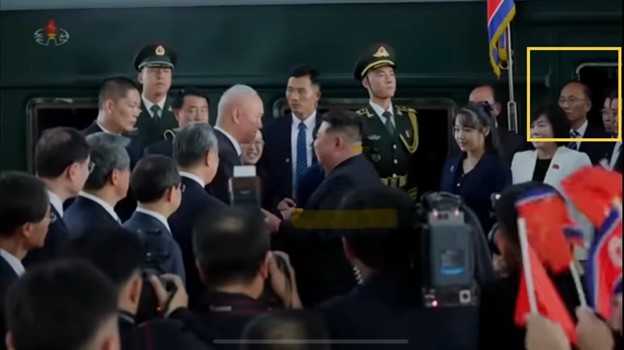
Amid these tensions with party elites, Ju Chang Il, the Workers Party of Korea (WPK) Propaganda and Agitation Department (PAD) Director, has risen to the ranks of KJU’s close aides by accompanying KJU to Beijing.[3] Despite being on the trip, Ju was one of two members of KJU’s travel party that did not attend the Xi meeting.
Context and Implications
PAD Director Ju Chang Il has become a core elite in the WPK in a year of headwinds for North Korean elites.
When Ju’s predecessor, PAD Director and WPK Secretary Ri Il Hwan, went missing in January 2025, Ju assumed Ri’s ceremonial role at public events.[4] Initially, it appeared Ju was a temporary surrogate until Ri returned to office. However, going to China and being in the train meeting room with KJU shows Ju is involved in strategic advice and decision-making.
Ju Chang Il has not assumed Ri Il Hwan’s slot on the Secretariat. Traditionally, the PAD director has concurrently held Secretariat status. However, Ri’s portfolio on the Secretariat was divided between the PAD and workers’ and social organizations. The PAD was added to Ri’s portfolio in 2023. It is highly probable that the Secretariat-PAD divide will be resolved at the Ninth Party Congress.
Kim Jae Ryong Brings Personnel Discipline to Beijing
Kim Jae Ryong, WPK Disciplinary Investigation Departments Director, traveled to China with KJU but did not make any observed public appearances. Kim’s presence on the trip was publicized in a state media report on KJU’s return to the DPRK.
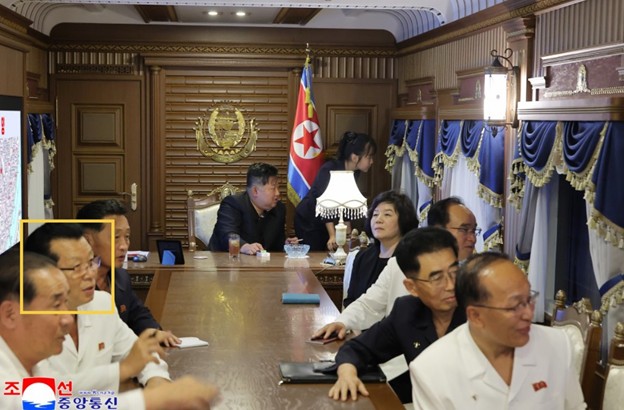
Kim Jae Ryong was the second WPK official involved in personnel affairs to go on a foreign trip in 2025, after Ri Hi Yong, WPK Secretary and Director of the WPK Cadres Affairs Department, led a delegation to Russia in February. While their overseas roles and position may diverge, it is notable that the Party’s top two personnel managers went on foreign trips this year.
Context and Implications
Sending party personnel managers on foreign visits is probably a concerted effort to ensure effective implementation of any agreements North Korea makes with Russia and China. One way to do this is by having loyal and effective management to mitigate graft and malfeasance that have previously ailed North Korea’s bilateral relationships. It indicates Pyongyang might be adjusting its network of overseas managers to ensure effective bilateral ties with Russia and China.
- [1]
“DID Cracks Down on Cadres,” NK Leadership Watch, February 10, 2025, https://www.nkleadershipwatch.org/2025/02/10/did-cracks-down-on-cadres/.
- [2]
“North Korean Leadership through Strategic Revolving Doors,” 38 North, April 24, 2025, https://www.38north.org/2025/04/north-korean-leadership-transitions-a-strategic-revolving-door/
- [3]
PAD director is a core leadership position, but Ju did not publicly evince the usual access and influence of his predecessors prior to KJU’s recent Beijing visit.
- [4]
“Ri Il Hwan, where you at,” NK Leadership Watch, February 12, 2025, https://www.nkleadershipwatch.org/2025/02/12/ri-il-hwan-where-you-at/.