

The Incoherence of the Policymakers
Book Review: Fallout: The Inside Story of America’s Failure to Disarm North Korea
By Joel S. Wit. Yale University Press, October 28, 2025. 560 pp.
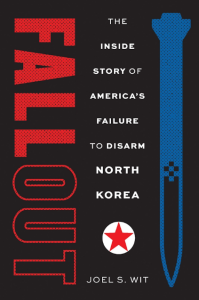 This encyclopedic and granular history of the US’ failures to engage with Pyongyang over the last third of a century maps all the substantive paths to peace ventured on the Korean Peninsula—the early cul-de-sacs, unsurmountable barriers, and fanciful false trails. We meet the kaleidoscope of workers on the US side and a broad range of the North’s negotiators and nuclear scientists. Stage left, with China and Russia, and stage right for the Republic of Korea, Japan and Europe, is sparsely populated, with their inhabitants restricted to playing bit parts and walk-ons.
Pyongyang could have been its own worst enemy; if not for Washington, and Seoul, and Tokyo, and even, on occasion, Beijing. This US game began in the early 1990s with a bid to halt and reverse the North’s initial efforts to produce weapons grade plutonium from its aging graphite moderated reactor. The zenith of US success was the Clinton Presidency’s 1994 Agreed Framework. Here—spending someone else’s money—Washington convinced Pyongyang to countertrade an immediate shutdown of its Yongbyon reactor and halt to the construction of two other larger reactors, in exchange for Washington facilitating the construction of two proliferation-resistant Light Water Reactors at a cost of $4.5 billion by 2003 and steps towards the normalization of US-DPRK relations.
The deal was strangled by Florida’s hanging chads, when George W. Bush won the US Presidency in 2000 by 537 votes and killed the deal with his ‘axis of evil’ State of the Union in 2002. It has been a roller coaster ride ever since, with gentle ups balanced by more brutal downs. Each American victory has been more pyrrhic than the last. In less than two generations, North Korea has gone from furtive plutonium reprocessing to a fully-armed nuclear state closing in on the capacity to strike the mainland United States. Washington, schooled by the Soviet Union’s extensive testing, failed for a long time to appreciate that the North’s staccato nuclear testing—closer to Beijing’s model—hides progress outside the feel of the West’s seismometers. Joel Wit, Distinguished Fellow in Asia and Security Studies at the Stimson Center and former implementation coordinator of the Agreed Framework, paints a pointillist picture of all this history across a short 400 pages in Fallout: The Inside Story of America’s Failure to Disarm North Korea.
Fallout has running through it a sundry of intertwined themes that can be assembled from Wit’s component parts, some highlighted by the author and others hidden in the undergrowth. Few would dispute the notion that there was no solution to the nuclear crisis whose unfolding would take a decade and more, unsuited to the pulse of US politics measured in four- and eight-year blocks of time. The increasingly toxic polarization and the absence of bipartisanship in Washington doom each fresh President to undo the work of his predecessor before starting anew. If the Clinton–Bush transition was bad, Bush–Obama and Trump–Biden were little better. But the Obama–Trump transition was different. Obama’s first term saw the illusory Leap Day Agreement between Pyongyang and Washington which, after it vanished like the mirage it was, saw the Administration retreat to malign neglect, leaving Obama at his exit to sound the warning to Trump. Trump’s problem in his first term was of his own making. While his adventures in engagement faced no Republican public condemnation, backstage John Bolton was only the tip of the spear with other senior Administration figures almost as eager to rein in Presidential ambitions.
Another handicap was US narcissism and overreach, often predicated on neo-liberal fairy tales from the Beltway. Negotiations were all American demands and few American offers. Pyongyang never had any interest in denuclearization, save in exchange for tangible returns, but after the death of the Agreed Framework, the table was bare. There was sharply asymmetric irreversibility: irreversible steps demanded of Pyongyang but not matched by Washington. Attempted deals on nuclear testing were stretched beyond breaking point, as they were misread to cover both weapons production and missile launches. When Pyongyang made it clear you only get what is in the box, absent any ‘happy hour’ two-for-one offers, the US pronounced bad faith.
Two of the encoded issues in Wit’s writing that bedevil North Korean negotiators, are civil nuclear power and free-ranging inspections. The first driven by economics and the second experience. For the North, right back to Kim Il Sung, civil nuclear power has been a touchstone of modernity and strength. It is the perfect technology to deliver energy autarky for a North beset, as it is, by the bottleneck of energy shortages. Moreover, Pyongyang is capable of delivering the full fuel cycle for Light Water Reactors. It was no accident that they were top of the North’s shopping list within the Agreed Framework negotiations. Since then, Washington has fiercely resisted putting them back on the table, leaving Pyongyang to its own devices. But for the North to go it alone it needs domestic uranium enrichment, thus explaining that one red line in Hanoi for Kim was Trump’s demand that the North surrender not just the enrichment plant in the Yongbyon complex but, in addition, the second in Kangson, abandoning both military and civil nuclear capabilities.
Equally, Pyongyang’s fierce resistance to ‘at large’ inspections is a product of institutional memory. It’s the reason why the North’s offer in Hanoi was the whole of the massive Yongbyon site with its multiple nuclear facilities, likely including its Nuclear Weapons Institute—the North’s equivalent of Los Alamos—but nothing outside its grounds. Between 1945 and 1947, the head of the Allied Reparations Committee, American Ambassador Edwin Pauley, trailed his group across the north of Korea to verify that the Soviet Union’s depredations did not exceed their mandate. While the Soviets weren’t cheating, Pauley conveniently ended up with detailed maps of the locations of the north’s heavy industry that were to prove invaluable to America’s Bomber Command with the coming of war. A lesson seared in Pyongyang’s institutional memory.
Wit sees this whole history as Paradise Lost, serial missed opportunities, meaning those in Washington responsible for this dereliction were and are complicit in the emergence of a dangerous nuclear power in Northeast Asia that threatens to destabilize the whole region and beyond. He identifies the blessed, anoints Saints, and names two classes of sinners: those guilty by commission and those by omission. The latest communion includes in the frontline Steve Biegun, Trump’s first term Special Representative for North Korea, Vincent Brooks, who commanded United Nations Command in Korea 2016-19, and Jeffrey Feltman, who as UN Under-Secretary for Political Affairs carried Trump’s offer to engage to Pyongyang in late 2017. Behind the scenes it’s Sig Hecker and Bob Carlin, with the latter’s perfect encapsulation of the Singapore Summit’s promise, ‘I don’t think we’re half done, but it was well begun.’
The sinners are a multitude. At the Presidential level it’s George W. Bush, Obama and Trump. The first murdered the Agreed Framework, the second’s malign neglect allowed the North to surge forward with its nuclear and missile capability and capacity, and Trump spurned the prospects of Singapore in Hanoi, snatching defeat out of the jaws of victory. Made all the worse, when given a second chance with his serendipitous third meeting with Kim on the DMZ, he allowed Bolton, Pompeo and Mattis to go back on the promise he made to Kim Jong Un to cancel the forthcoming Joint Military Exercises with the South.
What is missing, if anything? Accepting it is written as an American-centric story there can be little complaint from Seoul, Tokyo or Brussels, Beijing or Moscow. But that taken, on the North Korea side we do miss the Party. This—particularly after Kim Jong Un came to power—is a regime where the Ministry of Foreign Affairs (MFA) is subservient to the International Department of the Party, the United Front Department and the Korea Asia-Pacific Peace Committee. After Hanoi, those in both institutions were benched. Choe Son Hui did manage a comeback and a promotion in the MFA; almost as importantly, Kim Yong Chol returned as an Advisor in the United Front Department.
Fallout will be a quarry that will be heavily mined over decades to provide the foundations for many varied takes on this history. As the William Faulkner epigram from Requiem for a Nun here at the head of the first page, says, ‘The past is never dead. It’s not even the past.’ Wit is ensuring we are fully supplied with the ammunition for future battles on this issue, foreign and domestic, to come.