

South Korean Nuclear-Powered Submarine Plan: Unpacking China’s Moderate Reaction
 On October 29, President Trump announced that the United States will share nuclear propulsion technologies with South Korea and allow its navy to build at least one nuclear-powered submarine. Since then, the policy community has been trying to assess the feasibility and risks of this development, especially whether China will adopt a punitive approach toward South Korea as it did in 2016 after South Korea’s decision to deploy the terminal high altitude area defense (THAAD) system.
Surprisingly, China’s reaction to the announced plan has been mild so far, especially compared to China’s reaction to AUKUS when it was first announced. Three factors have contributed to the lack of severe reaction from Beijing, including the lack of prior knowledge and the awkward timing, the consideration for a positive relationship with the new Lee Jae Myung administration, and the perceived major differences from AUKUS. However, it should be noted that the situation is fluid and could rapidly change.
China’s Mild Official Response
The most official response from China to the nuclear sub announcement came from the Chinese Foreign Ministry on October 30. It was a relatively mild response: “China has taken note of the related development and hope U.S. and South Korea will loyally observe their nonproliferation obligations and engage in activities conducive to regional peace and stability, rather than the opposite.” On November 17, while answering a direct question about US Chief of Naval Operations Adm. Daryl Caudle’s comments on how a South Korean nuclear submarine could be a “global asset” and that countering China remains a top US priority, the Chinese Foreign Ministry spokesperson maintained a relatively low-key tone: “China has clearly expressed its position multiple times and wishes for U.S. and South Korea to handle related affairs with caution.”
The tone of the position is significantly more moderate compared to the Foreign Ministry’s reaction to AUKUS back in September of 2021 when it was first announced. On September 30, 2021, then-Foreign Ministry spokesperson, Hua Chunying launched severe attacks on AUKUS for its “grave risks of nuclear proliferation, obvious violation of the spirit of The Treaty on the Non-Proliferation of Nuclear Weapons (NPT), profound impact over international nonproliferation regime and realistic threat to regional peace and stability.” Wang Yi at the time also criticized AUKUS for its potential damages to the region in five different angles: nuclear proliferation, arms racing, regional tensions, regional bloc politics, and undermining the nuclear-free zone in Southeast Asia. Hua further pointed out that AUKUS served the US Indo-Pacific strategy and attempted to create an alternative order in the region.
Since then, China’s opposition to AUKUS has been consistent. One week before President Trump’s announcement on the nuclear-powered submarine for South Korea, the Foreign Ministry reiterated its “opposition to the camp confrontation, nuclear proliferation risks and intensified arms race” embedded in AUKUS.
The Differences Between South Korea’s Nuclear Submarines and AUKUS
The sharp contrast of China’s moderate response to the South Korea nuclear submarine and its intense criticism of AUKUS deserves scrutiny. Regional relationships could be a factor. At the time AUKUS was introduced in 2021, China had very different relationships with the key countries involved in AUKUS. By September 2021, US-China relations were in a deeply hostile state while by October 2025, China is looking at great “stabilization” of ties with US, hoping for a transactional relationship with President Trump. In September 2021, China also had strained and troubled relationships with both conservative governments in Australia and in the UK; while by October 2025, China has been hoping to maximize its improvement of ties with the progressive Lee Jae Myung government in South Korea as Lee begins his five-year presidential term.
It is also noteworthy that Chinese industry specialists have discussed in detail the technical differences between the two arrangements, which appear to be at the core of China’s rather different assessment of the South Korean submarine deal in comparison to AUKUS.
In terms of the legal arrangement, China sees AUKUS as exploiting the exception clause of the NPT and relying on IAEA safeguards, while the South Korean deal depends on its 123 Agreement for US-South Korea civil nuclear cooperation. The word “civil” carries significance here, as China sees AUKUS as a direct transfer of nuclear technologies and an expansion of the US security alliance, while the South Korean deal is more of an “economic investment deal” to cultivate President Trump’s favor.
More important are the technologies and nuclear materials involved. China sees AUKUS as a much graver concern due to the direct transfer of weapon-grade uranium to Australia, while the South Korean submarine is expected to utilize small modular reactor (SMR) technologies that will produce low enriched uranium and carries much less risk for proliferation of nuclear weapons. As such, AUKUS is defined as direct proliferation of nuclear materials while the South Korean nuclear submarine is seen as controlled proliferation.
In this sense, not all nuclear-powered submarines are created equal. The South Korean plan is less problematic, at least for now, based on information available, because it does not touch the red line of weapons-grade nuclear materials and associated designs and technologies. South Korea already has well-developed SMR technologies, and the plan to build the submarine in the United States presents the arrangement more as an economic transaction than a true expansion of the US-ROK security alliance.
Awkward Timing for China
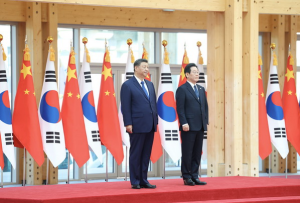
While these technical specifications came later, a key factor that affected China’s immediate response to the announcement is the timing and sequence of the events leading up to the announcement about the nuclear submarine. Xi’s state visit to South Korea was scheduled for APEC, and the nuclear submarine issue had not been on China’s radar prior to the trip. The recent turbulence in US-ROK relations—regarding tariffs and the Hyundai workers—had further created the impression that the US was not planning any significant upgrade of relations with South Korea.
As such, the announcement by Trump took place around 6 pm ET, October 29, which was 7 am on October 30 in Seoul. That was only a few hours before Trump’s meeting with Xi, and the Chinese did not have time to work this particular detail into the meeting before weighing its details and implications. Apparently, this detail was not included in Xi’s meeting with President Lee on November 1, either.
But China does feel played by South Korea given the timing and the trip arrangement, as it did not have the time to adequately assess and respond before the decision was shoved down its throat. By the time the announcement was made, Xi was already in South Korea. With meetings scheduled with Trump and Lee, the Chinese did not feel they could, or should make a scene in the meetings arranged. They also felt played because there had been no indicator from Seoul that the announcement about the nuclear submarine was going to happen. Although South Korea has been complaining to China about North Korea’s growing capability for years, the Chinese are used to the complaint and consistently and habitually ignore them.
Considerations for Sino-ROK Relations
While the Chinese feel Seoul exploited the opportunity offered by APEC to trap China in a difficult situation, Beijing’s desire to maintain a relatively positive beginning of relations with the new Lee administration is obvious. President Lee Jae Myung is only a few months into his presidency, and Beijing appears to want to avoid a hostile beginning that would sour the overall atmosphere of bilateral relations for the remainder of his term. This consideration reflects a pattern of China’s higher level of accommodation of perceived transgression by new South Korean presidents. In the early months of former President Yoon’s time in office, China also toned down its reactions to Yoon’s public positions on the peace and stability of Taiwan Strait, which are always seen by China as targeted against China’s refusal to abandon use of force for its unification.
In China, there is a view that a progressive South Korean government will be more China-friendly than a conservative one, so the Lee presidency is viewed as an opportunity. This partially explains why the Chinese narrative of the nuclear submarine focuses on the transactional nature of the deal between an investment-thirsty US and a nuclear submarine-thirsty South Korea. This same narrative has made very little reference to the deal’s implication for China’s near-term national security, most likely because the agreement is not viewed through that lens, at least for now.
The spat escalating between China and Japan since the APEC Summit, due to new Japanese Prime Minister Takaiichi’s comment on Japan’s potential intervention in a Taiwan contingency, further amplified the importance of trying to influence Seoul’s potential alignment with China. Within Northeast Asia, South Korea’s delicate balance of relations between China and Japan is always seen as a priority issue for China.
Future Chinese Reactions
Just like China was unable to force South Korea to abandon its deployment of the THAAD system, options are limited for China to effectively reverse the Korean and American decision about the nuclear submarine. China had engaged in a lengthy campaign to shape South Korea’s decision to deploy the THAAD system before 2016. Frustration over its failure led to China’s harsh reaction to and economic sanctions on South Korea. As Beijing has not engaged in a significant push and pull with South Korea this time around, it is unlikely to react as severely, for instance, by imposing economic sanctions.
However, as South Korea’s largest neighbor, trading partner, and potential security challenge, China maintains leverage over South Korea. In the Chinese view, South Korea exploited China and its timing of scheduled diplomatic events in South Korea. Beijing sees Seoul’s logic in addressing the North Korea security threat, but does not accept their reasoning on how this decision could push China to act more assertively against North Korea. In China’s view, any strengthening of South Korea’s security ties with the United States will only push China closer to North Korea. As a result, China will potentially be less restrictive the next time Pyongyang pushes Seoul around. This is the dilemma of South Korea’s national security strategy.
As more details about the deal emerge, particularly on its technical specifications and potential implications for the proliferation of nuclear weapons, Beijing could develop a more adamant and punitive response.