

Yongbyon Nuclear Scientific Research Center: Modernization and Expansion in 2025
Commercial satellite imagery of North Korea’s Yongbyon Nuclear Scientific Research Center from October and November 2025 shows continuation of modernization and expansion efforts throughout the site. Yongbyon plays a critical role in the country’s production of nuclear material for its weapons program, as the sole producer of plutonium and a significant source of enriched uranium.
During his visits in January 2025 to nuclear weapons related institutes, Kim Jong Un characterized the current year as a “crucial year” for “bolstering up the nuclear forces” and emphasized the need for “overfulfilling the plan for producing weapons-grade nuclear materials.[1] Activity over the course of 2025 reflects these directives, including: consistent operation of the 5 MWe Reactor since January, ongoing pre-operational testing of the Experimental Light Water Reactor, a probable reprocessing campaign over the summer, and construction of probable new enrichment and waste storage facilities. These improvements all serve to help fulfill Kim’s call for exponential growth of its nuclear weapons arsenals.
Construction of Possible Additional Enrichment Facility
The suspected uranium enrichment site northeast of the radiochemical laboratory (RCL)—and its surrounding area—has become the most active since the start of 2025. As reported in June, a large, at least two-story building with a hall in the middle, measuring approximately 120 meters by 47 meters—comparable in footprint, construction design, and security level to the suspected facility at Kangson—was constructed 500 meters northeast of the RCL.
The main building was completely enclosed and roofed by June, but other support buildings within the compound remained incomplete. By October 22, imagery showed that the exteriors of two support buildings in the eastern part of the complex were complete. A vehicle shed was added nearby another, and an enclosed passageway now joins that building with the main building. Concrete paving has been added around these buildings, and the slope within the compound has been terraced.
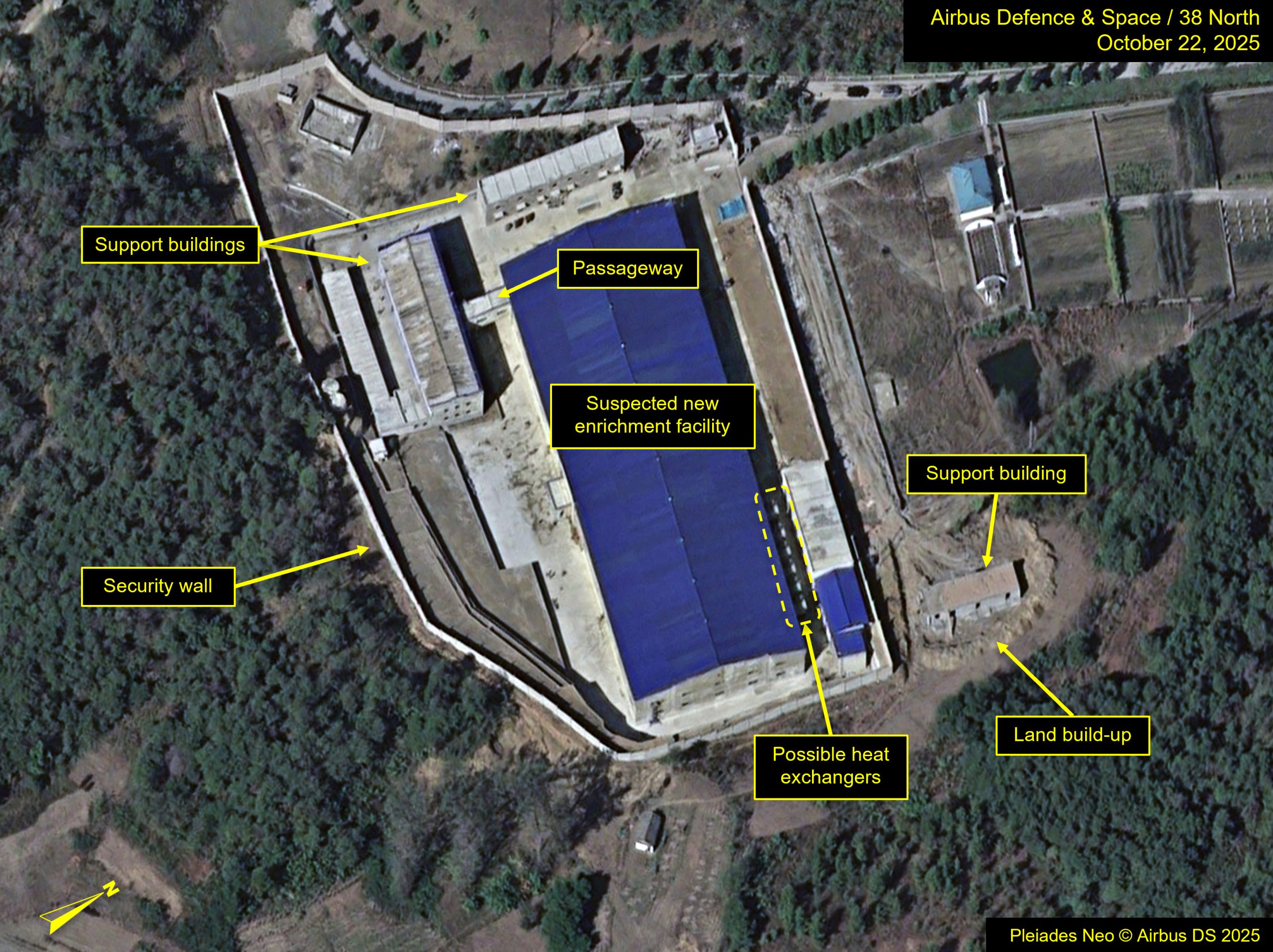
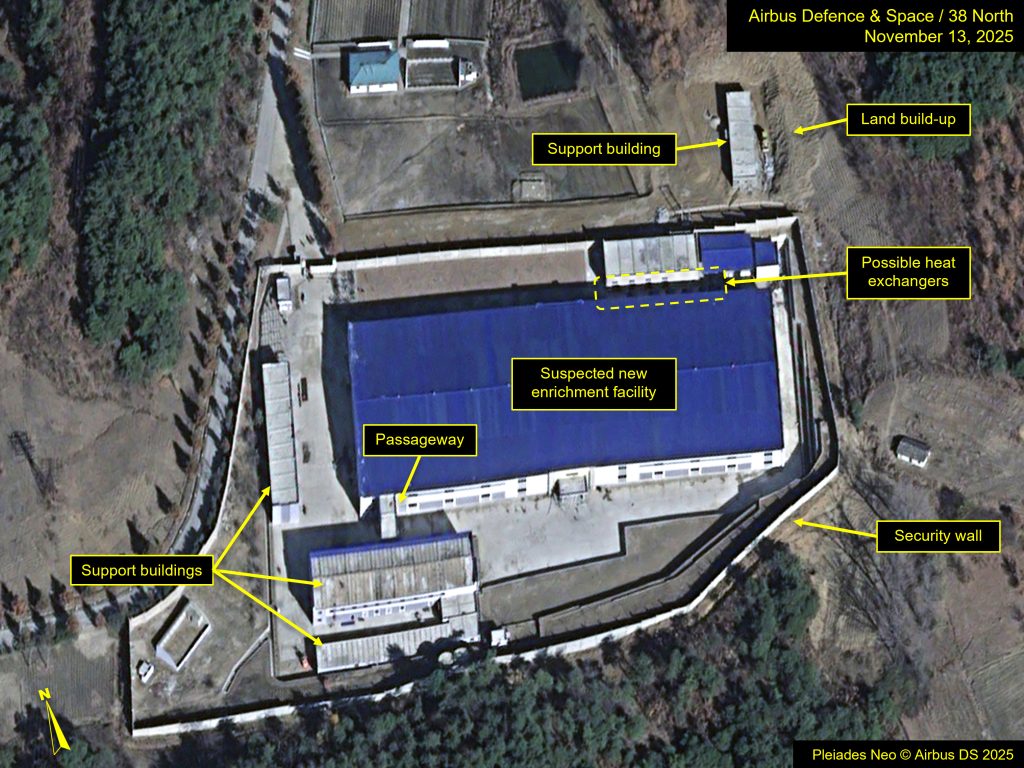
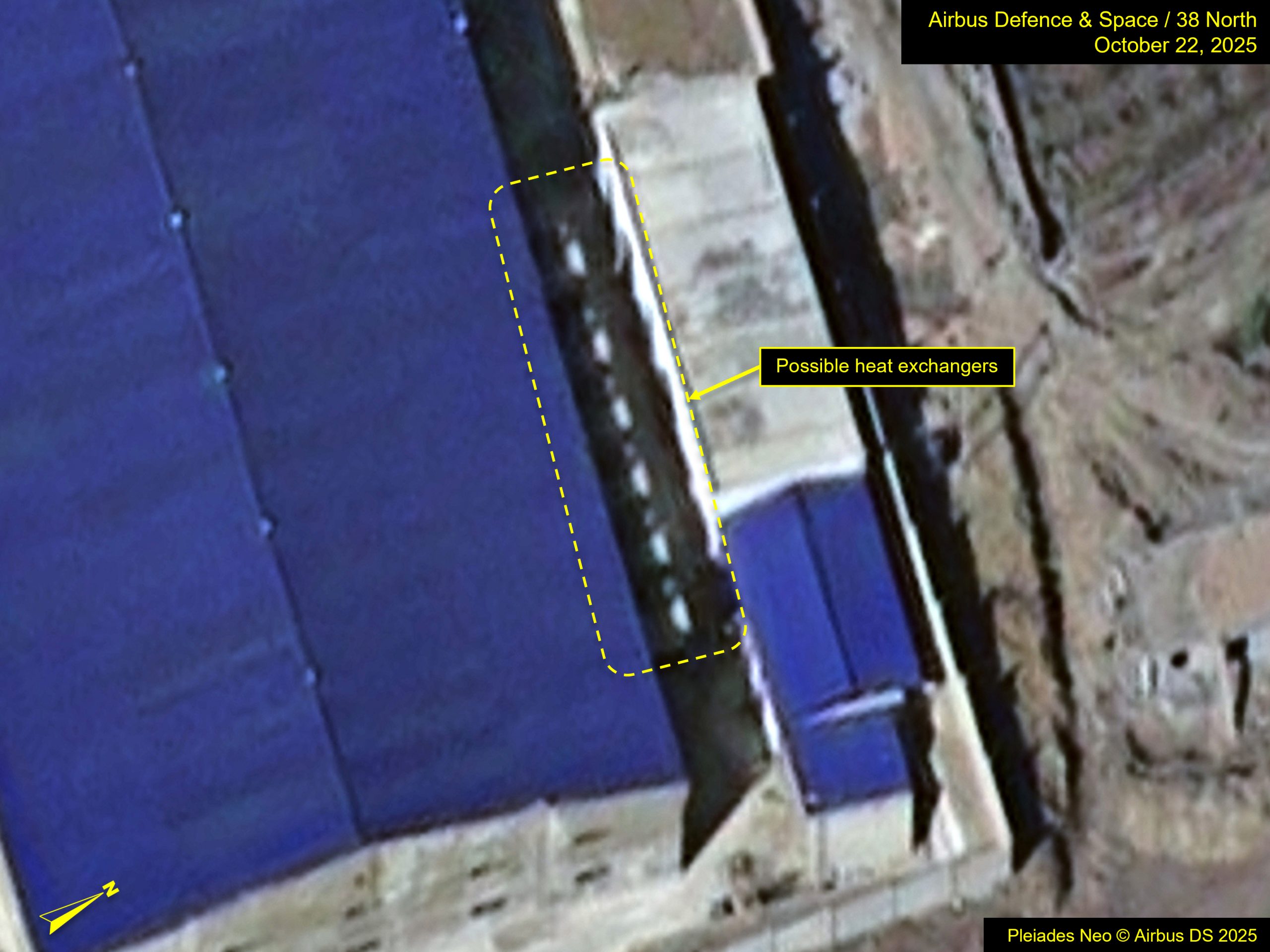
Since September, a series of six possible heat exchangers has been installed along the southeast side of the main building. Heat exchangers are required to cool centrifuges and maintain controlled temperatures inside the building. Other equipment appears to be outside the building. Together, these objects indicate it is likely that work to complete the interior of the main building is still underway.
Work to build up land surrounding a support building to the south of the suspected uranium enrichment site appears to be underway. The purpose of this building is unknown.
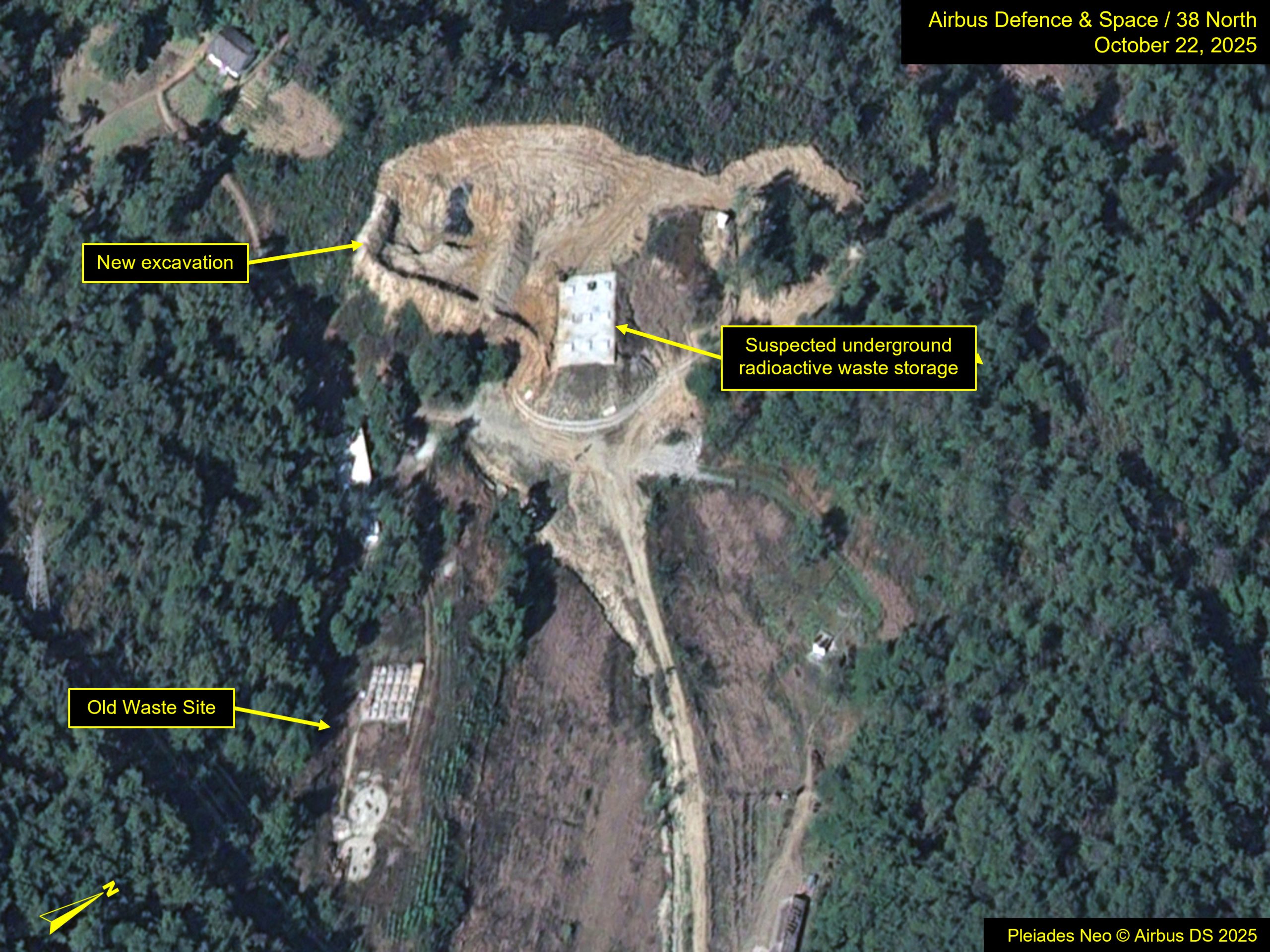
Work on a semi-buried radioactive waste storage facility continues near the Old Waste Site. Imagery from June 11 revealed the construction of a concrete building, measuring approximately 20 by 12 meters, with nine hatches on its top, similar to those of other waste sites. October imagery shows earth covering the sides, leaving only the top exposed. Immediately to its west, excavation is underway for what may be yet another underground storage vault. An expansion of waste storage capacity is in line with Kim Jong Un’s directive to increase nuclear material production.
A new administration or support building has been built in an area previously occupied by a farming and agriculture building compound. Seen in its early stages of construction in June, imagery from October 22 shows grading and ground-leveling activity.
The Reactor Area
Based on available imagery, the 5 MWe reactor has been operating since October 2024, even while the building’s roof was resealed or replaced and the exterior walls painted between April and August of 2025. The roofs and exteriors of buildings associated with the 5 MWe were repainted or refurbished, as well. In addition, minor construction on the east side of the main building has also been ongoing. Imagery from October 22 shows piles of sand or aggregate visible along the east side of the building, and new excavation—approximately 20 by 20-meters—has begun across the road. While the purpose of the excavation is unclear, it may be preparation for a new building foundation. Imagery from November 13 reveals construction of high wall docking bays outside of the 5 MWe shipping and receiving area. On November 18, two of the bays had received headers, suggesting they will have individual entrances and likely eventual roofs. Their function—and whether or not they will be roofed—is unclear.
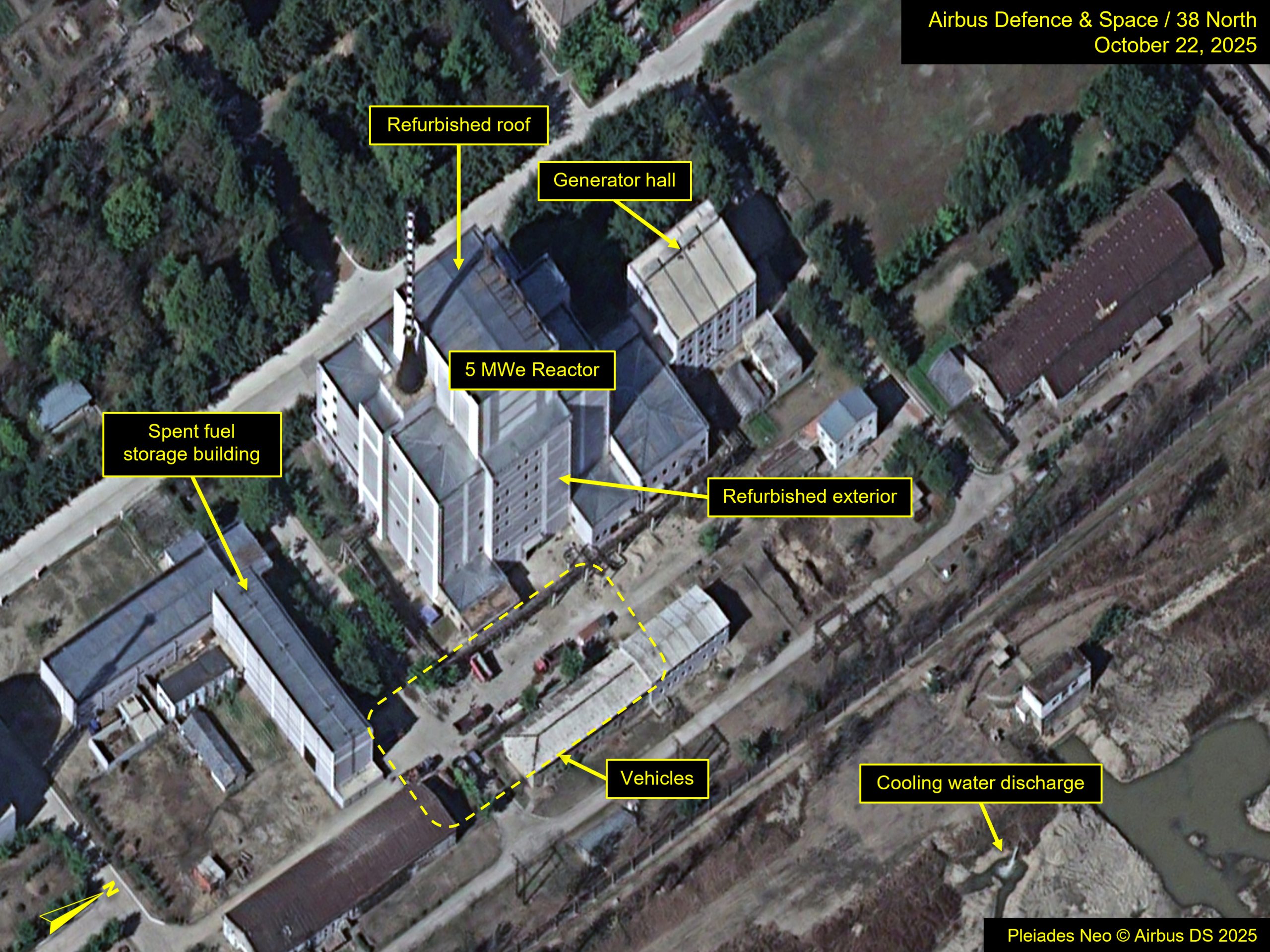
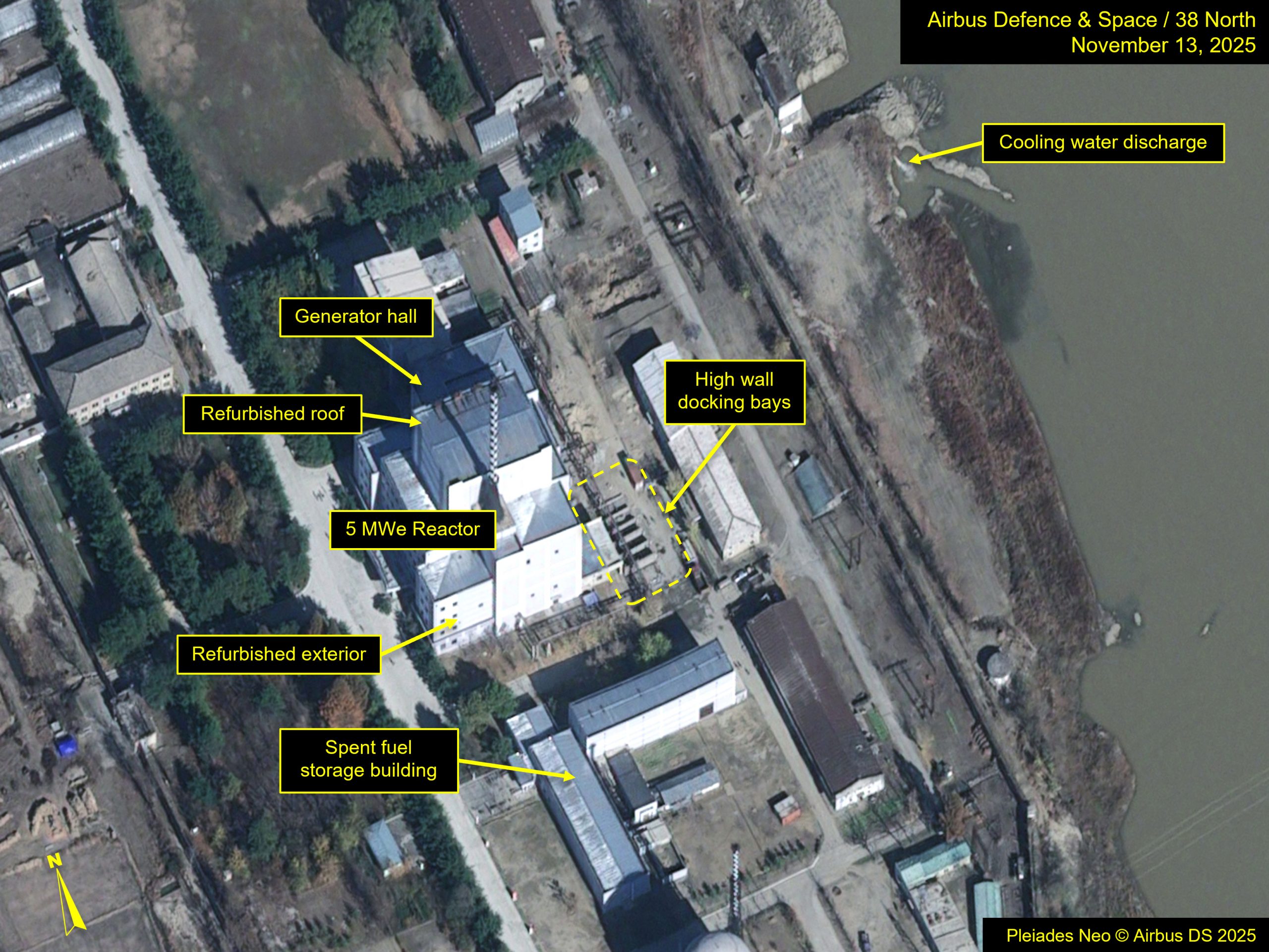
The exterior of the experimental light-water reactor (ELWR) has remained unchanged. Of the group of three large support buildings located just outside the security wall, the largest has been painted red since June. The ELWR continues its pre-operational testing prior to startup with a nuclear fuel load, marked by periods of flow stoppages of cooling water outflow from September-October 2024 and November 2024-April 2025, as indicated by water discharge into the Kuryong River. In June and July 2025, discharge was observed, but imagery throughout September and October shows discharge had ceased again. Discharge was observed again on imagery from November 13. This pattern indicates that the reactor is likely still at the pre-operational testing stage.
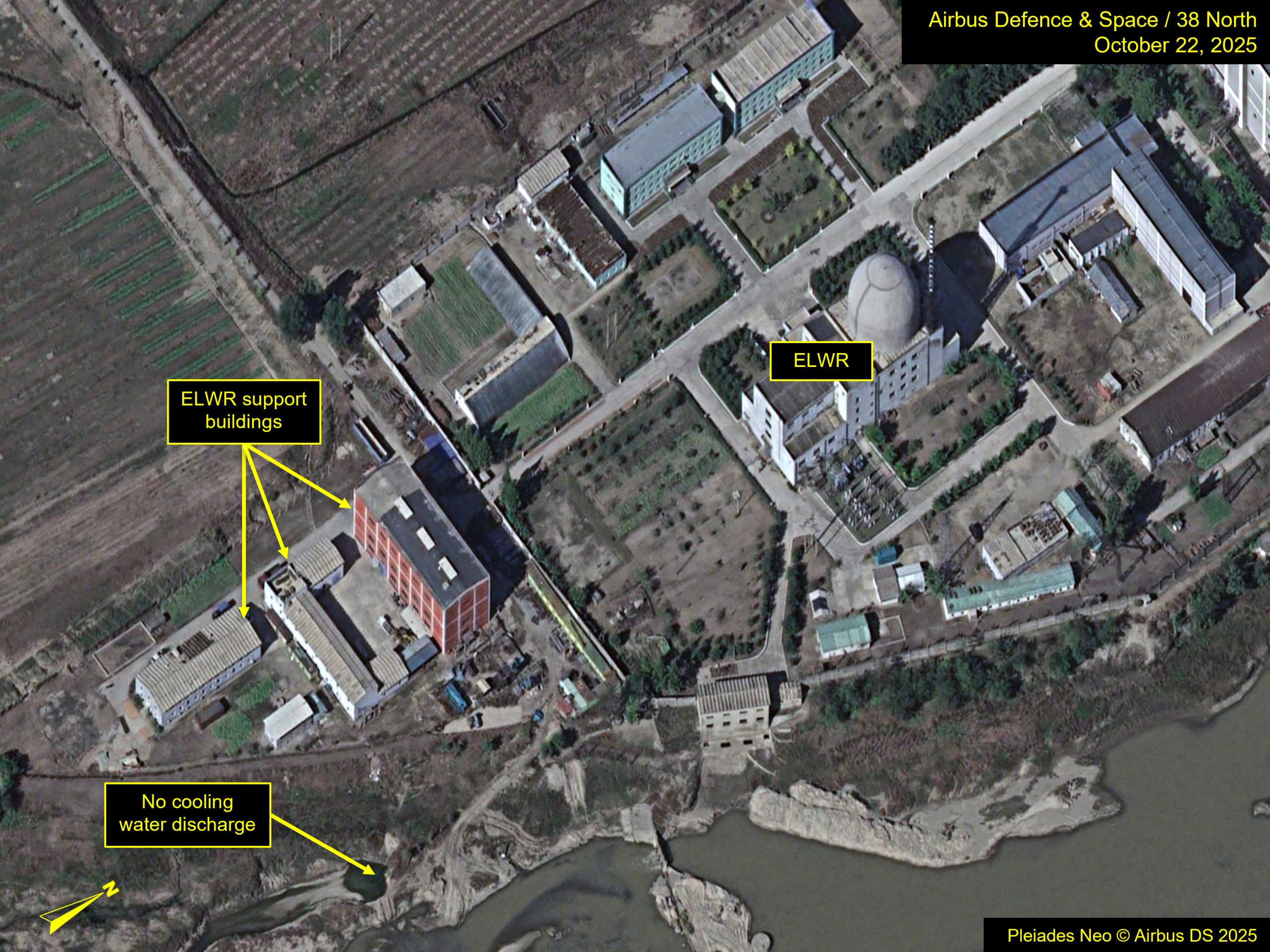
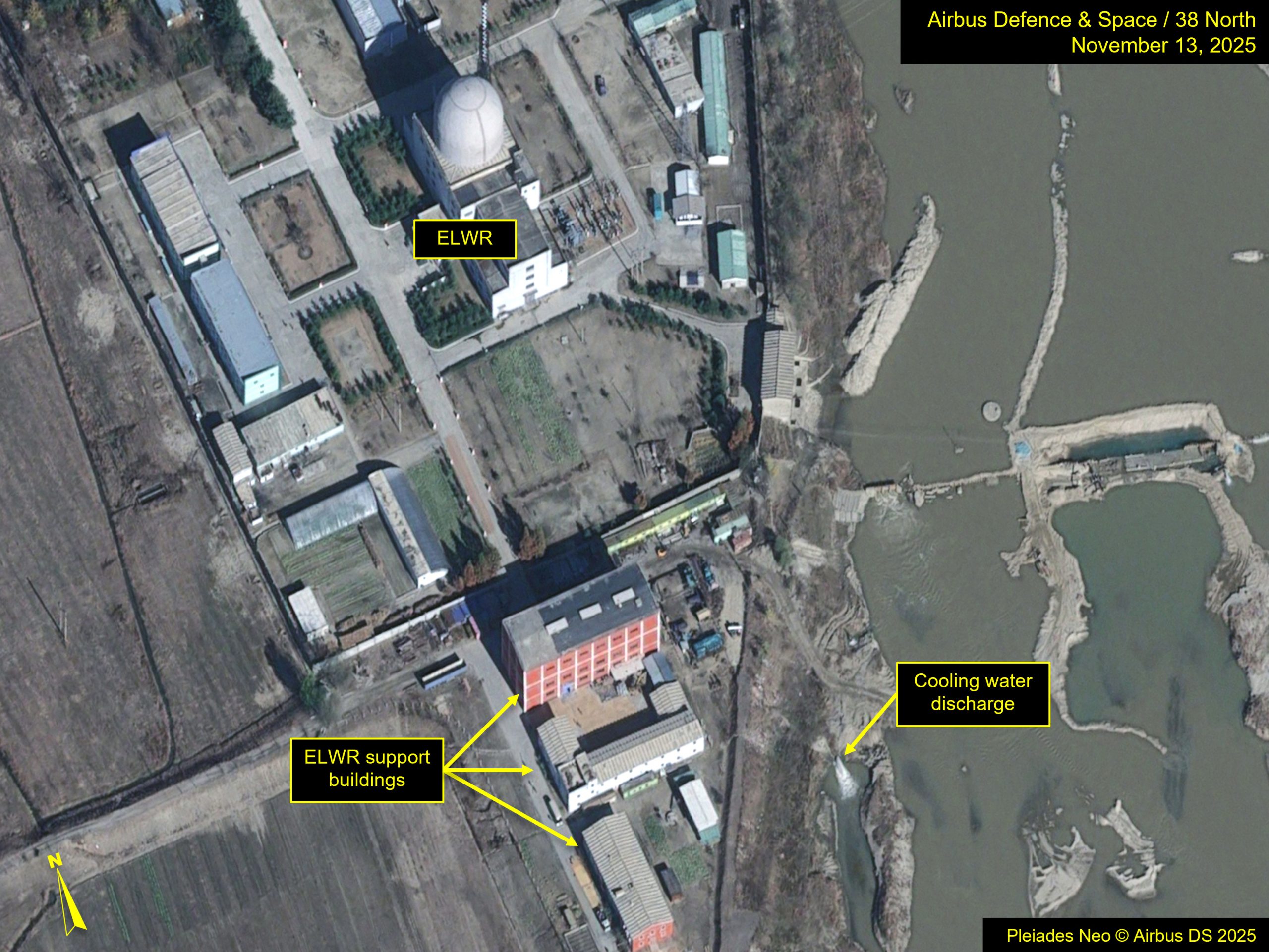
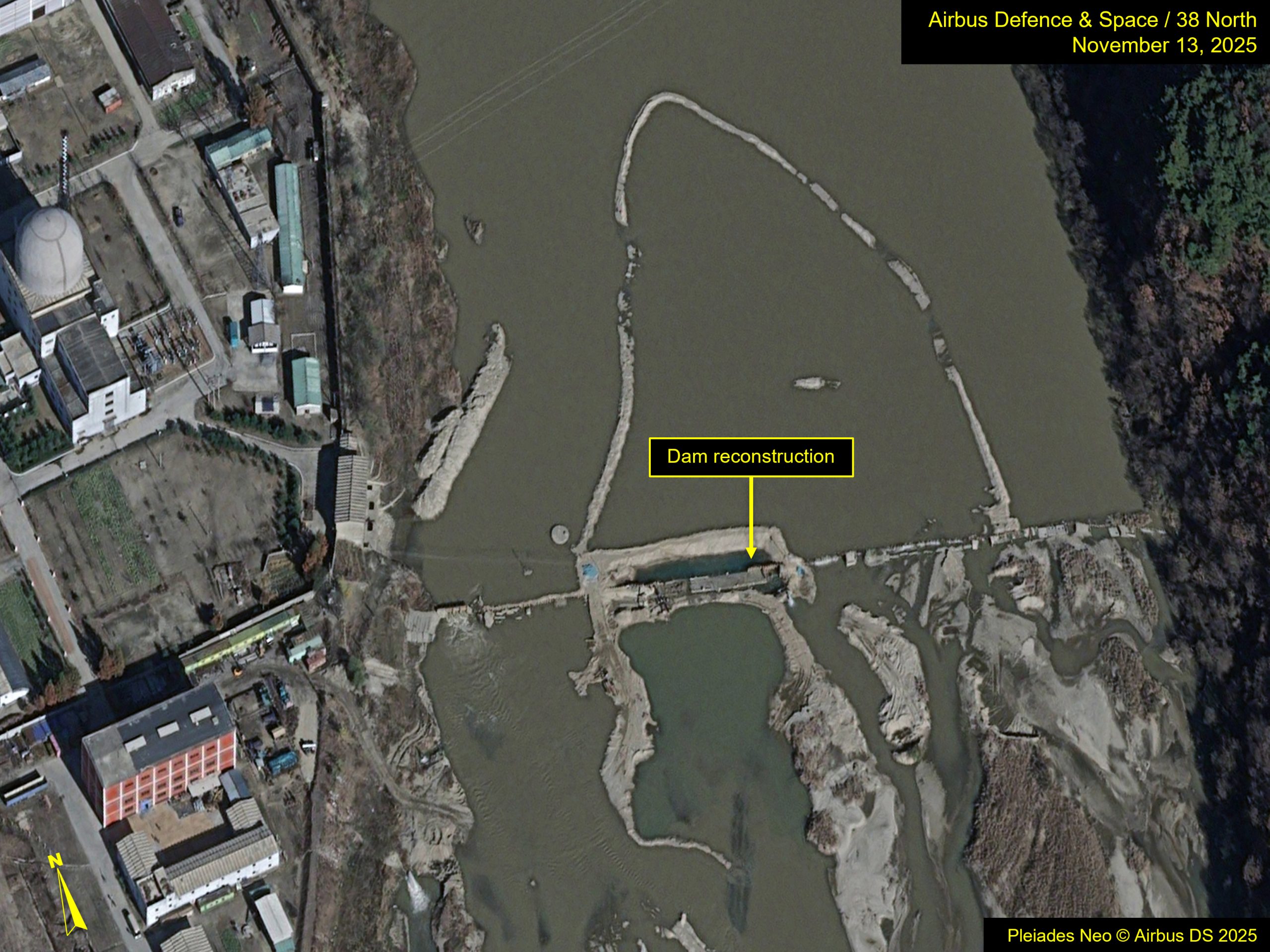
Heavy rains and flooding in July and August breached the overflow dam in the Kuryong River near the reactor area. The dam was designed to provide a consistent water depth above the dam to ensure the reactors received sufficient cooling waters, allowing for spillover when the river rises above a certain level. When the river is low, the water is directed toward a sluice located on the west end of the dam. To recover the ability to control the water level, a temporary, earthen levee was first extended into the river above the old dam in mid- to late-September. Imagery from November 13 reveals efforts to build a sturdier dam are underway. It appears the new design will be a more fortified overflow dam capable of withstanding seasonal flooding. However, the flooding does not appear to have interrupted reactor operations.
Uranium Enrichment Plant (UEP) and Conversion Facilities
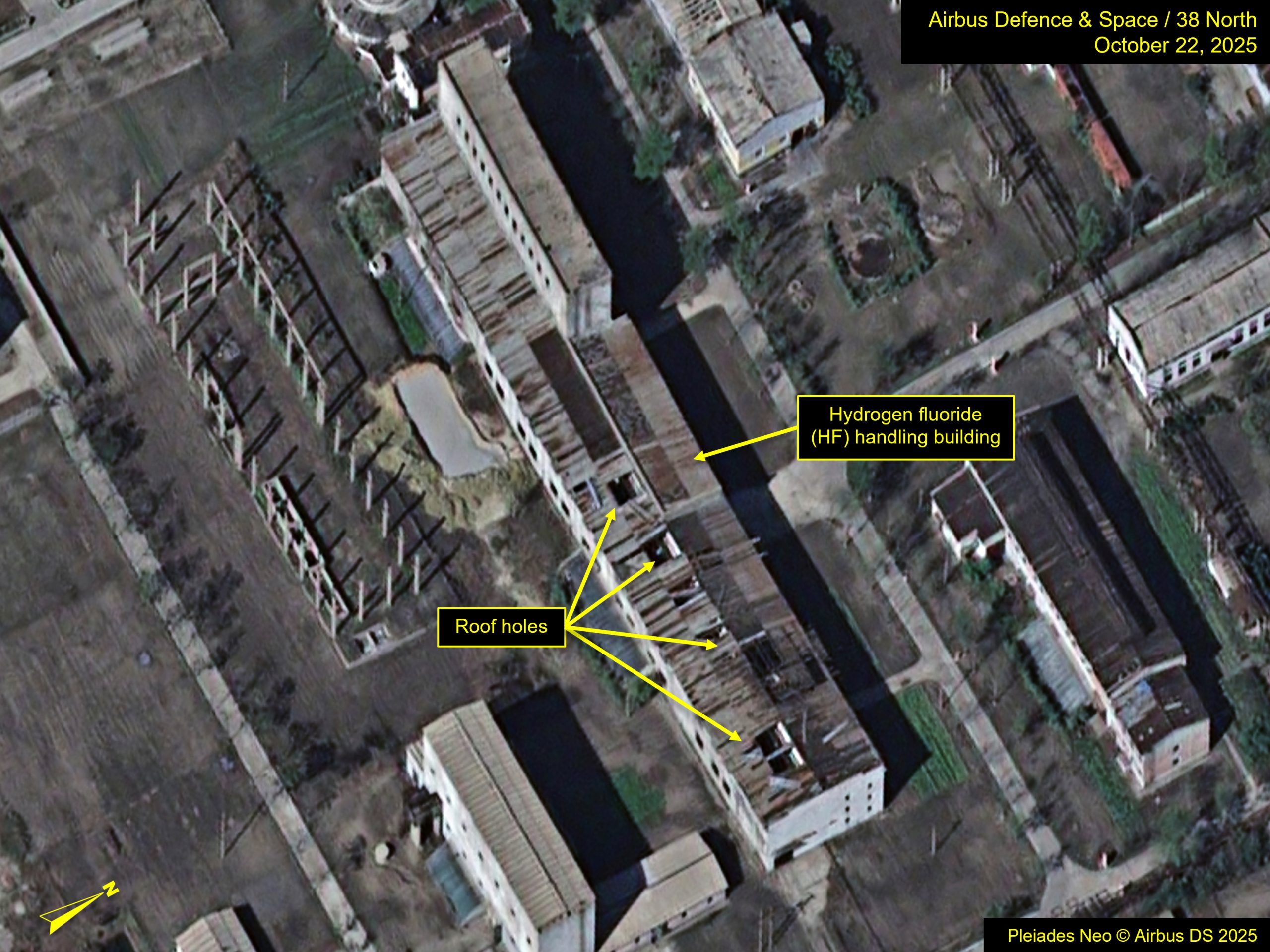
Over the last six months, the UEP and conversion facilities area have seen very little change, likely due to the significant refurbishment and expansion efforts in the last three years. However, imagery from October 22 shows the possible hydrogen fluoride (HF) handling building, a 150-meter structure and integral to activity at the UEP, appears to be next up for refurbishment. There had been one large opening in the east end of the roof since August 2020, but several more openings in the roof have been added, suggesting a complete or partial refurbishment—or dismantlement—is underway.
Radiochemical Laboratory (RCL)
Little activity has been recently observed within the RCL (reprocessing plant) compound. The thermal plant, which provides steam to the RCL, was emitting smoke throughout the spring, signifying its operation. The smoke ceased sometime after June, though the exact date is unclear due to inconsistent imagery. This suggests the reprocessing cycle has ended for the time being. The spent fuel reception building, which had been active with the regular appearance of vehicles during the spring, shows no signs of activity.
50 MWe
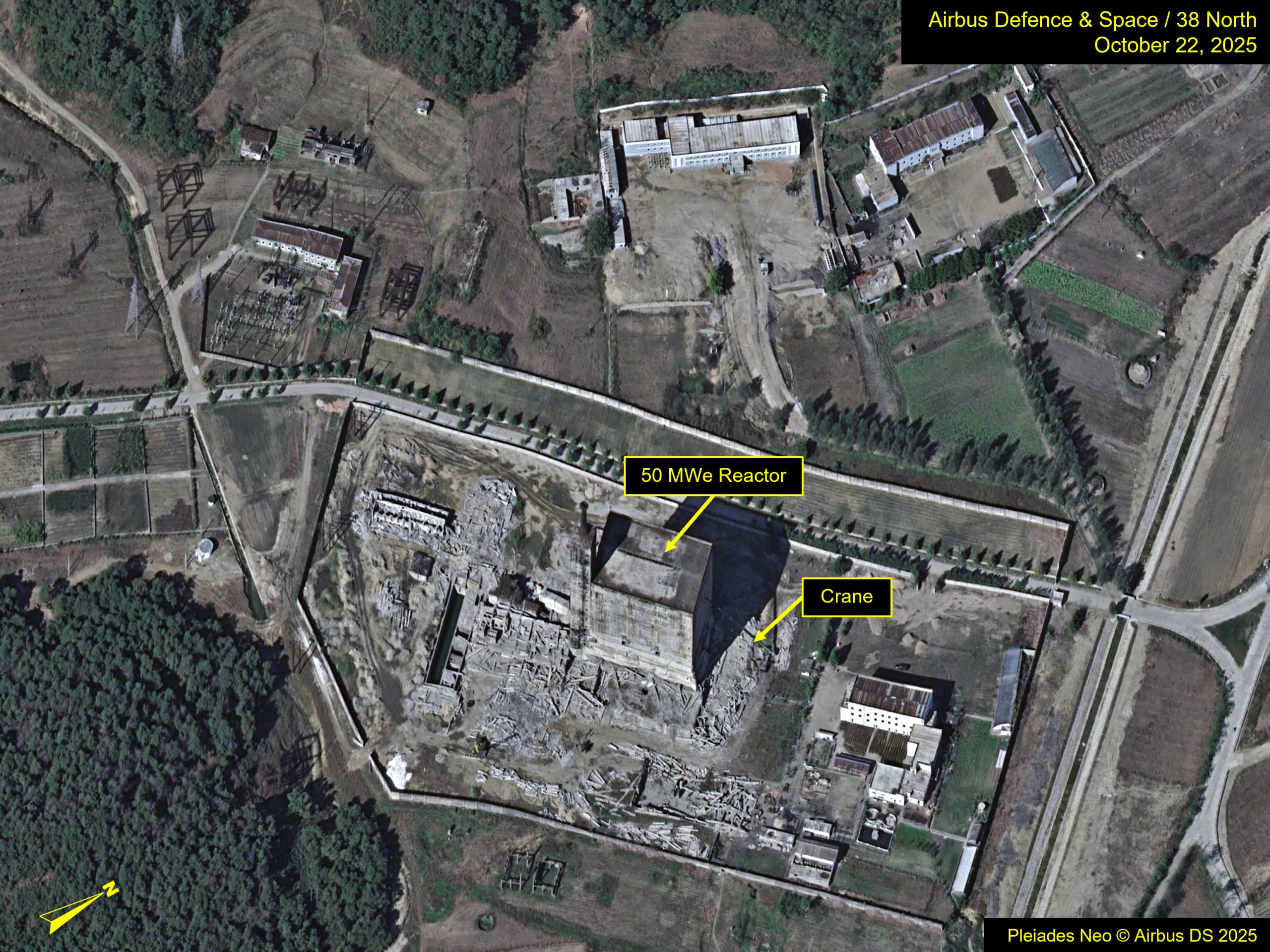
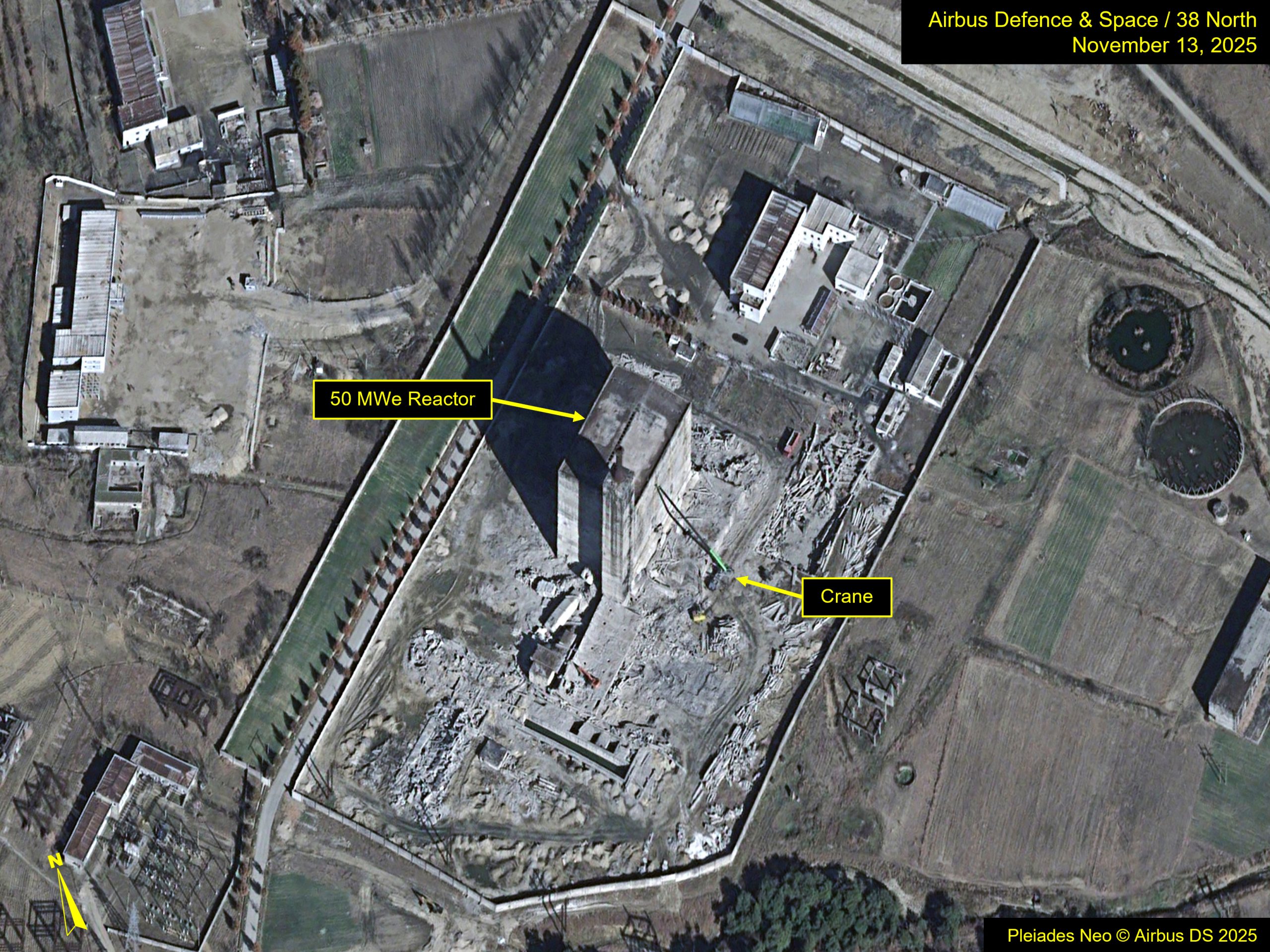
The 50 MWe reactor, located northwest of the RCL, was partially constructed when the Agreed Framework entered into force in 1994 and never completed. It has been gradually dismantled over the last several years, with some building materials reused in other projects around the Yongbyon complex. Razing began in earnest in June; now all that remains is the main reactor hall. Imagery from October 22 revealed a large mobile crane at the east side of the building with its boom extended toward the hall. The crane had moved to the south side by November 13. Its presence and movement suggests dismantlement of the remaining hall has begun.
Taming the River
Seasonal flooding of the Kuryong River has continued to plague Yongbyon due to the area’s low elevation and the winding river path. While efforts to shore up its banks has been ongoing for years, a concerted effort to better control the flow began following the back-to-back typhoons of 2021.
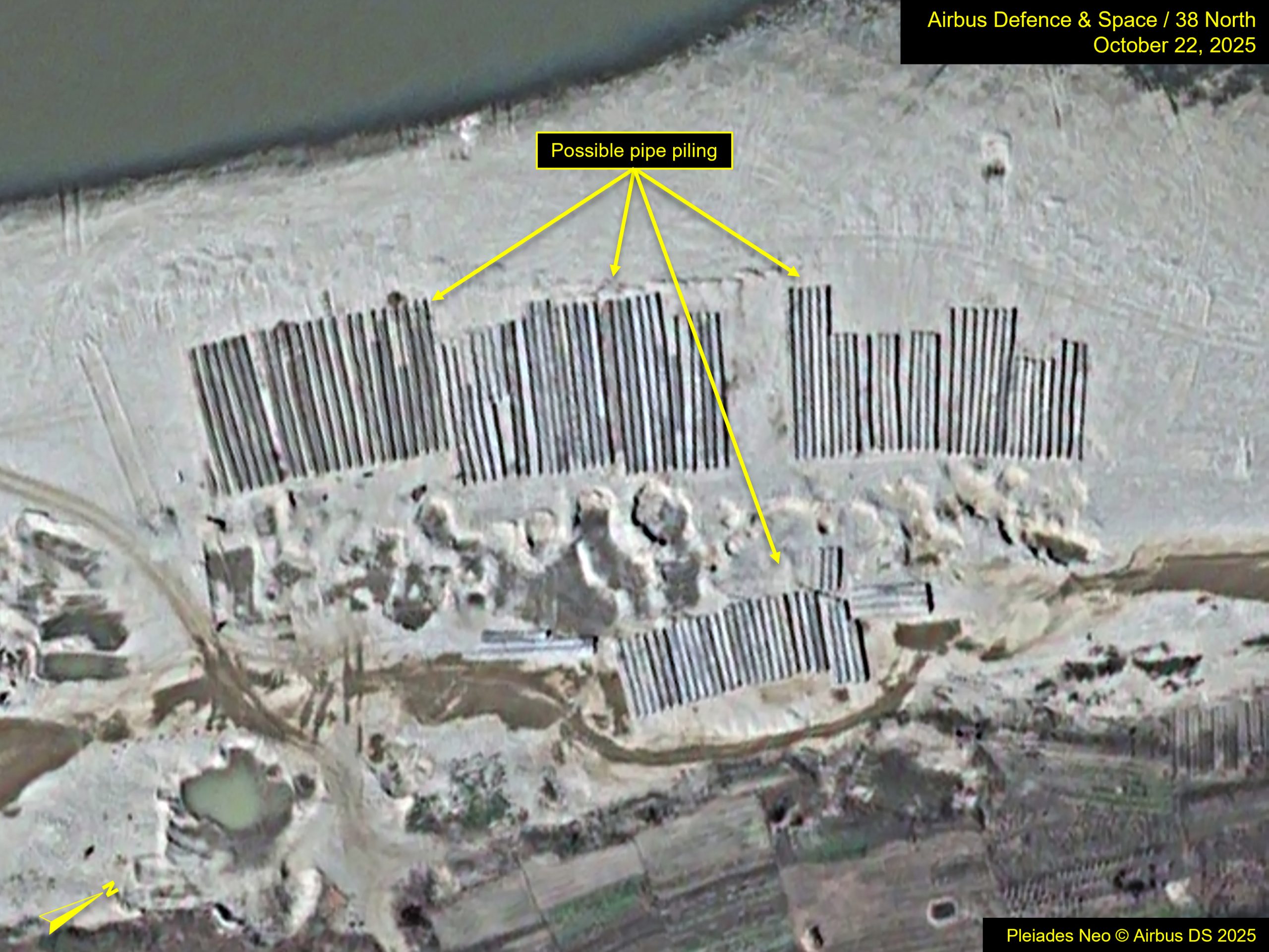
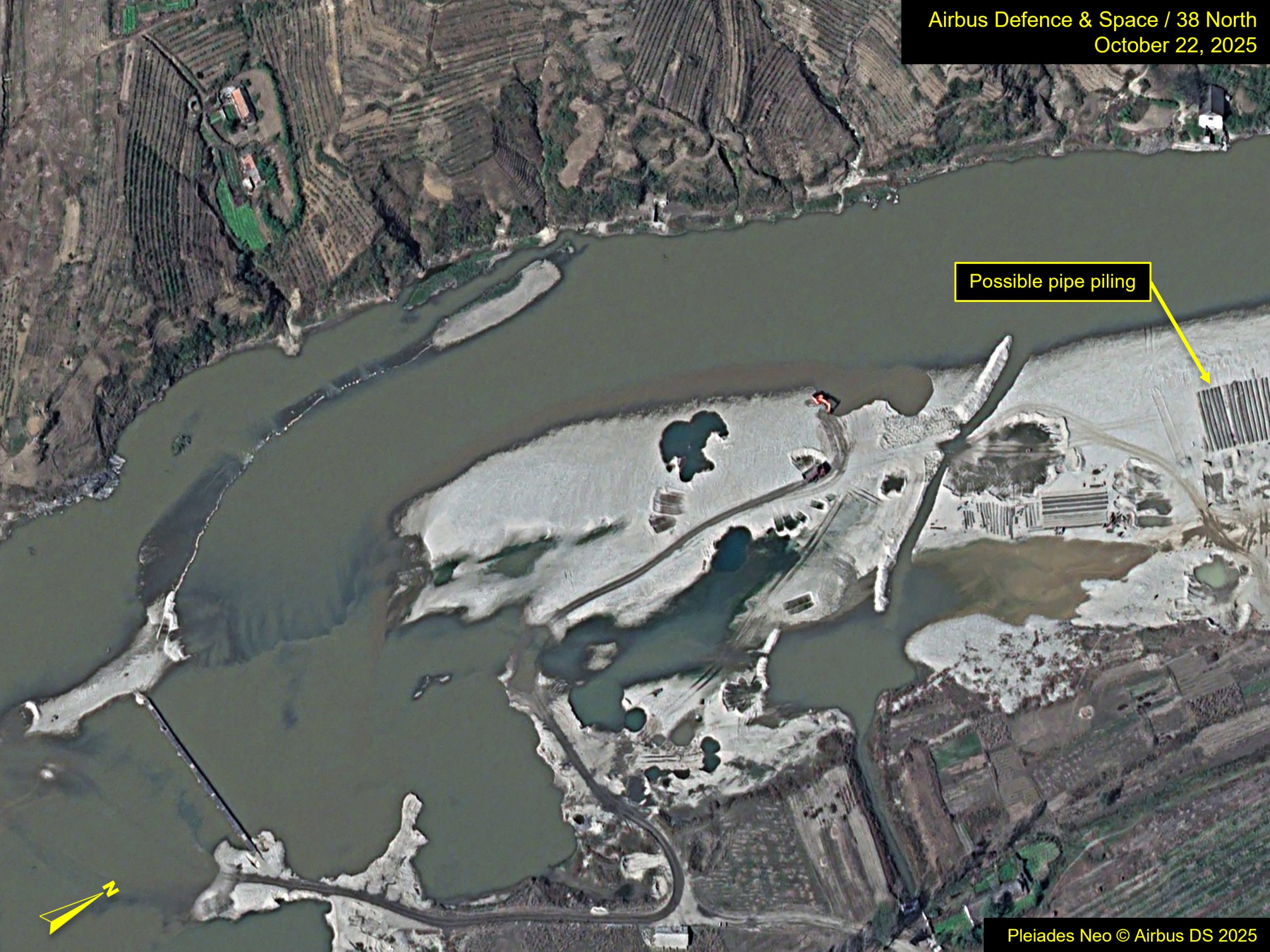
Imagery from October 22 shows approximately 80 pipes of differing lengths on the shore on the east side of the river, 3km north of the 5 MWe Reactor. They are uniformly grouped by length and range from approximately 12 meters to 25 meters. The pipes are possibly interlocking pipe piling, used in the construction of a dam or levee, or to shore up the riverbanks, though their exact purpose remains to be seen.
- [1]
‘Respected Comrade Kim Jong Un inspects Nuclear-material Production Base and Nuclear Weapons Institute’ Korean Central News Agency, 29 January 2025.