

North Korea Resumes Criticism of the US While Moderating Rhetoric, Accelerates Exchanges With China
This article is from the third edition (October-December 2025) of 38 North’s quarterly product, North Korea Briefing, that monitors key internal developments in North Korea. For the full series, click here.
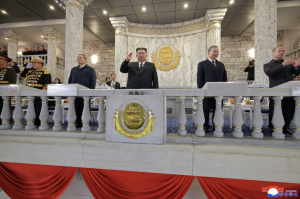
During the last quarter of 2025, North Korea quietly rejected US President Donald Trump’s overtures for dialogue and resumed criticism of Washington, yet carefully calibrated its rhetoric to avoid foreclosing future negotiations. At the same time, North Korea-China exchanges appear to have accelerated across the political, diplomatic, military and economic spectrums since September, when Kim Jong Un held his first summit with Chinese President Xi Jinping in more than six years. For the foreseeable future, North Korea will likely seek to expand ties with China while promoting greater Pyongyang-Beijing-Moscow alignment.
United States
In the lead-up to and during his October 26-30 Asia trip, Trump referred to North Korea as “sort of a nuclear power” and said he would “love to meet” Kim Jong Un. While North Korea did not directly respond to this overture, it effectively rejected it by carrying out its first missile launches (October 22 and 28) since May and sending its foreign minister to Moscow, where she met with Russian President Vladimir Putin (October 27)—all taking place around Trump’s Asia tour. On November 1, a vice foreign minister called denuclearization a “pipedream.”
In early November, immediately after Trump’s return to Washington, the United States held a joint air exercise with South Korea and imposed further sanctions on North Korea, and a US nuclear-power aircraft carrier entered a Busan port. In response, North Korea issued a vice foreign minister’s “press statement” criticizing US sanctions, launched a short-range ballistic missile, and released a defense minister’s “press statement” noting Pyongyang has “correctly understood the hostility of the U.S.”
A few days after the release of a joint fact sheet from the October 29 US-South Korea summit, Pyongyang issued a Korean Central News Agency (KCNA) “commentary” criticizing the document as a “confrontational declaration” of the alliance.[1]
Context and Implications
Kim Jong Un likely ignored Trump’s meeting offer because of the negative experience of the failed Hanoi summit and inconsistent US messaging that made Trump’s true intentions unclear. Moreover, having strengthened relations with Russia and begun rebuilding ties with China, Kim likely judged it more advantageous to pursue a North Korea-China-Russia alignment. A surprise summit with Trump also could have undermined Xi Jinping—which would have been awkward for Kim Jong Un, who had just begun restoring relations with China.[2]
Notably, North Korea modulated its anti-US rhetoric in response to the November joint military drill and joint fact sheet. It issued individual officials’ press statements and a KCNA commentary—formats Pyongyang tends to use when it wishes to comment on an issue while maintaining distance between the message and the top leadership. The KCNA commentary also avoided harsh language against efforts toward North Korea’s denuclearization, focusing instead on criticizing the strengthening of the US-South Korea alliance and Seoul’s quest for a nuclear submarine. Similarly, while guiding the construction of a nuclear-powered submarine in late December, Kim Jong Un appeared to shift the blame for South Korea’s nuclear submarine plan from Washington to Seoul, remarking that “Washington has agreed on [South Korea’s nuclear submarine] at the solicitation of Seoul.” These moves appear aimed at maintaining strategic ambiguity to avoid escalating tensions with the United States or foreclosing the possibility of US-North Korea dialogue.
However, significant obstacles would hinder meaningful progress even if US-North Korea dialogue were to resume. North Korea has not issued any high-level statements on foreign policy issues since November, and even its report on the December Party plenum made no mention of foreign policy or inter-Korean issues. The North will outline its foreign policy direction at the Ninth Party Congress, but its hardline stance is highly unlikely to change. This is reinforced by Kim Jong Un’s remark during his September weapons institute visits that the Party Congress will present a “policy of simultaneously pushing forward the building of nuclear forces and conventional armed forces.”
For its part, the United States would face significant challenges in meeting Pyongyang’s dialogue conditions—seemingly recognition as a “nuclear state,” sanctions relief, and a loosened US-South Korea alliance—due to the international nonproliferation regime, UN Security Council resolutions, and the strategic importance of the Washington-Seoul alliance. Even if the Trump administration attempts to sidestep denuclearization, Kim will likely prioritize maximizing immediate gains by continuing to deepen ties with Russia and restoring relations with China.
China
Kim Jong Un’s early-September summit with Xi Jinping in Beijing has reinvigorated high-level exchanges between the two countries. Just three weeks later, Foreign Minister Choe Son Hui visited Beijing for talks and a meeting with the Chinese foreign minister and premier, respectively. The Chinese premier visited North Korea in October for the Workers’ Party of Korea’s 80th founding anniversary—the first visit by a Chinese premier in 16 years. Later that month, a Chinese military delegation visited North Korea for the first time in six years.[3] On November 6, the director of the Chinese Communist Party (CCP) International Department met with the North Korean ambassador to China, possibly to brief him on the Lee-Xi summit—a sign of revitalized strategic communications.
Marking the 75th anniversary of Chinese People’s Volunteers (CPV) participation in the Korean War, Kim Jong Un paid tribute at the Cemetery of the Fallen Soldiers of the CPV, after which Chinese Ambassador to North Korea Wang Yajun hosted a reception showcasing friendship by inviting North Korean Defense Minister No Kwang Chol. Marking this same occasion, Wang contributed an article to the CCP daily Renmin Ribao on the importance of North Korea-China cooperation—the first time in six years that an article by a Chinese ambassador to North Korea appeared in the paper. At the Pyongyang International Trade Fair in October, Wang said he “expects Chinese companies to contribute to Korean socialist construction by helping with its national development strategy, including the ‘20×10 policy for regional development,’ that Korea is carrying out.”
In September 2025, for the first time since pandemic-related closures were lifted, large shipments of Chinese heavy machinery entered North Korea, and a relatively large number of North Korean workers were reportedly dispatched to Dandong.[4] Once the New Yalu River Bridge becomes operational—it has remained unopened for over 10 years since its completion—material exchanges are expected to expand further.[5] Connecting roads and customs facilities are expected to be completed by the end of December.
Context and Implications
North Korea-China exchanges and cooperation contracted sharply due to UN sanctions beginning in 2017 and North Korea’s border closures in early 2020 at the start of the global pandemic. Even after the pandemic ended, bilateral ties have been slow to recover. However, North Korea-China cooperation has been accelerating since the September Kim-Xi summit in Beijing.
North Korea is expected to call for the acceleration of “comprehensive prosperity” at the Ninth Party Congress in 2026, making expanded economic cooperation with China essential. Not only that, it will seek to learn from China’s best practices across multiple fronts, including party building, economic reconstruction, and welfare improvement. Accordingly, North Korea is expected to pursue a strategy of “security with Russia, economy with China” for the foreseeable future, focusing on expanding military cooperation with Russia and economic ties with China while promoting greater North Korea-China-Russia alignment.
Xi prioritizes North Korea-China relations over South Korea-China relations. This is evidenced by Xi’s remarks during his September summit with Kim, where he promised to place importance on China’s friendship with North Korea and consolidate bilateral ties “no matter how the international landscape may evolve.”[6] China therefore appears likely to continue high-level exchanges and communication with North Korea while expanding economic cooperation, including provision of livelihood supplies.
This chapter was originally drafted in Korean. The initial translation was produced using AI tools and subsequently reviewed word-for-word and refined by a bilingual subject-matter expert to ensure accuracy and readability.
- [1]
The KCNA commentary criticized the US and South Korean presidents’ commitment to the “complete denuclearization of the Democratic People’s Republic of Korea,” asserted that Seoul’s pursuit of a nuclear submarine and uranium enrichment were “bound to cause a ‘nuclear domino phenomenon’ in the region,” and took China’s side by saying their discussion of ensuring peace and stability across the Taiwan Strait was an attempt to “deny territorial integrity and core interests of sovereign states in the region.”
- [2]
At a press conference on his return journey on October 30, Trump told reporters: “We [Kim Jong Un and I] never were able to talk because… look I was so busy.” He added: “I think it would have been maybe disrespectful to the importance of this meeting (with Chinese leader Xi Jinping) if we did that. So I’d come back, with respect to Kim Jong Un.” This is interpreted to mean that the summit with Xi Jinping was the most important reason for visiting South Korea, and that meeting with Kim Jong Un could have been disrespectful to China.
- [3]
Since an August 2019 visit to China by a military delegation led by Kim Su Gil, director of the Korean People’s Army General Political Bureau, followed by a October 2019 visit to North Korea by Miao Hua, director of the Chinese Central Military Commission’s Political Work Department, there have been no confirmed reports of North Korea-China military exchanges. The recent Chinese military delegation was led by Xia Zhihe, political commissar of the Chinese People’s Liberation Army National Defense University— a lower-ranking position than Miao Hua’s—but the visit is significant as it marks a resumption of military exchanges between the two countries.
- [4]
Between August and September 2025, China supported the construction of North Korean local industrial factories by providing heavy machinery or by turning a blind eye to the large-scale smuggling of Chinese-made cars and used heavy equipment such as excavators and bulldozers. During the same period, North Korea reportedly dispatched approximately 100 information technology (IT) workers and 120-150 workers to garment and seafood processing factories in Dandong. See Jeong Seo-yeong, “N. Korea offers study opportunities for top Chinese language test scorers,” Daily NK, October 13, 2025, https://www.dailynk.com/20251001-4/; Seulkee Jang, “소규모로 中에 파견된 北 노동자들, 외진 공장들에 분산 배치 [North Korean Workers Dispatched to China in Small Groups Dispersed to Remote Factories],” Daily NK, December 3, 2025, https://www.dailynk.com/20251203-1/.
- [5]
In 2009, North Korea and China agreed to build the New Yalu River Bridge, with China covering the entire construction cost. Construction began in December 2010, and the three-kilometer, four-lane bridge connecting Langtou, Dandong with southern Sinuiju was completed in October 2014. However, its opening has been delayed due to unfinished connecting roads and other issues.
- [6]
According to China’s official report on Xi’s November 1 summit with the South Korean president, Xi made a four-point proposal to enhance bilateral relations: strengthen strategic communication and consolidate the foundation of mutual trust; deepen mutually beneficial cooperation and tighten the bonds of interests; strengthen the friendship between the two peoples; and enhance coordination in multilateral fora to jointly promote peace and development. South Koreans generally agree that momentum has been created for restoring Seoul-Beijing relations, but have also noted that China’s official report omitted any mention of the North Korean nuclear issue. Skepticism also remains about when China will actually accelerate efforts to improve ties with Seoul.