

North Korea Touts Kim’s Decade of Leadership, Charts Course for Ninth Party Congress
This article is from the third edition (October-December 2025) of 38 North’s quarterly product, North Korea Briefing, that monitors key internal developments in North Korea. For the full series, click here.
During the fourth quarter of 2025, North Korea commemorated the 80th anniversary of the Workers’ Party of Korea (WPK), declared completion of the five-year plan put forward at the Eighth Party Congress in 2021, and laid the groundwork for the Ninth Party Congress scheduled for 2026. During the Party’s anniversary celebrations, Kim unveiled a new vision for governance and nation-building over the next decade, aimed at achieving economic development through self-reliance and mass mobilization. This vision effectively continues the “spirit of Kangwon Province” that North Korea has been promoting since late November to drive increased economic production. While the 13th Plenary Meeting of the Eighth WPK Central Committee (CC) did not provide a time frame for the Ninth Party Congress, it offered hints about potential policies and Politburo personnel changes that may emerge at that event.
Kim’s Speeches on Party Founding
The North Korean leader delivered two important speeches marking the WPK’s founding anniversary—at the Party Founding Museum on October 8, and at a national meeting the next day. The speeches looked back on the WPK’s achievements and highlighted Kim’s leadership from 2016 to 2025. Significantly, they reviewed the five-year economic and defense plans since the Eighth Party Congress in 2021, and, building on that assessment, unveiled Kim’s new governance and nation-building vision for the next decade.
Context and Implications
At the 2016 Seventh Party Congress, Kim set the construction of a powerful socialist state as a medium- to long-term goal, presenting the “people-first principle,” the byungjin line (parallel economic and nuclear development), and a five-year economic strategy (2016-2020) as the means of achieving it. At the 2021 Eighth Party Congress, Kim touted nuclear, missile, and conventional weapons advancements but acknowledged that “the attainment of the goals for the growth of the national economy was seriously delayed and the people’s living standard failed to be improved remarkably.” The new five-year economic plan (2021-2025) prioritized strengthening self-reliance capable of withstanding external shocks by reinforcing equipment, processes, and infrastructure and comprehensively improving the economic system and order rather than pursuing forward-leaning policies, given UN Security Council (UNSC) sanctions and the pandemic border closures.
Kim’s post-Ninth Party Congress vision for governance and nation-building targets “comprehensive development of socialism” over the next decade (2026-2035)—a “second era of nation-building”—culminating in the establishment of a powerful socialist state by 2035. At the Party Founding Museum, Kim declared the need to “innovate at a much faster pace” and “adopt a bolder approach” across all sectors over the next decade. Despite this rhetoric, Kim’s model of building a powerful socialist state ultimately relies on self-reliance and mass mobilization under UNSC sanctions.
“Spirit of Kangwon Province”
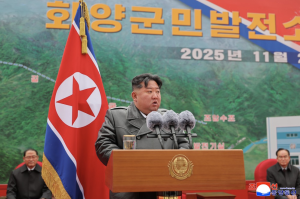
North Korea has launched a “spirit of Kangwon Province” propaganda campaign since November 21, when state media reported on Kim Jong Un’s attendance at the Hoeyang Army-People Power Station completion ceremony in Kangwon Province. Related articles have encouraged North Koreans to achieve five-year plan goals through self-reliance, following Kangwon’s example. North Korean media first used this formulation on December 13, 2016, during Kim Jong Un’s field guidance of the Wonsan Army-People Power Station in Kangwon, after a seven-year construction period. Kim praised the province’s officials and workers as “creators of the spirit of Kangwon Province” and called the power station proof that self-reliance and the self-development-first principle are the only path to survival. North Korea has touted Kangwon as exemplary for building small- and medium-sized hydroelectric power plants in Wonsan (2016), Ichon and Munchon (2020), Sepho and Phyonggang (2023), Kosong (2024), and Hoeyang (2025) without central government support.
Context and Implications
North Korea emphasizes the “spirit of Kangwon Province” for two reasons. First, the core of this principle is unconditional implementation of Party policies without central government support; in short, forging one’s own path to survival. It is Kim’s economic development model through self-reliance and mass mobilization under UNSC sanctions. Kim must develop the economy under sanctions while also improving the economies of 20 localities annually under the “20×10 policy for regional development,” which was launched in January 2024 and mandates building industrial factories in 20 cities and counties per year over a decade. This necessitates promoting the “spirit of Kangwon Province.”
Second, this spirit reinforces Kim Jong Un’s personality cult by encouraging loyalty that implements the Party Center’s plans at all costs. Wonsan is Kim Jong Un’s second hometown, where he reportedly lived for several years until Kim Jong Il’s 2008 stroke. Against this backdrop, North Korea has positioned Kangwon Province to embody Kim Jong Un’s policies of regional development and economic construction based on self-reliance and mass mobilization. Since Kim took power, North Korea has built the Masikryong Ski Resort, Wonsan Kalma Coastal Tourist Area, Sepho Tableland stockbreeding base, and, since 2016, army-people power stations in seven counties in Kangwon Province.
13th Party Plenary Meeting of the Eighth WPK CC
During its December 9-11 plenary meeting, the WPK addressed five agenda items. Beyond reviewing the implementation of 2025 Party and state policies, the meeting assessed the final year of the five-year economic and defense plans from the 2021 Eighth Party Congress and discussed Ninth Party Congress preparations, including a second-stage five-year economic plan (2026-2030).
The meeting report did not mention foreign policy issues, focusing instead on domestic messaging by addressing economic, defense, and regional development. The meeting declared that “the five-year plan was carried out” without offering statistics. The Ninth Party Congress likely will not introduce any fundamentally new economic strategies, but will reinforce the need for self-reliance and mass mobilization. On defense, Kim has already stated the Party Congress will present a “policy of simultaneously pushing forward the building of nuclear forces and conventional armed forces.”
Context and Implications
Three aspects of this meeting merit attention.
First, the North positively assessed the implementation of 2025 Party and state policies as having “accelerated speed of advance and redoubled self-sustenance.” North Korea announced it had achieved the 2025 economic objectives and five-year plan but provided no statistics. On defense, it noted “significant achievements” in modernization and said the country was “advance[ing] along the exact direction,” signaling the continuation of such efforts. It also cited the troop deployment to the Russia-Ukraine war as demonstrating national prestige.
Second, Kim criticized Party officials for “wrong ideological viewpoint and inactive and irresponsible work attitude.” Since early 2025, North Korea has punished officials for idolization, exceptionalism, self-centeredness, and corruption—behaviors that it says undermine Supreme Leader and Party authority and fuel public discontent. Examples include the corruption cases in Onchon and Usi Counties in January and the failed destroyer launch in May. The Ninth Party Congress will likely conduct Political Bureau personnel changes related to these incidents. The WPK Discipline Inspection Department may also intensify inspections of Party cadres and strengthen punishments.
Third, one full member and five alternate members of the WPK CC—all unidentified—were recalled. Leadership rostrum analysis suggests the Ninth Party Congress will conduct modest personnel changes in the Political Bureau, including presidium members, and in Party CC departments and the Central Military Commission. One or two new presidium members are likely: WPK Secretary Ri Il Hwan, who returned to the front row, where presidium members typically sit, after an 11-month absence; and WPK Secretary Pak Jong Chon, who accompanied Kim Jong Un on 19 field inspections in 2025. It appears that Ri Pyong Chol, who accompanied Kim only twice in 2025, will lose his presidium seat.[1] North Korea may also replace Party economic officials due to unresolved exchange rate volatility, rice price increases, and food shortages.
This chapter was originally drafted in Korean. The initial translation was produced using AI tools and subsequently reviewed word-for-word and refined by a bilingual subject-matter expert to ensure accuracy and readability.
- [1]
Ri Il Hwan is WPK secretary for propaganda. Pak Jong Chon is the WPK secretary who oversees the Party’s leadership over military affairs. Ri Pyong Chol is the Party’s general advisor for munitions policy.