

Assessing the Limits of Female Leadership in North Korea
This article was written and researched as part of the second cohort of 38 North’s Emerging Scholars Fellowship Program, under the mentorship of senior experts on North Korean affairs. The program and series were made possible through generous support by the Henry Luce Foundation. For more papers in this series, click here.
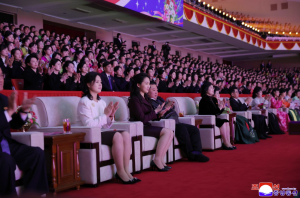
In the Democratic People’s Republic of Korea (DPRK or North Korea), state media have constantly shown women in meaningful, if not powerful, positions since Kim Jong Un came to power in December 2011. These figures include Choe Son Hui, the country’s first female foreign minister, and Ri Sol Ju, Kim Jong Un’s wife, whom he disclosed to the public in July 2012, soon after his ascendance to power. Most striking, however, is the emergence of two women belonging to the Mount Paektu Bloodline, the direct descendants of the DPRK’s founding father Kim Il Sung: Kim Yo Jong, Kim Jong Un’s younger sister, and Kim Ju Ae, his daughter.
Kim Yo Jong is believed to be only around four years younger than her brother and currently holds multiple formal positions within North Korea’s political system, serving as a member of the Worker’s Party of Korea (WPK) Central Committee (CC) and a deputy to the 15th Supreme People’s Assembly. On February 28, Pyongyang’s official Korea Central News Agency (KCNA) reported that she was appointed to the director of the General Affairs Department of the WPK CC.
Kim Ju Ae is believed to be around 13 years old and is the first child of the Kim family to be revealed to the public at such a young age. Despite her increasing visibility in state media and at major political and military events since 2022, she does not have any formal titles and is below the minimum age of 18 required for WPK membership. Nevertheless, in the lead-up to North Korea’s Ninth Party Congress, BBC reported that the South Korean National Intelligence Service (NIS) claimed Kim Jong Un had selected his daughter as his heir. The basis for this assertion is unclear.
This brings us to a central question: Is Kim Ju Ae a viable successor candidate? Given Kim Ju Ae’s increasing visibility and Kim Yo Jong’s expanding institutional authority, it may be suggested that women of the Mount Paektu bloodline are assuming more prominent political and public roles. However, it remains difficult to conclude that this constitutes a clear indication of female succession. While these appearances suggest the potential for women to assume more prominent roles, the opaque nature of decision-making and deeply entrenched patriarchal norms in North Korea make it uncertain whether they could exercise substantive political authority. Careful attention to state media portrayals and formal appointments may provide insight into whether such symbolic visibility could translate into institutionalized power.
Evolving Role of Women in Kim Jong Un’s Era
Kim Ju Ae’s and Kim Yo Jong’s prominent visibility exemplifies a broader pattern under Kim Jong Un, in which women have increasingly appeared around him in public events. This represents a notable departure from the Kim Jong Il era and is particularly striking in North Korea, where male-centric thinking remains deeply entrenched.
Kim Jong Il never appeared with his wives in public and did not bring his partners to his public activities and events, instead presenting himself alone in most settings. Although his younger sister, Kim Kyong Hui, held multiple official positions throughout her career, she remained largely out of the public eye until June 2009, when her public profile increased noticeably, as the Kim regime was preparing to debut Kim Jong Un as the successor.
By contrast, Kim Jong Un has actively showcased his wife, Ri Sol Ju, in public. In 2012, the couple attended the opening ceremony of an amusement park arm in arm, signaling a visible departure from past practice. Ri’s fashion choices, often described as bold and modern, have stood out in a society still deeply influenced by patriarchal norms.[1]
In the diplomatic sphere, Ri has also appeared to take on the role of a first lady, at times softening Kim Jong Un’s otherwise austere public image. She accompanied him during meetings with Moon Jae-in and his wife in September 2018, and co-hosted Xi Jinping and his wife during their first visit to Pyongyang in June 2019. One possible explanation is offered by Gomi, who argues that Ri’s public presence helps project a fresh and individualized image to the population.[2]
In Kim Jong Un’s early years in leadership, Kim Yo Jong was close by his side in roles that supported and complemented him. She has accumulated multiple and notable formal positions within the party and state apparatus and has emerged as a key figure in the regime’s external messaging, indicating that she exercises a significant degree of influence and practical authority beyond a merely symbolic role. Their close relationship and her rising political profile led many analysts to previously believe she was being groomed as a potential successor, despite their narrow age gap. However, this assertion has largely faded away.
Since being revealed, Kim Ju Ae has made numerous public appearances with Kim Jong Un at major state events, including her prominent seating during symbolic occasions such as New Year’s celebrations. In North Korea, such choreographed visibility and spatial positioning often indicate political favor. While she currently holds no formal party, military, or administrative position, and deeply entrenched patriarchal norms may constrain the feasibility of a female successor, her repeated exposure has nevertheless led to wide speculation she could be considered a potential successor.
Debate Over Kim Ju Ae
While Kim Ju Ae currently holds no formal political authority, she is often suggested to be a potential future successor to her father as leader of the DPRK. Since her first appearance in North Korean state media in 2022, she has been publicly observed on Korean Central Television (KCTV) more than 600 days over the past three years, beginning with her debut on Pyongyang’s Korea Central Television (KCTV). By October 2025, she had appeared on KCTV on 41 occasions, 25 of which were related to military events, the largest proportion among all categories.
Professor Atsuhito Isozaki of Keio University has observed that her presence across a wide range of events suggests that the Kim Jong Un regime maintains firm control over the military to the extent that it can afford to display a potential successor in such settings. He further notes that this visibility may even indicate the possibility of successor education, reflecting the regime’s confidence and institutional stability.[3] However, the same could be said about simply the exposure and education of a young Kim child regardless of succession status. In general, Kim Jong Un must have high confidence in the stability and safety of his surroundings to bring his child around.
Kim Ju Ae, when she does make public appearances, is usually featured prominently on the front pages of Rodong Sinmun, the party daily newspaper. Since 2022, the terms “beloved child” and “respected child” have been used to describe her. In the March 16, 2024, issue of Rodong Sinmun, reporting included the phrase “great guiders,” which is understood to refer jointly to Kim Jong Un and Kim Ju Ae. According to Isozaki, this term has historically been reserved for a select few, particularly the supreme leader, as it signifies clarifying the path forward in revolutionary struggle and suggests a significant symbolic elevation of her status. However, given the lack of precedent, the implications of such language should be interpreted with caution.
This symbolic prominence has led Isozaki to suggest that Kim Ju Ae may be accorded a status superior to that of Kim Yo Jong and Ri Sol Ju. For example, in August 2024, Yo Jong is observed escorting Ju Ae to her seat, which implies a hierarchical distinction. He notes that Ju Ae is treated as an exceptional figure, emphasizing that while KCNA does not explicitly define her political role, her continuous exposure helps normalize her presence in public life and reinforce her symbolic importance.[4]
On the other hand, Ri Il Gyu, a former high-level diplomat at North Korea’s Cuban embassy who defected to South Korea in 2023, does not believe that Kim Ju Ae is likely to succeed her father, given the importance the regime places on its patriarchal lineage. He contends that Ju Ae’s inherited power would signify the end of the Mount Paektu bloodline, thereby undermining the hereditary foundation of the Kim dynasty.
At the same time, he notes that Ju Ae’s recent public appearances appear to convey a message to the North Korean populace that a fourth-generation succession is forthcoming. Even if Ju Ae herself is not designated as the successor, these appearances lay the ideological groundwork for legitimizing the succession of a child of Kim Jong Un.
Ju Ae’s frequent and highly visible public appearances as well as her apparent proximity to her father constitute observable features of recent state media representation. While these developments have led some analysts to view her as a potential candidate for succession, the absence of clear precedent and institutional confirmation makes such interpretations necessarily tentative.
Repeated exposure also appears to shape public perception. Through images and footage alone, audiences may increasingly come to associate Ju Ae as an important figure in North Korean leadership, much like her mother and her aunt have been portrayed. State media have consistently portrayed her in close physical proximity to Kim Jong Un, including scenes in which they hold hands or interact affectionately. At the New Year’s celebration performance in 2026, for example, such images were again prominently featured. These portrayals message, at the least, the seemingly close relationship between Kim Jong Un and his daughter and the importance he places on his family.
At that same time, Ju Ae remains in her early teens, and questions have been raised regarding age norms and potential gender constraints in North Korea’s leadership structure. The extent to which such factors would apply in practice remains uncertain given the opacity of the system.
Conclusion
The public elevation of female members of Kim Jong Un’s family, including his daughter, sister, and wife, may suggest a shift in representational practices under his leadership. The broader significance of this trend is still unclear—particularly, how much is about the women themselves versus shaping Kim Jong Un’s public image as a leader, a husband, a brother, a father, or unlike his father, a man of the people.
In the coming years, particular attention should be paid to future political appointments, or potential changes in terminology describing Kim Ju Ae,even the visual framing and frequency of her appearances in North Korean media, and especially the framing of female leadership in public discourse. Will there be more than just the Kim family women to gain visibility in public and especially political life? Will more women be elevated into elite positions to support the idea of female leadership writ large? These changes could serve as indicators of whether her role is transitioning from symbolic representation to a more institutionalized political position. Moreover, when succession happens will matter to what the choices are at that time. Kim Yo Jong, while around her brother’s age, is unlikely a planned successor, but should something happen to Kim Jong Un in the short-term, she could be part of a contingency plan given her family status and gained political power.
However, it should be kept in mind that everything around how young Ju Ae is being portrayed is unprecedented, so tweaks in language and title could be as much finding the right tone as intentional signaling. Moreover, the complete lack of information about Kim Jong Un’s other children should also be reason for caution in reading too much into the current situation.
- [1]
Gomi, Yoji. Women Who Move North Korea (Onna ga Ugokasu Kitachousen). Tokyo: Bunshunshinsho. 2016.
- [2]
Ibid.
- [3]
Isozaki, Atsuhiko. Reading North Korea. (Kitachosen wo Yomu). Jiji Shinsho. 2025.
- [4]
Nikkei Visual Data. “North Korean Leader Kim Jong Un’s Daughter: Is the ‘Princess’ a Successor?” Accessed November 25, 2025. https://vdata.nikkei.com/newsgraphics/north-korean-daughter/