

Post-Party Congress Elections
This article is from the fourth edition (January – March 2026) of 38 North’s quarterly product, North Korea Briefing, that monitors key internal developments in North Korea. For the full series, click here.
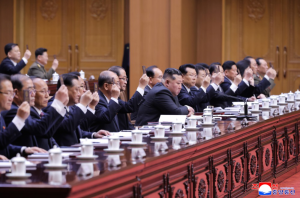
The first quarter of 2026 saw follow-on events to the Ninth Party Congress.[1] North Korea held national elections for the 15th Supreme People’s Assembly (SPA) on March 15, its first parliamentary elections in seven years and two years behind schedule. Following his replacement as director of Bureau 10, formerly the United Front Department (UFD), during the Party Congress, Ri Son Gwon took on leadership positions at one of the DPRK’s (Democratic People’s Republic of Korea or North Korea) satellite parties.[2] Finally, one of Kim Jong Un’s closest advisers, Jo Yong Won, was elevated to head the SPA itself.
Supreme People’s Assembly Elections Held
For the first time in seven years, the DPRK held national elections for its unicameral parliament, the SPA. Kim Jong Un voted at a coal mine in the Sunchon Youth Coal Mining Complex in South Phyongan Province. The elections were two years overdue, as the SPA lasts five years. This may have been to align SPA elections to the years of a Party Congress, but could also be due to self-declared crises and national emergencies in 2021 and 2022. One theory is just as good as the other.
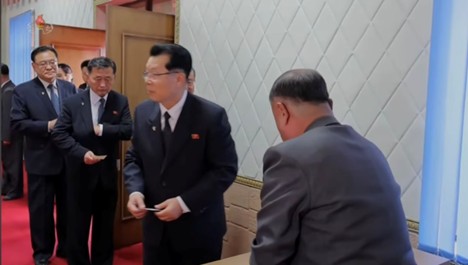
The 15th SPA might formalize any legal changes and, via budget control, implement any government policies resulting from the Party Congress and the Central Committee apparatus elected therein.
Context and Implications
Kim Jong Un’s choice to cast his SPA ballot at one of the country’s major coal mines reiterates the Ninth Party Congress’ emphasis on domestic economic development. His appearance and speech may have also been meant to be a subtle message to North Korean citizens that the country’s “self-sufficient” economy can be immune from the high energy prices caused by geopolitical problems such as the recent attack on Iran.
Coal is one of North Korea’s viable exports. Opting to appear at the Sunchon Area Coal Mining Complex may foreshadow Sino-North Korean interactions during 2026 with an eye toward boosting coal exports to China, the largest purchaser of North Korean coal.
Former UFD Boss Crosses Over to Satellite Party
Ri Son Gwon, former head of the #3 Office Complex (the bureaucratic units tasked on inter- and diaspora Korean issues) and former UFD director, was elected to the 15th SPA as a member of the Korea Social Democratic Party (KSDP) and during the SPA’s opening session on March 22, Ri was elevated to vice chairman of the SPA Standing Committee. Along with Chondoist Chongu Party, the KSDP is one of two satellite parties which elect SPA deputies. Both satellite parties are technically subordinate to the former UFD. According to some South Korean reporting, the former UFD might now be called “Bureau 10,” but no further reporting has neither substantiated nor corroborated if that is the institutional name.
Context and Implications
During the Ninth Party Congress, Ri Son Gwon was replaced by another former UFD Director Jang Kum Chol as head of the former UFD. Jang was observed at a Party Congress sideline policy meeting with the other two top officials for external affairs—Party Secretary for International Affairs Kim Song Nam and Foreign Minister Choe Son Hui.
Ri Son Gwon’s migration to the KSDP placed him in the 15th SPA’s leadership as Vice Chairman of the SPA Standing Committee, despite the KSDP’s subordination to the former UFD.
Ri’s appointment to the KSDP continues a trend in which the WPK exerts a heavy-handed approach to the DPRK’s satellite parties. For example, during the second session of the 14th SPA, former KSDP Chairman Kim Yong Dae was replaced on a motion initiated by the WPK. As Ri Son Gwon is a former negotiator, his SPA and KSDP appointment indicate some degree of external engagement by the regime during 2026 may be possible. This could very well take the form of Ri issuing a communique on external relations or participating in delegation visits.
Jo Yong Won Migrates to SPA Leadership
During the opening session of the 15th SPA, Jo Yong Won was elected chairman of the SPA Standing Committee. Jo is a former top aide in the personal secretariat to Kim Jong Un and his last position was Secretary and Director of the WPK Organization Guidance Department (OGD).
Context and Implications
Jo’s SPA election fits into two broader personnel trends of the last 10 or so years of Kim Jong Un’s leadership. At the SPA, Jo Yong Won replaces Choe Ryong Hae, a princeling of the partisan core elite cohort (North Korea’s naval destroyer the Choe Hyon is named after Choe’s father). Jo Yong Won is a self-made core elite, attaining trusted positions through accomplishment, accountability, and hard work. Jo served in administrative affairs via the OGD’s local and provincial party apparatus before becoming a close aide to Kim Jong Un during his succession. He emerged in 2014 as a close aide and adviser to the leader and was mainstay in Kim Jong Un’s entourage until 2025. This is almost certainly due to Jo being an effective gatekeeper and proxy who can brief the leader in candid and constructive fashion.
Jo Yong Won’s migration to the SPA leadership also fits into a broader trend of core elites who hold different positions across the regime. Like his peers No Kwang Chol and Kim Jae Ryong, he has held different posts; compared to No and Kim, Jo’s experience is not as diverse. However, Jo’s lengthy public absence at the start of 2025 possibly involved him inspecting or working at local development projects. This type of experience familiarizes North Korean elites with the implementation and implications of strategic policy on a micro-level. It seasons core elites with holistic managerial experience. Once that experience is acquired, the individual elite can be appointed to any number of leadership positions as an effective regime manager. For Kim Jong Un this provides two benefits. First, it ensures his policies are being implemented. Secondly, it builds the institution itself.
- [1]
For this author’s assessments of the leadership changes at the Ninth Party Congress, see Michael Madden, “Quick Take: Initial Assessment of Key Personnel Changes in North Korea’s 9th Party Congress,” 38 North, February 25, 2026, https://www.38north.org/2026/02/quick-take-initial-assessment-of-key-personnel-changes-in-north-koreas-9th-party-congress/.
- [2]
Satellite parties refer to North Korea’s two political parties, other than the WPK, which send representatives to the SPA. Prior to 2024, the three parties (the WPK, the KSDP and the Chondoist Chongo Party) formed the Democratic Front for the Reunification for the Fatherland.