

How War Memorialization Legitimizes the Russia-DPRK Alliance and Strengthens Kim Jong Un’s Legitimacy
The first road bridge linking Russia and North Korea across the Tumen River opened in September 2026 and was named after a former Soviet officer, Yakov Novichenko, who saved Kim Il Sung from an assassination attempt in 1946 and was honored with the title of Hero of Labor of the DPRK. Novichenko’s restored red Zaporozhets, driven by his grandson, led the convoy of vehicles that crossed the bridge during the opening ceremony. Such commemorative practices are abundant in North Korea-Russia relations, serving to legitimize the military alliance and underscore its long history.
The framing of a long-standing alliance between North Korea and Russia helps justify their growing military cooperation despite the lack of military contact between the two states in previous decades. It links Soviet contributions to Korea’s war history to North Korea’s contributions to Russia’s war with Ukraine, providing a political foundation growing their military ties. For North Korea, the memorialization and special treatment of the families of the fallen also helps the state to mitigate the frustration of those who lost their relatives, while the underlying shared war narrative helps present future potential aid to Russia as a matter of national sovereignty, rather than a mere pragmatic transaction.
War Memories That Unite
Recently, enhanced Russia-North Korea cooperation has led to the creation of new memory sites that commemorate North Korea’s military aid to Russia in the Kursk area and recall the Soviet Union’s contribution to liberating Korea in 1945 and assisting it during the Korean War. Defense Minister Andrei Belousov announced plans to open a memorial for North Korean allies in fall 2026, in recognition of their support for Russian forces in Kursk and their assistance with demining and rebuilding damaged infrastructure. This statement was made at a reception marking the 81st anniversary of Korea’s liberation from Japanese occupation, highlighting parallels between the two events. Even the name of the street in Kursk where the monument will be opened—International Street—carries symbolic meaning.
Earlier this year, in July, a memorial plaque commemorating North Korean soldiers who fought in Kursk opened at the Pantheon of Defenders of the Fatherland – a federal war memorial cemetery near Moscow, which functions as a burial site for honored military personnel and high-ranking military commanders. The plaque shows a North Korean soldier with a battlefield scene behind him, and the inscription at the bottom states, “Russia will not forget the heroism of DPRK soldiers in the Kursk region.” The event was also commemorated with a mural painting on the Golden Bridge in Vladivostok depicting a North Korean and a Russian soldier clasping hands in a firm handshake. During the opening ceremony, Primorsky Krai Governor Oleg Kozhemyako emphasized that the Soviet army supported the Korean people’s struggle for independence and thanked the North Korean leadership for its support of Russia against Ukrainian forces, underscoring the historical connection between these two episodes.
Tributes to Soviet soldiers killed during the operation to liberate Korea in 1945 and in the Korean War are preserved in North Korea as well. Graves and cemeteries honoring Soviet soldiers can be found in Pyongyang, Wonsan, Chongjin, Rajin, Hamhung, and Uiju, totaling 11 mass grave sites and 345 individual graves. Russian diplomatic staff, including high-ranking diplomats, frequently visit these locations to check and maintain the monuments, lay flowers, and pay tribute to fallen soldiers. Since some soldiers’ names are still unknown, efforts by the Russian Ministry of Defense archives continue to identify the fallen, and the lists of names on Korean monuments are updated periodically. For instance, in August 2020, the Russian embassy, in collaboration with the Mansudae Art Studio, opened a Memorial Arch at the entrance of the Soviet citizens’ cemetery in Sadong district, Pyongyang. Despite the nationwide pandemic lockdown, the project continued and the opening ceremony went forward, underscoring the importance of historical memory to the two states’ diplomatic relations. In August 2026, a new memorial section and several plaques were installed at the cemetery, one day before National Liberation Day. That same month, North Korean authorities in Hamhung installed two additional granite memorial panels with the names of Soviet soldiers who were killed while liberating Korea in 1945 at its memorial cemetery, which was established in 2005, marking the 60th anniversary of Korea’s liberation. Hamhung and Pyongyang were cities where Soviet airborne troops were deployed in 1945 to accept the Japanese surrender.
War Memories That Legitimize
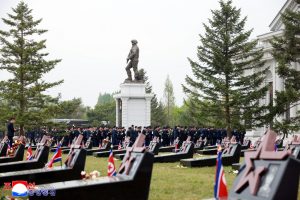
While the mutual war memorial tributes have been an important feature of Russia-North Korea relations, Kim Jong Un is now also using the commemoration of North Korean soldiers’ participation in the Kursk operation for his own political narrative. The numerous ceremonies and monuments that have been established in memory of those who lost their lives in Russia’s war work to portray Kim as a benevolent leader who shows compassion and care for his nation. At the opening ceremony of the Memorial Museum of Combat Feats at the Overseas Military Operations, for instance, Kim met and spoke with the soldiers, showing closeness by embracing them and patting them on the back. To show unity with his people, he took part in the burial of the fallen soldiers’ ashes, he knelt on one knee to lay flowers, then stood with his head bowed in silence. Last year, North Korean media broadcast emotional footage of Kim Jong Un arriving at the airport at night to meet a plane carrying the coffins of soldiers killed in the Kursk region, struggling to hold back tears as the coffins were passed by. Rather than disguise the fact that the soldiers were sent abroad, the regime reframed the event as a struggle for the country’s integrity and sovereignty, highlighting the soldiers’ patriotism and longing for their nation while fighting abroad. A North Korean documentary about soldiers in Kursk emphasized the symbolic significance of the flag and Kim Jong Un’s portrait, showing soldiers touching the flag to their faces and passing Kim’s portrait among themselves before leaving on a military mission. Russian reports showed that political education sessions continued in the units stationed there, with soldiers watching North Korean materials and participating in daily discussions on political topics.
These episodes fit into a broader state effort to present Kim Jong Un as empathetic and approachable, not ashamed to show his feelings and acknowledge mistakes. Such image management aims to convince the population that the leader is genuinely committed to improving their lives, and to shift responsibility for the inability to significantly improve living conditions from him to the elite or local authorities. The trend has been clear since the late 2010s when the state economy suffered due to the tightening of international sanctions and then faced new challenges during the COVID-19 pandemic. In his 2017 New Year address, Kim Jong Un admitted his weaknesses and pledged to work harder for his people. Kim Jong Un famously shed tears when talking about the difficulties that his nation faced at the parade celebrating the party’s 75th anniversary in 2020. He cried in public again at a Meeting of Mothers in December 2023 while discussing the country’s declining birth rate. Although the country has been steadily recovering since the disruptions of the late 2010s and early 2020s, the effort to portray Kim as a caring leader has not weakened; in fact, it has only grown stronger.
Beyond the memorials, Kim has also worked to reward the families of the fallen soldiers. In February 2026, he took part in the opening ceremony of Saebyeol Street, meeting with families of war veterans and fallen soldiers to gift them apartment documents and congratulate them on moving into their new homes. Inspecting the houses, he spoke with residents and thanked them for their sacrifices. Material compensation is needed to prevent potential discontent among the fallen soldiers’ families and avoid public criticism of the government.
Conclusion
Inherited memories of Korea’s liberation and the Korean War are increasingly co-mingled with the recent memory of North Korean troops fighting in Russia, functioning as a tool for North Korea’s foreign and domestic policies. In bilateral relations with Russia, they help justify the current alliance by framing present military aid as an obligation arising from the Soviet Union’s past assistance in North Korea’s war efforts. The performative history, based on ceremonies, rituals, and public demonstration of mutual respect, is central to North Korea-Russia relations.
These actions also serve multiple domestic purposes. By expressing empathy and providing some material benefits for the families of the fallen, Kim Jong Un redirects public frustration away from himself while bolstering his own leadership. Moreover, the heroic portrayal of North Korean troops, along with the state’s emphasis on respecting their sacrifice and courage, provides an ideological basis if the leadership decides to send additional forces abroad.