

North Korea Balances Between China and Russia While Hardening Its Regional Posture
This article is from the fifth edition (April-June 2026) of 38 North’s quarterly product, North Korea Briefing, that monitors key internal developments in North Korea. For the full series, click here.
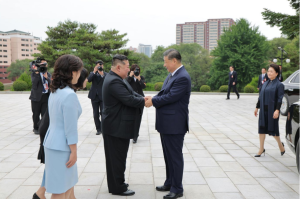
Between April and June 2026, North Korea restored its traditional bilateral relationship with China through a summit meeting while also elevating its status as Beijing’s partner on the global stage. At the same time, it continued to deepen ties with Russia, as evidenced by high-level Russian visits to Pyongyang and North Korean troops’ first-ever participation in Moscow’s Victory Day parade. Together, these developments suggest that North Korea is pursuing balanced diplomacy toward China and Russia. Toward the United States and Japan, Pyongyang has sharpened its criticism; toward South Korea, it has codified the southern border in the constitution and continued reinforcing its military presence near the Demilitarized Zone (DMZ).
North Korea-China Relations Acquire a Global Strategic Dimension
During his first visit to Pyongyang in seven years, President Xi Jinping and Kim Jong Un formalized a sweeping deepening of bilateral ties. Xi called for enhancing “military affairs” exchanges and said the two countries should “strengthen strategic coordination, firmly safeguard their respective sovereignty, security and development interests, and jointly uphold regional peace and development”—broadening cooperation beyond the traditional bilateral framework into national security and foreign policy.
Kim welcomed Xi’s choice of Pyongyang as his first overseas destination of the year, calling it the highest expression of priority given to bilateral relationship, and pledged to treat the relationship as “the most important top-priority strategic work.” He added that “no matter how the situation may change,” Pyongyang would “fully support the policy and stand of the Chinese party and government to defend the core interests on the ‘one-China’ principle.”
Context and Implications
Chinese media described the summit as providing “the highest-level design and strategic guidance for China-DPRK relations in the new era,” while North Korea hailed it as “a new milestone” for bilateral ties. From an outside perspective, the summit effectively gave the relationship a global strategic dimension while signaling closer alignment against the United States and its allies.
While Xi’s June 2019 Pyongyang visit served to steer North Korea toward negotiations with the United States, this summit was primarily aimed at restoring China’s influence over the Korean Peninsula and drawing Pyongyang into Beijing’s strategic orbit. Whereas the old North Korea-China relationship was largely bilateral in focus, with China playing unilateral patron and principal external stakeholder, this summit reflected a shift toward strategic parity, as China now needs the cooperation of a North Korea whose international leverage has grown. Since declaring at the Party Congress in February that North Korea stands “right at the centre” of a movement to build a multipolar world, Kim has moved to deepen strategic cooperation with China, though his underlying aim appears to be securing the backing of North Korea-China and North Korea-Russia coalitions of nuclear powers.
The summit elevated bilateral ties beyond restored economic cooperation into broader strategic cooperation, suggesting that Beijing’s priorities toward North Korea have shifted from denuclearization to security alignment.[1] This could encourage Kim Jong Un’s military assertiveness: together with North Korea’s expanding relations with Russia, restored ties with China could provide Pyongyang with greater access to military technology as well as a stronger diplomatic and economic safety net, indirectly facilitating its military buildup.
How fully the latest summit agreement will be implemented—and how durable the resulting partnership proves to be—remains uncertain. Even so, both leaders have demonstrated a strong commitment to closer strategic cooperation, and the geopolitical forces driving North Korea-China rapprochement are unlikely to dissipate soon. The trajectory of this evolving partnership, and its broader implications for regional and international security, will therefore warrant sustained attention.
North Korea-Russia: Institutionalized Cooperation Amid China’s Return
North Korea-Russia cooperation continued to expand in 2026. The Tumen River motor bridge was connected, and a succession of senior Russian officials visited Pyongyang ahead of the first anniversary of the “liberation of Kursk,” including the natural resources, health, internal affairs, and defense ministers, as well as the speaker of the State Duma. In May, North Korean troops participated for the first time in Russia’s Victory Day parade while provincial delegations from South Phyongan and South Hwanghae visited Russia.[2]
The visits by Russia’s natural resources and defense ministers merit particular attention because they suggest the institutionalization of an exchange arrangement under which North Korea receives Russian energy and military technology in return for troop deployments. During his meeting with Kim Jong Un, the Russian defense minister said Moscow was “prepared to sign a Russian-Korean military cooperation plan for the 2027-2031 period.” Russia has also continued its diplomatic backing of North Korea, apparently blocking the inclusion of language on North Korea’s nuclear program in the final draft outcome document of the 2026 Nonproliferation Treaty (NPT) Review Conference.[3]
Context and Implications
North Korea-Russia relations entered “alliance” territory in 2024 with the conclusion of their comprehensive strategic partnership treaty and the deployment of North Korean troops. That trajectory continued in 2026, with expanding high-level exchanges and five-year military cooperation plan negotiations as part of the relationship’s broader institutionalization across multiple domains. The visits by North Korean provincial delegations to Russia—an uncommon occurrence—also suggest that cooperation is extending to the subnational level. Together with China-Russia alignment and the restoration of China-North Korea ties, these developments raise the possibility of trilateral North Korea-China-Russia cooperation.
Whether the restoration of China-North Korea relations will loosen the North Korea-Russia bond remains to be seen. For now, however, no major disruption appears likely—closer North Korea-China ties may produce modest adjustments, including a partial reorientation of North Korea’s economic activity toward China. Instead, the two relationships are likely to evolve along complementary lines: North Korea-Russia ties centered on military technology and security, and North Korea-China ties centered on economics and diplomacy. China has an interest in checking excessive North Korea-Russia closeness and improving relations with Pyongyang for its own regional security interests, Russia in easing the burden of Pyongyang’s demands for compensation for troop deployments, and North Korea in pursuing pragmatic division of labor that balances “security from Russia and economics from China” to reduce its overreliance on Moscow.
Military Buildup on the Southern Front as North Korea Hardens Its Posture Toward Seoul, Washington, and Tokyo
While North Korea deepened ties with China and Russia in the second quarter of 2026, it maintained a confrontational posture toward the United States, Japan, and South Korea. In his concluding remarks at the June Party plenum, Kim Jong Un reaffirmed the principle of “strengthen[ing] the allied front with the anti-imperialist, independent forces,” while accusing the United States of pursuing “indiscriminate and high-handed practices” and Japan of transforming into “a military power”—both of which, he charged, were “inviting a strong backlash and serious concern from the international community.” Regarding South Korea, he reiterated that the North must “firmly adhere to our principle of struggle against the enemy.”
Context and Implications
Although North Korea has continued to refrain from directly criticizing President Trump, Kim singled out “America First,” Trump’s signature foreign policy, and continued to portray the United States as an untrustworthy global actor, reinforcing themes first laid out in his report to the Ninth Party Congress in February. At the same time, North Korea has intensified its criticism of Japan through official statements and state media, bringing its message closer to Beijing’s. Kim’s direct criticism of Japan at the June Party plenum, immediately following his summit with Xi, suggests growing North Korea-China policy coordination toward Japan.
Meanwhile, Kim stressed the need to “complete qualitatively the ongoing project for fortifying the southern border” and again described South Korea as “the most hostile state.” These remarks suggest that that North Korea’s constitutional redefinition of inter-Korean relations is being translated into concrete military policy. On the anniversary of the Korean War’s outbreak, Kim supervised weapons tests that he said demonstrated “the great technological progress made in … the fire posture on the southern border.” The previous day, North Korea commissioned the destroyer Choe Hyon into the West Sea Fleet. Given that the waters around the disputed Northern Limit Line (NLL) in the West Sea (Yellow Sea) have historically been the site of inter-Korean naval clashes, Kim’s declaration at the commissioning ceremony that the “waves raised by this destroyer will surely create the first storm putting an end to the history stained with mistaken practices” appears to signal Pyongyang’s intention to challenge the NLL more assertively in the future.
This chapter was originally drafted in Korean. The initial translation was produced using AI tools and subsequently reviewed word-for-word and refined by a bilingual subject-matter expert to ensure accuracy and readability.
- [1]
Putin likely played a role in drawing Xi closer to Kim. It is possible that Russia encouraged China to embrace North Korea across several junctures: Kim’s visit to China in September 2025, the China-Russia joint statement opposing North Korea sanctions at the May 2026 Xi-Putin summit, and Xi’s visit to Pyongyang in June. Kim likely asked Putin to serve as the go-between.
- [2]
- [3]
From 2010 until 2026, NPT Review Conference outcome documents consistently affirmed that North Korea cannot, under any circumstances, have the status of a nuclear-weapon State under the Treaty and reaffirmed support for the complete denuclearization of the Korean Peninsula.