

Peace First: Seoul’s Two-State Answer to a Changed Peninsula
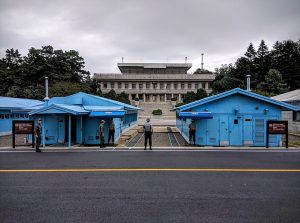
At a July 1 meeting of the Peaceful Unification Advisory Council in Incheon, President Lee Jae Myung pledged that South and North Korea would find a path on which they “respect each other’s systems and sovereignty” and coexist in peace.
Sovereignty is an attribute of statehood. A South Korean head of state was undertaking, on the record, to treat the Democratic People’s Republic of Korea (North Korea or DPRK) as a state.
Behind the pledge is a changed Peninsula. Pyongyang has declared the two Koreas hostile states and abandoned unification as a goal—and with that, the division both sides had shared for eighty years, each claiming the whole, has come apart. One side has left it. The other still lives under a constitution that mandates peaceful unification and has to decide what that mandate means now that the counterpart has withdrawn.
The administration’s answer is the Policy for Peaceful Coexistence on the Korean Peninsula. Its implementing strategy is a peaceful two-state framework: peace first, and the counterpart acknowledged as a state. It keeps faith with the constitution’s mandate, keeps the peace, and does not wait on the other side’s goodwill.
The Policy: What Changed, and What Seoul Answers
In December 2023, Kim Jong Un declared that inter-Korean relations were no longer a relationship of kinship but a relationship of two hostile states—two belligerents at war. Within months the declaration was made concrete: the monuments to unification demolished, the rail and road links across the border severed and walled. The country’s recently revised constitution has also deleted the unification clauses.
North Korea’s practices changed as well. Pyongyang disbanded the institutions that used to manage inter-Korean relations and refuses dialogue and exchange with South Korea across the board. The military hotlines lie dormant. While Seoul still hopes to restore the suspended 2018 Comprehensive Military Agreement—a once-promising set of confidence-building measures—Pyongyang has declared it void and reversed the concessions it once made. Two armies face off along the world’s most fortified border with no functioning mechanism between them for managing a crisis—and on such a line, a minor collision can escalate, step by step, into war.
This is the situation the Policy for Peaceful Coexistence on the Korean Peninsula seeks to address. It was not written for a quiet pPeninsula. It is designed to help manage a fraught relationship where one side has walked away and shut every door behind it.
In his Liberation Day address of August 15, 2025, President Lee set out three principles underlying the new approach: respect for the North’s current system, no unification by absorption in any form, and no hostile acts. The Unification Ministry’s white paper released in May gave the relationship its official name—a peaceful two-state relationship oriented toward unification—and framed it explicitly against North Korea’s “hostile two-state relations.”
The Ministry’s August 5 report to the President states the aims: face the reality of inter-Korean relations as it is, ease the North’s distrust, establish peace as the top priority, and strengthen the future orientation of unification.
Facing the reality of inter-Korean relations as it is means starting from the fact that North Korea is a state—separate, but not foreign. Easing the North’s distrust means removing the ground Pyongyang has named for it—the South’s ambition of unification by absorption—from the Republic’s declared policy. Establishing peace as the top priority means placing it before unification and before denuclearization. And strengthening the future orientation of unification means leaving unification to the future, for a time when its conditions are met. Together, these four are what the government calls a peaceful two-state relationship oriented toward unification.
Changing course rarely comes without controversy. Domestic debate has centered on three criticisms: that deferring unification abandons the constitution’s mandate for peaceful unification; that the framework weakens security by accommodating a nuclear-armed adversary at the expense of deterrence and the alliance; and, above all, that acknowledging North Korea’s statehood violates the constitution’s territorial clause. Each misreads the policy. The sections that follow take them in turn.
Why Peace Must Come First
Neither element of a peaceful two-state framework is new. Seoul introduced the two-state framing more than half a century ago: the June 23 Declaration of 1973 opened the door to coexistence within international institutions, and the simultaneous UN admission of 1991 made both Koreas full members of the state system. And “peaceful” is older still. In the détente of the early 1970s, both Koreas committed to peaceful unification in the July 4 Joint Statement and then wrote it into their constitutions. Even the ordering is not new: “peace first, unification later” was Park Chung-hee’s stated line from 1974.
What has changed is the setting. Both sides then claimed unification, and each meant unification under its own system—the survival of one and the end of the other; “peaceful” meant only that neither would go to war for it. Within that limit everything else was tried. Engagement—contact and exchange—was meant not only to draw the two Koreas closer but to open the North, in the belief that an opened North would change and that change would lead, in time, to unification; Kim Dae-jung’s Policy of Reconciliation and Cooperation, better known as the Sunshine Policy, said as much. Pressure served the same end by the opposite route—sanctions, arms competition, diplomatic isolation, human-rights campaigns, leaflets and loudspeakers across the line—and North Korean “collapsism”—the expectation that the regime would fall—never quite died out. And the North wanted the same, in reverse: what it called completing the territory, and so called liberating the South. Between two states each claiming the whole nation, that was a contest, and while it lasted it justified everything short of war.
However, North Korea’s revised stance now changes what the mandate requires. A counterpart that has renounced unification will receive every unification-oriented approach—even reconciliation, exchange, common growth, peaceful coexistence itself—as an assault on its existence. Pursuing the disappearance of a state that has refused unification is no longer competition between two claimants; it is coercion directed at the other state. The old latitude is gone.
Maintaining the old definition of “peaceful,” then, means the constitution’s mandate is contradictory. On the old definition, everything short of war counted as peaceful. But peaceful unification is unification by agreement, and unification pursued without the other side’s consent, whatever a unified Korea would finally look like, is a hostile merger by peaceful means.
The way out is to set the pursuit aside and keep the goal. The goal itself does not change, and it is not abandoned. What changes is its character. Unification ceases to be a matter of time—something that arrives, however gradually—and becomes a matter of conditions: something only both sides can bring about, not a goal one side carries toward the other. Because it depends on consent, its timing and its form, and whether it happens at all, are left open. This is where the government’s language points—leave unification to the future, strengthen its future orientation—and it is the only reading under which the constitutional goal and the constitutional means no longer collide.
The design is not without precedent. The Good Friday Agreement of 1998 preserved the aspiration to Irish unity while placing it under consent: unity may come only “by peaceful means with the consent of a majority of the people, democratically expressed, in both jurisdictions.” Unity remains available; coercion is excluded; the door is open and no one is pushed through it. A generation has lived under that arrangement without the aspiration being treated as a hostile posture. An aspiration disciplined by consent can survive—and can keep the peace while it waits.
Peace first, then, sets aside the one thing that cannot be pursued against the North without denying its existence: unification. This is where the framework differs most from the coexistence policies before it, from Kim Dae-jung’s onward. Those policies also renounced absorption, put coexistence first, and treated the North as a state in practice; but coexistence was, for them, the road to unification—the means, and unification the end it served. Now the framework takes coexistence as the end. The door to unification is left open, but only by agreement if or when the time comes. That is the arrangement the Good Friday Agreement made for Irish unity, and it is the only form in which the constitution’s mandate can still be honored, because every other form has become coercion.
Institutionalizing Peace Begins with Statehood
What does a peaceful coexistence policy actually change, given that the two Koreas have existed as separate states in fact since 1991? The answer is what it makes possible. Declaratory peace dies with the government that declared it, as the July 4 Joint Statement of 1972 did, and as the 1991 Basic Agreement did. Peace lasts only when it is institutionalized. On the Korean Peninsula, that process requires acknowledging the counterpart as a state.
Coexistence begins with how each side classifies the other. If the counterpart is unrecovered territory and an anti-state organization to be suppressed, then every offer it receives–reconciliation, cooperation, aid—reads as a sophisticated disguise for absorption. The distrust is justified.
In December 2023, Kim Jong Un confirmed it, and said it made no difference which side of Seoul’s politics was in power: the ambition to destroy the North’s system and regime had “remained unchanged even a bit whether they advocated ‘democracy’ or disguised themselves as ‘conservatism.’” He named what the party had concluded from the long history of inter-Korean relations—that unification could never be achieved with a South that had made unification by absorption its state policy—and read Article 3 of the South Korean constitution back at Seoul, word for word, as the proof. Decades of contact never dislodged that reading, because the classification underneath it never changed.
Acknowledging statehood does two things: it accepts the reality of the counterpart, and it creates a new possibility for the two Koreas to establish agreements that bind.
The record shows what that possibility is worth. The Basic Agreement read like a treaty; the South Korean Supreme Court and Constitutional Court both framed it as a gentlemen’s agreement, without legal force—a holding that followed from a legal order that withheld statehood. West Germany, by contrast, took the opposite path: it accepted East German statehood—two states in Germany, not foreign to each other—concluded the 1972 Basic Treaty as a treaty, and saw that treaty survive constitutional review and bind successive governments. The same design met opposite fates, and the difference was statehood.
With statehood acknowledged, new agreements between the two Koreas can be registered under Article 102 of the UN Charter and take their place on the plane of international obligation. Universal norms—the prohibition on the use of force, non-interference—become rules the two Koreas can invoke against each other, not abstractions floating above the Peninsula. Violations acquire a cost the violator does not control.
None of this makes the relationship foreign. The government’s own formula already draws the line: two states, not two foreign states. Statehood is acknowledged; the special relationship, and the orientation toward unification, remain. That is what separates a legal foundation for coexistence, which Seoul proposes, from a declaration of permanent estrangement, which Pyongyang has made.
Under Seoul’s new policy, deterrence remains untouched. The framework alters no military posture and no alliance commitment; the army that watches the border on the day the policy succeeds is the army that watches it now. Nor could the framework do otherwise: the same constitution that mandates peaceful unification mandates national defense, and the peace it commands is not a peace that forgoes the means of defending it.
Nor does the framework ask for trust. Both sides have now officially disavowed what the other most feared. Pyongyang has renounced not only unification but the means: Kim Jong Un has said that the North once spoke often of liberating the South and of unification by force, and that it now has no interest in either. Seoul has renounced unification by absorption in the principles set out above. Coexistence stands on those declared positions, not on goodwill. That is a floor: thin and cold, but load-bearing. The security objection mistakes this floor for a concession. It is the opposite—the first structure on this Peninsula that does not rest on trusting the adversary.
Is This Unconstitutional?
The constitutional objection rests on Article 3, the territorial clause. On the traditional reading, the Republic is the sole legitimate government on the peninsula; the area north of the line is unrecovered territory under unlawful occupation; the DPRK is therefore not a state but an anti-state organization; and a government that calls it a state acts against the text. A second prong follows from Article 4: to call the North a state is to call it a foreign country, and one does not unify with a foreign country—so acknowledging statehood ends the special relationship, and the command of unification with it. The question is not only domestic: because Pyongyang cites Article 3 as proof of the South’s intent, what the clause means is part of the dispute between the two Koreas, not merely a debate within one of them.
Status asks what an entity is; relationship asks how two entities treat each other. Whether the North is a state is not Seoul’s to choose—the DPRK has territory, population, government, and a seat at the United Nations, and it is a state whether or not any government concedes it. What relationship to have with that state is Seoul’s to choose.
The framework makes three distinct moves. It accepts the status. It withholds recognition — the discretionary act that would establish ordinary relations between foreign countries. And it chooses the relationship: special, not foreign. Two states can stand in a special relationship if they are not foreign to each other — and whatever Pyongyang now declares, these two are not: one people, divided in 1945 by the occupying powers, against its own will and without its consent. Seoul holds that position on its own account, as West Germany held it against East Germany’s insistence that the two Germanys were foreign states; it asks nothing of the other side.
Nor does statehood put unification out of reach. In 1973 the state of Bavaria asked the Federal Constitutional Court to strike down the Basic Treaty with East Germany (GDR) on grounds that read like the Korean objection today—that acknowledging the GDR as a state betrayed the Basic Law’s command of reunification and made the two Germanys foreign to each other. The court upheld the treaty. The GDR was a state; acknowledging it was not recognition of it as a foreign country; the two Germanys stood in a special relationship, not a foreign one; the treaty barred reunification neither in law nor in fact; and which road to take toward reunification was for the political branches to decide. Every element of the Korean objection was put to that court, and every element was rejected.
What of Article 3 itself? The objection reads it as a standing command to recover the North and remove its government. Two things follow from that reading. First, it makes Article 4 impossible to obey. A norm that denies the counterpart’s existence can be squared with the facts in only one way—by ending the counterpart—so every policy under it, however it begins, has to aim at that end; and a policy so aimed is not a peaceful unification policy. A peaceful unification is a unification by agreement, and an agreement requires a counterpart able to give it. Second, it condemns the record. The UN admission of 1991, the Basic Agreement, and every summit declaration since acknowledged the North in practice, and none of them has ever been held unconstitutional.
The command is in Article 4, not Article 3. Article 3 declares the extent of the territory and directs no one to do anything; Article 4 speaks in the imperative and mandates a peaceful unification policy. Read literally, the two collide—Article 3 admits no division, Article 4 presupposes it, and colliding provisions are read to accommodate each other: Article 3 states the goal, the territorial extent of a unified Korea, and Article 4 governs the means, which must be peaceful—and peaceful means require a counterpart. What Article 3 forbids is not acknowledging that the North is a state; it is renouncing unification for good and recognizing the North as an ordinary foreign country. The framework does neither.
On unification, then: the constitution mandates the goal, and Article 4 sets two limits on the means: peaceful, and within the free and democratic basic order. Within those limits, which road to take is for the political branches to decide. The framework stays within both limits: it confines itself to peaceful means, and acknowledges the North as a state, respects its system, and holds unification open to consent change nothing in the South’s own constitutional order. Respecting the North’s present system is not the same as accepting what a final unified state would look like; what exists across the border today and what unification must finally adopt are different questions, and the framework answers only the first.
Unification is not abandoned. It is kept, but is no longer considered a matter of time. Instead, it is of of conditions: whether it comes, and when, is for both sides to decide. After the counterpart’s withdrawal,as argued above, peace first is the only way to pursue unification that is not coercion; it carries the constitution’s command of peaceful means through to the end. A policy cannot violate Article 4 by being the last available way of obeying it.
Pyongyang’s Own Texts
The policy is, by the government’s own framing, an answer to a position Pyongyang has put in writing. Read as doctrine, it reduces to four sentences. We are two states. The project of liberation is closed. Leave us alone, and we will leave you alone. Touch us, and we will strike.
Everything about separation is unconditional and final: the declaration of two states, the removal of unification from the party charter and the constitution, the demolished monuments and the severed roads. These sentences close; they do not bargain. Everything about hostility and force, by contrast, is conditional, and Kim has said so himself. In October 2024 he told the world to read him properly: whenever he had stated the North’s position on the use of force, he had “clearly and consistently put a precondition of the word ‘if.’” If sovereignty is infringed, if territory is violated—then force. The threats are drafted as a conditional rule, and a conditional rule turns on what the other side does. The supreme norms show the same asymmetry. The party charter revised at February’s Ninth Party Congress carries the erasure forward—no unification task, no kinship with the South—while the first wartime clauses in the party’s history name no adversary. The constitution deleted the unification clauses and added a territorial article, but it did not name the South a hostile state. Separation is codified; hostility is not.
Separation is therefore grounded in a closed past, eighty years of confrontation that no one can reopen or amend. That verdict will not change, because the years it judges will not change. Hostility is grounded in present conduct, above all in what Pyongyang calls the South’s ambition of unification by absorption.
Of the grievances Pyongyang names, Seoul controls exactly one. Kim Yo Jong itemized them in August 2025: the ambition to absorb the DPRK, written into the South’s own constitution; the ROK-US Nuclear Consultative Group; the war drills “of aggressive nature”; and the repeated talk of “denuclearization,” which she cast as “totally denying” the North’s constitution. Only the first is Seoul’s to withdraw, and the framework withdraws it—officially, at the level of declared policy, which is the only level at which a doctrinal ground can be answered. The rest remain disputes: the nuclear program, military posture, the alliance. Nothing in this essay pretends otherwise.
Conclusion
North Korea’s abandonment of a shared goal of unification is a fact and will not be undone. What Pyongyang cannot end is the commitment on the southern side of the line: the constitution still mandates a peaceful unification policy, and no other state’s declaration can amend it.
A workable policy must therefore do three things at once: preserve the goal, exclude force and absorption, and acknowledge the state that stands on the other side. The peaceful two-state framework does all three. Nothing else on offer does.
Whether Pyongyang responds is an empirical question, and the argument does not depend on the answer. What it buys is not warmth. It is a cold peace—the floor described above, on which nothing further may ever be built, or which, if the other side chooses, becomes a staircase. This is what a peace-first policy looks like.