

Changes to PAD Ideological Instructors
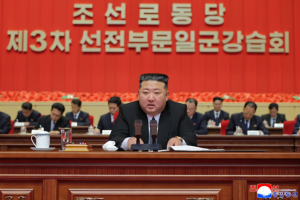
The Third Workshop for Ideological Instructors, under the Workers’ Party of Korea (WPK) Propaganda and Agitation Department (PAD), held over three days in late September concluded with a system-wide modernization of ideological indoctrination. In his speech to the workshop, Kim Jong Un said that “our party’s propaganda work must clearly change and become deeper, more substantial, and more effective than in the past.” To that end, the regime has adjusted the roles of propaganda instructors and intends on modernizing and innovating propaganda itself and the way in which it is disseminated.
These changes are part of a larger restructuring of how the Party and party organizations function and prospective adjustments to North Korean society and social control.
Realism in Propaganda
The Third Workshop is most likely the culmination of a six-year ideological modernization program. The First Workshop in 2022 defined the problems: formalism and outdated propaganda. The Second Workshop in 2024 presented new tools and methods for producing and disseminating ideology. The Third Workshop formalized a new propaganda doctrine and changed the roles of instructors. Given that these workshops have been held biannually, there is a very good chance that another one will be held in 2028 and assess the instructors’ new roles.
PAD instructors are responsible for ideological indoctrination and cultural modules outside routine basic party indoctrination and propaganda activities. Instructors are based in provincial and city WPK committees linked to propaganda cadres who manage administrative affairs and propaganda distribution in their given areas. Instructors work in several modalities:
- Workplace or production unit on-site political work whereby instructors give motivational speeches, hold informational sessions with employees and lecture on party policies;
- Visual agitation involves the placement of posters, slogan banners and other visual arts to encourage production; and
- Performing arts agitation which takes the form of itinerant art propaganda squads or performing arts troupes going to production units or workplaces to play music, sing revolutionary songs, perform skits and engage in dramatic storytelling.
The Third Workshop formalized a new propaganda doctrine and practice intended to transcend PAD’s usual package of songs, charismatic speeches and revolutionary history and the pedagogical and entertainment role of PAD instructors.
In his speech to the Third Workshop, Kim Jong Un said that “ideological education must be firmly rooted in reality” which means that propaganda should reflect the lived experience of North Korean citizens and call attention to their local concerns and themes previously given low visibility such as supply crunches, food security and cadre corruption. He also talked about how propaganda should eschew hyperbole and flowery language about the leadership; Kim remarked that “the power of truth has absolute force beyond any flashy rhetoric.”
Some of these changes have a historical antecedent. Jong Ha Chol, PAD’s chief during the early 2000s attempted to introduce realistic propaganda. Literary works and some ideological essays acknowledged supply shortages and the Arduous March. Jong’s innovations are similar to what Kim Jong Un now demands—new content, realism and propaganda rooted in lived experience. Jong’s changes lacked a doctrinal foundation at the time and were deemed excessive, leading to his dismissal. However, the Third Workshop has effectively upgraded and institutionalized what Jong Ha Chol attempted to do two decades ago.[1]
Instructors as Influencers?
Following the Third Workshop, the roles of instructors were also restructured and enhanced. Kim Jong Un remarked that instructors should be “all-rounders versed in politics, economics, science and culture.” This means that instructors are required to be knowledgeable about the technology and production processes of the worksites they visit, aware of the economic or resource constraints production units might be facing and somewhat conversant in the technical details driving economic or ideological campaigns. Instructors are also expected to be mindful of the opinions and viewpoints of their audiences and attuned to their psychology. Instructors, in Kim Jong Un’s formulation, must be able to “read the psychology of their target audience masses from a singular word or singular glance.”
With local and technical knowledge combined with a developed psychological acuity, instructors are now expected to personalize their ideological and cultural outreach to audiences and produce or revise their propaganda efforts accordingly. Ideological and propaganda messaging should be tailored to a specific workplace, aware of its strengths and weaknesses, mindful of its goals and tasks and sensitive to the concerns and viewpoints of its workers. The goal of instructors’ work is to create a “heart-stirring impact” in local populations.
These instructions increase the expectation for pedagogy to be more entertaining. With that comes greater flexibility for the form and content of the materials instructors use in their outreach efforts. Instructors should be producing and innovating materials as a “daily work habit.” Kim Jong Un also said the new propaganda doctrine might require “a thousand or ten thousand methods.” This suggests that instructors and propaganda cadres have a greater amount of autonomy in what and how they present ideology or propaganda to local populations. This might assume the form of instructors being able to create their own indoctrination or cultural presentations. It might also indicate that the production and dissemination phase has been shortened, with some internal PAD editorial review controls no longer in place.
The Third Workshop also expanded PAD instructors’ responsibilities in a fundamental way. Instructors are required to be role models of socialist virtue to other Party members. Instructors should maintain ideological consistency. They should avoid corruption and bureaucratic privilege and demonstrate ideological loyalty through their behavior and actions. Kim Jong Un said that “if what they say in front differs from what they do behind, they destroy the ideological front.”
Kim also remarked that PAD instructors should be viewed as “ideological guardians.” The phrase recurs throughout state media coverage of the Third Workshop. This moves instructors’ roles from one of pure output—speeches, teaching, performances—to one of regime input as well. Instructors now are tasked with identifying “anti-socialist” and “nonsocialist” behaviors and attitudes and detect negative opinions in local populations. When detected, the instructor is required to intervene to correct such perspectives through targeted messaging. This is new terrain for PAD instructors, requiring a new level of connection with the audience and some responsibility for their behavior. Rather than show up at a factory with a nice tale about Kim Il Sung and sing a few songs, instructors now formally must monitor the behavior and attitudes of the audience and adapt messaging accordingly.
Emphasizing information collection along with establishing instructors as moral role models and “guardians” indicates a structural expansion of instructors’ roles. Kim Jong Un’s remark that instructors should “read the psychology” is not rhetorical. Rather, it requires instructors to observe, interpret and report on the ideological conditions of workplaces, party organizations and local communities. Identifying instructors as “guardians” formalizes this change—guarding ideological purity, political loyalty and social cohesion. The Third Workshop transforms PAD instructors from ideological performers to embedded ideological sensors, an early warning system for popular discontent.
It is reasonable to assume that PAD instructors will keep records of local ideological attitudes, workplace morale, anti/nonsocialist behavior, corruption and local grievances. If PAD instructors are expected to tailor their messages and intervene preventatively, they will require systematic information collection.
Emphasis on Accuracy
The Third Workshop called for instructors’ outreach and their materials to be evaluated and analyzed “scientifically” for continuous improvement. This implies a standardized reporting channel into the Central Committee. All outcomes, assessments and tasking fall under the control of the WPK Central Committee. This alters PAD instructors’ reporting requirements. Under the old model, they received thematic guidance from PAD and duly reported their outreach activities. Under the new model, it is highly probable that they are now expected to file reports about:
- ideological observations;
- workplace or party organization psychological assessment;
- notes detecting ideological deviation; and
- alerts on anti/nonsocialist behavior.
This new creates a new institutional space in North Korean social control architecture: Ideological and population data flows upward into the Central Committee and tailored propaganda messaging flows down.
Moreover, PAD is providing additional inputs into the Central Committee’s surveillance apparatus. Where party surveillance once derived from the WPK Organization Guidance Department and internal security apparatus, PAD instructor reports now represent an additional reporting channel of micro-level intelligence. Instructors’ proximity to workplaces and local communities gives the Party a new embedded mechanism detecting discontent and ideological drift before it becomes visible to internal security services.
Conclusion
Changes to propaganda and the role of PAD instructors is part of a larger recalibration and restructuring of Party and regime social control. However, according to one report, the instructors’ new roles have been implemented inconsistently. This suggests that their new functions might be in a transitional period until other domestic changes come online.
The overhauled WPK Charter, passed during the Ninth Party Congress, defines the boundaries and clarifies the authority of party organizations across the wider regime. During the first session of the 15th Supreme People’s Assembly Kim Jong Un proposed reforming North Korea’s inminban (neighborhood) system, establishing a police force and holding a legal conference. The Third Workshop effectively upgrades PAD instructors to yet another layer of social control but might be waiting for full implementation alongside proposed changes to inminban chiefs, cops and lawyers.
- [1]
Jong Ha Chol was later executed, but there are conflicting accounts as to why.