

Closer to China and Russia, Firm on Nuclear Status
This article is from the sixth edition (July–September 2026) of 38 North’s quarterly product, North Korea Briefing, that monitors key internal developments in North Korea. For the full edition, click here.
In the third quarter of 2026, North Korea continued to expand relations with both China and Russia while seeking to avoid excessive dependence on either and preserve its strategic autonomy. In its messaging to the United States and the international community, Pyongyang has increasingly emphasized the irreversibility of its nuclear status and the possibility of using its nuclear forces.
China: A Limited Rapprochement
Following the June Kim-Xi summit, North Korea-China relations improved most visibly in the political and diplomatic spheres, while bilateral trade continued its post-pandemic recovery and military-to-military contacts showed signs of renewed activity.
The two countries exchanged high-level delegations in July to mark the 65th anniversary of their Treaty of Friendship, Cooperation and Mutual Assistance. Premier Pak Thae Song visited China and met with Xi Jinping, while Wang Huning, chairman of the National Committee of the Chinese People’s Political Consultative Conference, visited North Korea and met with Kim Jong Un. Both sides reaffirmed the treaty’s significance and their commitment to implementing the agreements reached at the June summit.[1] Pak also visited the Beijing Rail Transit Command Center, while Wang’s delegation toured the Wonsan coastal tourist area, suggesting efforts to promote urban development cooperation and Chinese tourism to North Korea.
Kim’s third-quarter correspondence with Xi emphasized developing bilateral relations around their shared socialist cause, with his July message calling for elevating ties to a “new strategic level.”[2] Military cooperation also appeared to advance, at least outwardly. In July, North Korea’s defense minister attended the Chinese Embassy’s reception marking the 99th anniversary of the People’s Liberation Army, an upgrade from a vice minister’s attendance in 2025. In September, a North Korean vice defense minister also attended the Beijing Xiangshan Forum, China’s version of the Shangri-La Dialogue, marking the first vice-minister-level North Korean delegation since 2019.
Bilateral trade reached approximately $1.51 billion in the first half of 2026, up 19.6 percent from the same period in 2025. Last year’s total had already recovered to 98.1 percent of its 2019 level. If the trend continues, annual trade could exceed its pre-pandemic level. Reports that the New Yalu River Bridge could open in October suggest bilateral trade may expand further.
Context and Implications
Despite the gradual recovery following Xi’s June visit, it is difficult to regard this as a return to a more China-centered foreign policy. Bilateral trade has recovered substantially, but major new economic initiatives remain limited, with the New Yalu River Bridge still unopened. Military contacts have increased, but publicly observable steps toward substantive defense cooperation remain limited. The limited scope of cooperation is consistent with North Korea’s longstanding desire to preserve strategic autonomy even as it improves relations with China.
China, meanwhile, signaled a strong interest in further developing the relationship, as reflected in Xi’s remarks at the June summit and Foreign Minister Wang Yi’s comments during his August visit to South Korea. Wang spoke of the two Koreas moving toward “peaceful coexistence” while omitting “denuclearization.” These developments suggest Beijing may be placing greater weight on managing relations with Pyongyang than on publicly reiterating positions that could create friction with North Korea.
Russia: Deepening an Operational Alliance
In July, Foreign Minister Choe Son Hui made a high level visit to Russia; in September, Russia’s deputy foreign minister said Kim Jong Un had been invited to Russia and the two countries would coordinate dates for a visit. North Korean arms supplies continued, while the September opening of the first road bridge across the Tumen River expanded cross-border logistics infrastructure.
Choe visited Russia from July 18 to 21, meeting President Vladimir Putin and holding the third strategic dialogue with Foreign Minister Sergey Lavrov. The ministers reviewed implementation of the 2024 comprehensive strategic partnership treaty and discussed strengthening high-level exchanges and coordinating responses to international developments. They reaffirmed “their steadfast political will to accelerate the long-term multi-faceted development of the bilateral relations, reinforcing indications that the diplomatic and security relationship is on a long-term track extending beyond immediate wartime cooperation.
Although neither country specifically mentioned bilateral military cooperation in its readout of the strategic dialogue, cooperation continued. Ukrainian intelligence reported continued North Korean missile transfers to Russia and that a North Korean missile unit had begun deploying there. In an August 19 statement, Kim Yo Jong dismissed reports of additional troop deployment as an “ungrounded farce” but defended the legitimacy of existing military cooperation. On August 28, Lavrov said North Korean soldiers were the only foreign troops that had been “in the trenches” alongside Russia in the war against Ukraine.
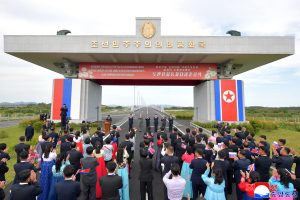
Economic cooperation, meanwhile, continued to expand beyond trade into labor and logistics. An estimated 15,000 to 30,000 North Korean workers were already in Russia, and August reports pointed to an increasing presence of North Korean women in manufacturing, agriculture, logistics and service sector jobs. The September opening of the Tumen River road bridge linking Rason and Khasan also improved the infrastructure supporting bilateral logistics cooperation.
Context and Implications
If North Korea portrays its relationship with China as moving toward strategic cooperation, it describes its relationship with Russia as having progressed a step further—toward consolidating an alliance and building a long-term partnership. Similarly, while North Korea-China exchanges and Kim-Xi correspondence have largely focused on the future direction of cooperation, North Korea-Russia strategic dialogues and Kim-Putin letters have emphasized ongoing areas of joint work.
Kim’s replies to Xi and Putin around the anniversary of North Korea’s state founding illustrate this distinction. In his September 12 message to Xi, Kim remained within the established framework of “traditional relations of friendship” and put forward the abstract goal of safeguarding “the common cause of socialism.” By contrast, his September 14 message to Putin foregrounded the ongoing “alliance” and called for “expand[ing] and deepen[ing] the joint work with the Russian Federation in a comprehensive way.” The messages thus emphasized traditional and ideological ties with China, compared with a greater focus on deepening current strategic and military cooperation with Russia.
North Korea’s economic cooperation with China far exceeds that with Russia in scale and scope. Cooperation with Russia differs, however, in that it is part of a broader relationship that includes active military cooperation. Pyongyang appears to be using the complementary aspects of the two relationships to maximize practical benefits from both countries. In particular, it appears to be prioritizing comprehensive cooperation with Russia and using that relationship to calibrate cooperation with China.
If the Tumen River bridge increases logistics flows and becomes a route for North Korean workers, raw materials, and manufactured goods, it could help make economic cooperation with Russia more regular and sustained.
United States: Nuclear Status and Nuclear-Use Signaling
North Korea’s rhetoric toward the United States increasingly emphasized two themes in the third quarter: the irreversibility of its nuclear status and the circumstances under which it might use nuclear weapons. Pyongyang also continued to distinguish the personal relationship between the North Korean and US leaders from what it regards as Washington’s “hostile policy.”
In an August 19 statement, Kim Yo Jong described the Trump-Kim relationship as “still excellent,” the while insisting that US policy toward North Korea had not changed. An August 31 Foreign Ministry spokesperson criticized the US State Department’s reaffirmation of complete denuclearization and the US military’s decision to proceed with a trilateral exercise with South Korea and Japan, pledging to respond to Washington’s “invariable hostile policy with the toughest stand to the last.” In response to an IAEA General Conference resolution, Kim Yo Jong on September 19 characterized North Korea’s nuclear forces as “the most important matter for the national security” and firmly rejected denuclearization. Choe Son Hui’s September 24 statement similarly condemned a US-South Korea-Japan joint statement reaffirming their commitment to North Korea’s “complete denuclearization.”
In September, North Korea also placed greater rhetorical emphasis on potential nuclear use. At the commissioning of the destroyer Kang Kon, Kim said the ship was part of North Korea’s “nuclear counteraction system” and called for operation of nuclear combat systems to be developed “for an actual war.” He warned that he would order the use of North Korea’s “absolute strength” if its adversaries resorted to armed force. September 16 and 18 statements by the Defense Ministry and Kim Yo Jong similarly invoked the possibility of nuclear use in response to US and allied military activities.
Context and Implications
North Korea’s recent rhetoric toward the United States has moved beyond its longstanding justification of nuclear weapons as a response to US “hostile policy” to increasingly emphasize the permanence of its nuclear status and the circumstances under which it might use nuclear weapons. This does not represent a new nuclear use doctrine—North Korea has previously specified conditions for nuclear use—but the third-quarter statements placed renewed emphasis on potential operational use. This appears aimed at reinforcing nuclear deterrent signaling while setting parameters for future diplomacy with Washington: Pyongyang will not enter negotiations premised on denuclearization.
This chapter was originally drafted in Korean. The initial translation was produced using AI tools and subsequently reviewed word-for-word against the Korean original and refined by a bilingual subject-matter expert to ensure accuracy, nuance, and readability.
- [1]
In his talks with Pak, Xi called for developing bilateral ties in that way that “serves our respective socialist cause and modernization” and “defend[ing] our respective sovereignty, security and development interests, and create[ing] a favorable external environment” for both countries. This suggests that China was expressing support for North Korea’s development while also signaling an interest in closer strategic coordination in responding to external pressure. See “President Xi Jinping Meets with DPRK’s Premier of the Cabinet Pak Thae Song,” Chinese Ministry of Foreign Affairs, July 10, 2026, https://www.fmprc.gov.cn/mfa_eng/xw/zyxw/202607/t20260710_11979902.html.
- [2]
For example, see “Respected Comrade Kim Jong Un Sends Congratulatory Message to Comrade Xi Jinping, General Secretary of C.C., CPC and President of PRC,” Korean Central News Agency (KCNA), July 11, 2026, https://koreanewsservice.com/en-news/respected-comrade-kim-jong-un-sends-congratulatory-message-to-comrade-xi-jinping-general-secretary-of-c-c-cpc-and-president-of-prc-2/; “Respected Comrade Kim Jong Un Sends Reply Message to President of PRC,” September 13, 2026, https://koreanewsservice.com/en-news/respected-comrade-kim-jong-un-sends-reply-message-to-president-of-prc-2/.