

North Korea’s Expanding Military Capabilities Across Domains
This article is from the sixth edition (July–September 2026) of 38 North’s quarterly product, North Korea Briefing, that monitors key internal developments in North Korea. For the full edition, click here.
In the third quarter of 2026, North Korea continued to strengthen its conventional and emerging military capabilities across multiple domains. It prepared to deploy nuclear-capable 600 mm multiple rocket launchers (MRLs) near the inter-Korean border, expanded its cyber and intelligence capabilities, and advanced its ambition to operate beyond coastal waters by commissioning a second 5,000-tonne destroyer. It also demonstrated a more sophisticated mixed-salvo capability, integrating drones, cruise missiles, MRLs, and ballistic missiles under a unified fire-control system. Together, these developments point to two parallel trends: Pyongyang is expanding the range of tools available to gain advantages below the threshold of armed conflict while developing capabilities across multiple domains that could support all-domain operations in wartime.
Strategic Significance of the 600 mm MRL
North Korea continues to fortify what it calls its national border along the Military Demarcation Line (MDL). While erecting fences and laying minefields in the border area, it has also been preparing to deploy 600 mm MRLs along its “southern border,” according to an August 2026 South Korean Ministry of National Defense report. The deployment of the 600 mm “super-large” MRL, known as the KN-25, near the inter-Korean border is of particular concern because North Korea claims the system can carry the Hwasan-31 tactical nuclear warhead.
Pyongyang on September 22 tested “updated,” “range-extended” 240 mm controlled MRLs, with claimed ranges of 100 km and up to 115 km, depending on flight mode. According to North Korean state media, defense cadres characterized the development as assuring North Korea of “a significant change in the firepower readiness along the southern border,” underscoring Pyongyang’s continued emphasis on strengthening artillery and long-range strike capabilities along the border.
Context and Implications
According to the South Korean Defense Ministry, North Korea was preparing to deploy KN-25s along the border. This appears consistent with Kim Jong Un’s May order to strengthen front-line units guarding the “southern border” and fortify the border line. It also follows a July Party Central Military Commission (CMC) decision to modernize military bases.
North Korea’s older MRLs were primarily designed to saturate broad areas with fire. Newer systems, however, appear to follow quasi-ballistic trajectories and incorporate guidance systems intended to improve accuracy at longer ranges. During a March 2020 drill, North Korea already demonstrated reduced launch intervals of only tens of seconds.
Deploying nuclear-capable weapons near the border increases the visibility and immediacy of the threat to South Korea while also significantly raising the risk of an accidental clash escalating into a nuclear war. North Korea’s efforts to fortify the border, therefore, may be intended in part to reduce the risk of inadvertent escalation even as Pyongyang continues to build up its forces in the area.
Expanded Mandate of Principal Intelligence Organization
One development from the Kim-led July CMC meeting that deserves particular attention was the renaming of the Reconnaissance General Bureau (RGB). The RGB, which had focused heavily on intelligence collection and covert operations against South Korea while also operating abroad, became the General Reconnaissance and Intelligence Bureau (GRIB). According to the meeting readout, the CMC discussed expanding the GRIB’s functions and missions, characterizing its role as “controlling the potential enemies’ threats and gathering key information, and enhancing its capability of military reconnaissance and intelligence activities.”
During the first half of this year alone, state-sponsored hacking groups linked to North Korea, China, and Russia conducted 158 cyberattacks, a 7.5-percent increase from the second half of the previous year. North Korean-linked operations targeted South Korea more than any other country and expanded into the cryptocurrency, information technology, and software-development sectors, using generative artificial intelligence, deepfakes, and fraudulent recruitment schemes. North Korea is also a suspected perpetrator of the August 20 theft of personal information belonging to South Korean presidential office officials.
Context and Implications
North Korea’s decision to expand and strengthen the former RGB, with greater emphasis on intelligence capabilities, should also be understood in the context of Kim Jong Un’s two-state policy. The restructuring comes as Pyongyang has defined South Korea as a “completely hostile state,” potentially requiring changes in how its principal intelligence organization defines its missions and priorities toward the South, including cyber and cognitive warfare.
Cyber operations are an important component of North Korea’s gray-zone tactics, allowing Pyongyang to exploit vulnerabilities and strengthen strategic advantages without resorting to armed conflict. Information collected and access established through such operations could also have wartime utility, including by enabling the disruption of command-and-control networks or degradation of communications.
Moreover, the GRIB’s expanded mandate may signal a broader geographic or functional scope for its intelligence operations. The CMC’s call to expand the bureau’s functions and missions in “a many-sided way” did not specify what that expansion would entail, but it could mean greater attention to targets beyond South Korea, including Japan and the United States.
The Kang Kon and North Korea’s Ambitions in Eastern Waters
On September 6, North Korea commissioned the Kang Kon, the second Choe Hyon-class destroyer, into its East Sea Fleet at Wonsan Port. At the commissioning ceremony, Kim Jong Un declared that the 5,000-tonne destroyer would “soon be assigned with a strategic mission” as part of North Korea’s nuclear counterattack system.
North Korea has sought to modernize and expand its navy since the early years of Kim Jong Un’s reign, with those efforts accelerating following Kim’s August 2023 call for naval modernization. Its first new 5,000-tonne destroyer, the Choe Hyon, was built at Nampo on the west coast and commissioned in June 2026. At the commissioning ceremony, Kim said North Korea would continue building 5,000-tonne warships and, over the longer term, acquire strategic vessels displacing as much as 10,000 tonnes.
Context and Implications
North Korea appears to be strengthening its naval capabilities as part of a broader ambition to become a maritime power. Traditionally, its navy has focused on coastal defense and surprise attacks, relying primarily on small surface vessels and submarines. A 5,000-tonne destroyer, however, can remain at sea for extended periods and operate much farther from the coast. North Korea is therefore attempting to move beyond what it describes as a “coastal defense navy” toward a force capable of operating across a wider maritime area.
Korea’s eastern sea is particularly well suited to expanding the navy’s operational reach and pursuing a longer-term maritime strategy, with deep and expansive waters, and offering relatively favorable conditions for North Korean ships to move beyond coastal waters toward Japan and the western Pacific. The area could become increasingly important if North Korea seeks to develop the ability to operate more distant naval operations, establish sea-based strike capabilities against South Korea or Japan, or threaten US reinforcements approaching the Korean Peninsula during a contingency.
It could also provide a natural operating space for future joint exercises and expanded military-technical cooperation with Russia’s Pacific Fleet, and, potentially, China, if Pyongyang’s defense cooperation with those countries expands into the maritime domain. North Korea’s evolving naval activities in these waters therefore warrant continued attention.
Drill Demonstrates Mixed-Salvo Capability
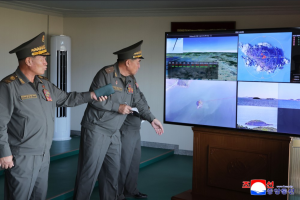
On September 12, North Korea conducted a “joint firepower attack drill” to train artillery and missile units in the use of an “integrated firepower control system.” According to North Korea’s report, the drill involved the simultaneous use of several weapons systems, including attack drones, a tactical cruise missile, large-caliber thermobaric MRL, and a tactical ballistic missile.
Although the drill itself did not pose an immediate threat to the region, it prompted responses from both South Korea and the United States. South Korea’s Office of National Security convened an emergency meeting and condemned the launches as a violation of UN Security Council resolutions. USPACOM stated it was aware of the missile launch and was “consulting closely with allies and partners.”
Context and Implications
This drill is notable for two reasons. First, it demonstrated North Korea’s ability to integrate four different types of weapons into a mixed salvo. Mixed salvos have long been part of North Korean military tactics, but the growing diversity and sophistication of the systems involved deserve close attention. Although North Korea’s claim that the weapons achieved “100 percent hit accuracy at a stroke” cannot be independently verified, a heterogeneous salvo could complicate detection, prioritization, and interception by confronting South Korean and US defenses simultaneously with weapons of different flight profiles, speeds, and ranges. Moreover, if North Korea were to signal that some participating systems carried nuclear warheads, this could further complicate South Korea’s threat assessment and interception prioritization.
Second, the drill was conducted the day after Freedom Edge, a five-day US-South Korea-Japan exercise in international waters near South Korea’s Jeju Island, and appeared to have been North Korea’s response to it. The use of weapons with different ranges may also have enabled Pyongyang to explore the possibility of coordinating attacks against multiple targets at varying distances in preparation for a future conflict.