

Private Cars and State Lotteries in North Korea
This article is from the sixth edition (July–September 2026) of 38 North’s quarterly product, North Korea Briefing, that monitors key internal developments in North Korea. For the full edition, click here.
North Korea’s authorization of private car ownership and its promotion of state-run lotteries point to new ways of serving and drawing revenue from consumers. The automobile law, amended in 2025 and obtained by the author in the third quarter of 2026, sets conditions for buying, selling, and driving cars, while recent lottery promotions show the state using games of chance and electronic payments. Both developments expand consumer options within systems the state can regulate and monitor.
The Rules Behind Pyongyang’s Automobile Boom
In the shadow of the Juche Tower in Pyongyang stands a three-floor glass-and-steel parking structure outside the Taedonggang Beer Restaurant. That would have been out of place in North Korea until recently, but it is a sign of growing private car ownership and a sizable wealthy class, at least in Pyongyang.
Private ownership of cars was banned until October 2024, when a new law changed that. The law was amended in January 2025 and the author obtained a copy of that version in July 2026. The law sets the conditions under which citizens can buy, own, operate, and sell cars.[1] There’s a limit of one car per household, owners must be at least 18 years old, and they must have a driving license. Active-duty military personnel cannot own cars. Driving licenses can be obtained through a 40-day training course held outside working hours or on Sundays or holidays.
Prospective buyers need to submit an application to the state, their identification card, and driving license. Cars must be bought through and sold back to licensed dealerships. That appears to rule out private sales (person to person), apparently helping the state maintain control of the market, uphold official prices, and collect taxes. The law provides for pre-orders and electronic payments, ostensibly to make purchases more convenient. This likely also enables closer oversight of transactions.
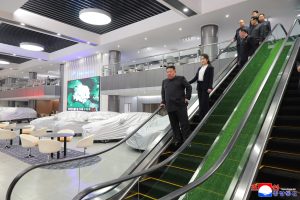
At least two car dealerships are part of the Hwasong development that has transformed northeastern Pyongyang. In April 2025, Kim Jong Un visited one, the Misan Automobile Technology Service Center, while touring the fourth-stage Hwasong District.
The cars available are generally imported from China and include several Chinese brands along with some Japanese and Western ones, but no South Korean models. The state sets prices, which are premium. At the top end, a 2020 Lexus LX570 SUV cost $250,000 and a Mercedes Benz S450L cost $190,000, according to NK News, citing photos taken in Pyongyang in early 2026. The Lexus price is double the manufacturer’s retail price and the Mercedes at a 30 percent premium, according to the report. At the lower end, a Chinese account on X reported cars are available for around $15,000.[2]
Even with a car, citizens are not allowed unrestricted travel. For “long-distance travel,” drivers need to apply to a security agency for approval, depending on the region. The law does not specify which regions need approval, but it bars vehicles registered outside Pyongyang from being driven in the capital.
The law also takes into account the effects of more cars on everyday life. It calls on “relevant design institutions, urban management institutions, and construction institutions” to build parking lots, service stations, and gas stations in urban plans. Additionally, it states that cars must be parked in lots, garages, or designated places without obstructing traffic or pedestrians, which is a possible reason for the new parking structure outside the Taedonggang Beer Restaurant.
Context and Implications
While some facilities in North Korea already contain car parking spaces, they remain uncommon. Similar structures may thus become more common. Foreign tourists also report more cars on the streets of Pyongyang, many with the yellow license plates that denote private ownership.
The new ownership rules create a legal market for private vehicles while keeping sales, prices, travel, and related infrastructure under state supervision. The parking structure and reported increase in cars suggest that the changes are becoming visible in Pyongyang, although the available observations do not establish how widespread private ownership is beyond the capital.
More Ways To Lose Money
State lotteries and other games of chance appear to be a new way the state is persuading people to part with their hard-earned cash. In recent months, Chinese citizens in Pyongyang and Rason have posted details of two games on social media.
The first was a World Cup lottery, although its connection to the tournament beyond the ticket sale dates is unclear.[3] Winning numbers were drawn on July 20, three days after the World Cup ended.
The lottery offered 100,000 tickets at 50,000 won each (around US$0.72), with the top prize at 500 million won (US$7,245). Total prize money was 3.25 billion won (US$47,101), leaving the state sports lottery administration (체육추첨관리소) a 1.75 billion won (US$25,362) cut, should all tickets have been sold. A poster at a Pyongyang street stand noted that prizes would be paid out via an electronic wallet, a further sign of the state’s push to digitize payments.
A second video showed a visitor playing a scratch card game in Rason. Six tickets offered the top prize: a 65-inch LCD TV. Other prizes included a heater, electric fan, Bluetooth watch, and a handheld fan.[4]
Context and Implications
Keen readers of North Korean law will know that Article 296 of the criminal code outlaws gambling. “In cases where a person gambles by staking assets worth approximately 30,000 won or more per year, or gambles for approximately 30 hours or more or on 15 or more occasions per year, the person shall be sentenced to correctional labor for a term of up to five years.”
Despite the law, gambling has been permitted in international hotels to foreign nationals. It is unclear if the law applies to state-run lotteries, either because they are not classified as gambling or because they are run by the state.
The lottery promotions suggest that the state is willing to offer regulated games of chance while criminalizing private gambling. Payment through an electronic wallet would also bring lottery transactions into the expanding digital payment system. The available examples do not show how widely such games are offered or whether all advertised tickets were sold.
These new lotteries are another way the state is seeking to soak up idle cash in the market as it tightens its grip on the economy.
- [1]
“자가용승용차리용법 [Private Passenger Car Use Law],” January 28, 2025.
- [2]
Sally, @JustCherry__, X, September 13, 2025.
- [3]
Sally, @JustCherry__ on X, July 22, 2026.
- [4]
Sally, @JustCherry__ on X, September 8, 2026.