

Sustaining Production: Coal, Regional Industry, and a Domestic Wheat Economy
This article is from the sixth edition (July–September 2026) of 38 North’s quarterly product, North Korea Briefing, that monitors key internal developments in North Korea. For the full edition, click here.
North Korea’s third-quarter economic reporting suggests that Pyongyang has continued to emphasize not only expanding productive capacity but also sustaining production and building more integrated domestic production systems. Three developments stand out: modernization of the coal and power sectors; efforts to keep new regional industry factories supplied and operating; and the construction of a domestic wheat economy linking cultivation, machinery, processing, and consumption.
Modernizing the Coal and Electric Power Sectors
An August 1 article in the government daily Minju Joson described strengthening the coal sector as strategically important for completing the new five-year plan and for the country’s subsequent medium- and long-term economic development.[1] Coal is essential for steelmaking, fertilizer production, and thermal power generation; the article argued that stronger production would support both the current and later economic plans.
In another article later that month, the same daily said coal output needed to keep pace with economic expansion to ease electricity shortages and sustain factory operations.[2] Researchers and technicians were reportedly working to mechanize underground operations, develop mining machinery suited to domestic conditions, and modernize machinery factories and repair facilities.
In addition to improving coal production, this effort also seems to emphasize using coal more efficiently. A September 1 Minju Joson report said the Pyongyang Thermal Electric Power Plant had increased electricity production to more than 1.1 times the previous year’s level while saving coal each month.[3] It attributed the gains to improved combustion, equipment management, and longer operating periods for generating units.
Context and Implications
Third-quarter reporting suggests a two-track strategy to reduce the economy’s vulnerability to coal and power shortages: increase domestic production capacity while using coal more efficiently. Weak coal supply can disrupt power generation, metallurgy, and fertilizer production. The Ninth Party Congress and subsequent meetings elevated coal sector modernization accordingly. In his policy speech to the Supreme People’s Assembly in March, Kim Jong Un said the country’s economic growth hinged on the electric power and coal industries and called for increasing production in these two sectors. Kim’s March 16 visit to the Chonsong Youth Coal Mine and his speech to the mine’s workers and officials also underscored the political weight attached to the sector.
Keeping the New Regional Factories Running
Until recently, much of the coverage of the 20×10 regional development policy—Kim Jong Un’s plan to build regional industry factories in 20 cities and counties each year for a decade—has focused on construction and inauguration. In the third quarter of this year, however, state media began paying more attention to their operation. On July 31, for example, Minju Joson reported that factories in roughly one-fifth of the country’s cities and counties had entered a course of “normalized production,” citing increases in production and net income at selected factories.[4] These official claims do not establish profitability, but the indicators show a shift in reporting toward performance after construction.
Subsequent reports emphasized product quality, raw material supplies, equipment maintenance, and trained personnel. An August 6 report cited Kim as saying that the factories should make a practical contribution to improving local living standards and pursue “expanded reproduction,” pointing to an emphasis on sustaining and expanding operations after construction.[5]
Context and Implications
Building a factory does not ensure continuous inputs, trained workers, functioning machinery, competitive products, or demand. These become the constraints once construction ends. Third-quarter coverage increasingly highlighted the elements needed to sustain regional production: local raw materials, factory operations, technical improvement, product diversification, quality control, and local consumption.
This approach is consistent with earlier official reporting. At the inauguration of the regional industry factories in Jongphyong County in December 2025, Kim instructed officials and employees to regard the people’s demands and evaluation as an absolute criterion and to manage and operate the factories responsibly to maintain high productivity.[6] Product quality was another concern. During his December 2025 visit to Jongphyong County, Kim personally tasted wheat sauce and paste and gave instructions on improving the quality of the wheat sauce.[7]
The challenge for the 20×10 policy is increasingly whether factories can sustain operations after inauguration. The repeated focus on raw material bases, technical capability, and product quality suggests that the North Korean leadership’s attention is increasingly turning from whether factories are being built to whether they can normalize production.
Building a Domestic Wheat Economy
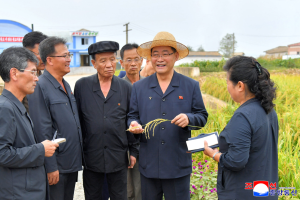
The clearest example of an effort to build an entire domestic production chain, however, may be wheat.
An August 27 Minju Joson article described the shift in grain production over the past several years from one dominated by rice and corn toward rice and wheat, linking it to a policy aimed at shifting diets toward white rice and wheat-flour foods and changing dietary habits.[8] The policy dates to 2021, when Kim Jong Un called for a major shift in crop allocation toward rice, wheat, and barley, including more than doubling the area sown to wheat and barley.[9]
The effort extends beyond cultivation. The article emphasized expanding flour and processed food production and establishing processing bases in major wheat-growing areas, warning that processing delays could cause losses and weaken farmers’ incentives. Agricultural machinery is another component: on September 2, Minju Joson reported that the Haeju Farm Machine Factory had produced several hundred wheat and barley seeders ahead of schedule.[10]
These efforts suggest an attempt to develop a domestic wheat economy encompassing cultivation, agricultural machinery, and processing, while also seeking to shift consumption toward wheat-based foods.
Context and Implications
The chain runs from cultivation and agricultural machinery through harvesting, milling, and processed foods to consumption.
A shift toward wheat would be difficult to sustain if demand for wheat-flour foods grew faster than domestic agriculture and processing could supply them. Conversely, greater output would have limited value without capacity to mill and process the harvest.
The policy appears to address both sides: domestic production and processing capacity on the supply side, and efforts to shift dietary habits toward wheat-based foods on the consumption side.
“Domestic” does not mean every input must be produced in North Korea or that imports are inconsistent with the strategy. The August 27 article points to an effort to build a more domestically integrated wheat system, linking increased production with expanded processing capacity. The goal is better understood as reducing external dependence on the core food system than eliminating trade.
Wheat thus resembles coal and regional industry in reflecting a broader effort to move beyond simply expanding productive capacity, whether by sustaining its operation or by building more integrated domestic production systems.
- [1]
Jo Chol Jin, “석탄공업부문의 세기적변혁은 인민이 반기고 환호하는 우리 국가의 새로운 변화를 안아올 거창한 혁명사업 [The Epochal Transformation of the Coal Industry Is a Grand Revolutionary Undertaking That Will Bring About New Changes Welcomed by the People],” Minju Joson, August 1, 2026.
- [2]
Kim Won, “<석탄증산으로 인민경제의 안정적이며 지속적인 발전을 믿음직하게 담보하자> 석탄공업은 자립경제발전의 척후전선 [Let Us Reliably Ensure the Stable and Sustained Development of the People’s Economy by Increasing Coal Production — The Coal Industry Is the Vanguard Front of the Development of the Self-Reliant Economy],” Minju Joson, August 27, 2026.
- [3]
Korean Central News Agency (KCNA), “지난해보다 전력생산 1.1배이상 증가, 매월 많은 석탄 절약 [Electricity Production Increases to More Than 1.1 Times Last Year’s Level, Large Amounts of Coal Saved Each Month],” Minju Joson, September 1, 2026.
- [4]
Ri Chol Su, “생산정상화의 동음과 더불어 꽃펴나는 새 생활, 새 문명 [New Life and Civilization Blossoming Along With the Sound of Normalized Production],” Minju Joson, July 31, 2026.
- [5]
제품의 질제고사업에 힘을 넣어: 옷공장에서 [Putting Effort Into Improving Product Quality: At a Garment Factory],” Minju Joson, August 6, 2026.
- [6]
“정평군 지방공업공장, 종합봉사소 준공식 성대히 진행 [Regional Industry Factories and Leisure Complex Inaugurated With Splendor in Jongphyong County],” Rodong Sinmun, December 25, 2025.
- [7]
“인민을 위한 끊임없는 헌신의 길에서 [Along a Path of Endless Devotion to the People],” Rodong Sinmun, March 20, 2026.
- [8]
Jo Un Hye, “알곡생산구조의 변혁과 더불어 꽃펴나는 새 생활, 새 문화 [New Life and Culture Blossoming Along With a Transformation in the Grain Production Structure],” Minju Joson, August 27, 2026.
- [9]
“경애하는 김정은동지께서 력사적인 시정연설 《사회주의건설의 새로운 발전을 위한 당면투쟁방향에 대하여》를 하시였다 [Respected and Beloved Comrade Kim Jong Un Made a Historic Policy Speech “On the Immediate Direction of the Struggle for the New Development of Socialist Construction”],” Rodong Sinmun, September 30, 2021.
- [10]
Jang Hyon Il, “수백대의 능률높은 밀보리파종기 생산 [Hundreds of High-Efficiency Wheat and Barley Seeders Produced],” Minju Joson, September 2, 2026.