

Nuclear Stockpile Uncertainty Amidst a Continuing Strategic Missile Launch Drought
This article is from the sixth edition (July–September 2026) of 38 North’s quarterly product, North Korea Briefing, that monitors key internal developments in North Korea. For the full edition, click here.
US President Trump and South Korea’s defense minister advanced differing figures for the number of North Korean nuclear weapons, underscoring key uncertainties in assessing the size of Pyongyang’s stockpile. These include the amount of fissile material, the North’s manufacturing capacity, the amounts and types of fissile material used in its nuclear weapons, and the proportion of different weapon designs deployed. The third quarter again featured only launches of short-range ballistic missiles (SRBMs) and land attack cruise missiles (LACMs), continuing a drought in strategic missile launches extending back to at least October 2024. This suggests the North may regard previous launches as sufficient to maintain minimum reliability in the deployed strategic force and underscores the importance of political over technical and operational factors in decisions over what missiles are launched when. Finally, Russia reportedly is seeking North Korea’s scaled-up Hwasong- (HS-) 11C variant of the KN-23 SRBM, which would provide a heavier payload for use in its war with Ukraine.
Dueling Estimates Highlight North Korea Nuclear Stockpile Uncertainties
On August 19, US President Trump stated without providing further detail that North Korea “has 57 very powerful nuclear weapons.” The next day, South Korea’s defense minister told parliament, “We typically see that [the North has] around 80 to 120” nukes, later attributing that figure to “an estimate by a private research institute.” (After the end of the quarter, on October 3, President Trump said without further explanation that Kim Jong Un had “112 nuclear missiles.”)
Context and Implications
Trump’s 57 number is consistent with various Western think tank analyses, including those of the Congressional Research Service (about 50 weapons and fissile material for up to 40 more), Stockholm International Peace Research Institute (60 weapons and fissile material for at least 30 more), and Federation of American Scientists (same). The ROK’s (Republic of Korea; South Korea) Korean Institute for Defense Analysis has estimated the North’s stockpile at 127-150 weapons, closer to the defense minister’s figures and Trump’s “112 nuclear missiles.”
The variation among these figures underscores the uncertainty in assessing North Korean fissile material and nuclear weapons holdings. Even Western intelligence agencies probably face estimative uncertainties, albeit hopefully to a lesser extent than outside analysts. Four key uncertainties probably underpinning different estimates are:
Amount of weapons-grade fissile material. Even open-source estimates of plutonium production at North Korea’s original 5-megawatt reactor at Yongbyon should be pretty good. But production at the new experimental light water reactor (EWLR) will be harder to estimate given uncertainties over the extent to which the reactor will be used for electricity generation or tritium rather than plutonium production. Enriched uranium production is even harder to estimate given uncertainties about the North’s centrifuge enrichment capacity, its use for EWLR or future nuclear submarine fuel rather than weapons, and the possible existence of additional enrichment facilities beyond Yongbyon and Kangson.
Weapons manufacturing capacity. The North’s capacity for manufacturing nuclear weapons from fissile material and other components is unknown. Western estimates posit substantial amounts of fissile material not yet manufactured into weapons, suggesting manufacturing limits. But this is an assumption rather than data-driven. Meanwhile, North Korea made continued increases in nuclear weapons production a priority at the Ninth Party Congress in February, and a July 9 enlarged meeting of the Party’s Central Military Commission led by Kim Jong Un “decided [inter alia] on … bolstering up the nuclear force both in quality and quantity.”
Fissile material per weapon. Open-source information does not reveal the designs or amounts and mixes of fissile material used in deployed North Korean nuclear warheads. Although photos of nuclear weapons mockups can help bound estimates, it is unclear to what extent they represent deployed designs. Analysts also differ on Pyongyang’s technical capabilities and therefore the amount of fissile material needed per weapon type. This is compounded by uncertainty over the extent to which the weapons use mixes of plutonium and uranium, and whether the North deploys high-yield pure fission, boosted, or thermonuclear weapons.
Mix of different weapons types. Translating fissile material production into nuclear weapon numbers also is complicated by the lack of open-source information on the stockpile’s breakdown among different weapons types. A stockpile of mostly small “tactical” nuclear weapons will have different fissile material requirements than one made up mostly of high-yield pure fission or boosted weapons. Uncertainty over how many launchers and missiles North Korea has or will deploy, and the large number of delivery systems associated with nuclear weapons further complicate stockpile estimates.
Launch Activity Continues Focus on Theater Systems
North Korea reportedly conducted six sets of ballistic missile and LACM launches in the third quarter, three of which were reported in Pyongyang’s media:
- On July 4, North Korean media reported that five “strategic cruise missiles” were launched from the Kang Kon, the second new Choe Hyon-class destroyer, as part of the ship’s pre-operational sea trials. (The Kang Kon was formally commissioned into service with the East Sea Fleet on September 6, according to North Korean)
- On August 6, ROK and Japanese defense agencies reported the launch of a single SRBM of an unknown type “from the Wonsan area … toward the East Sea,” to an unknown range.
- On August 12, a single SRBM was launched from a similar location to a range of about 700 km and a maximum altitude of 90 km, according to the ROK and Japanese militaries. The flight characteristics suggest the use of a KN-23/Hwasong-11A SRBM.
- On August 20, according to ROK and Japanese military sources, about 10 SRBMs were launched from Pyongyang to the northeast, flying about 300 km at a maximum altitude of 90 km. The range and number of missiles suggest the use of KN-25 SRBMs, what Pyongyang terms 600-mm “super-large” multiple launch rockets.
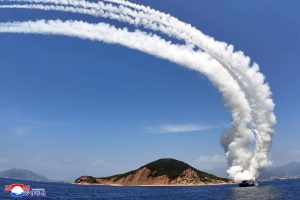
- On September 12, North Korean media reported a “joint firepower attack drill of long-range artillery and missile units.” Analysis of associated photographs suggests that at least one KN-23 and five KN-25 SRBMs, and one Hwasal-class LACM, were launched to arrive at the same impact area at about the same time. The South Korean military reported that “several” SRBMs had flown about 250 km. A number of tactical drones apparently were launched at the same target in a separate coordinated impact.
- On September 20, the North reported having “successfully tested a new-type weapon” that associated photos showed to be the HS-11E, which was revealed in October 2025 to use the larger booster of the HS-11C variant of the KN-23 SRBM to carry a hypersonic glide vehicle (HGV). Two missiles were launched, according to the South Korean military, to ranges of 450 and over 600 km. Data from the North Korean photos suggest the “HS-11E-1” flew to about 900 km on a maneuvering trajectory that might have partially gone below South Korean radar.
Context and Implications
Although Western media ascribed a political messaging purpose to the three sets of August SRBM launches related to US-ROK joint military exercises and to the North’s August 19 response to US President Trump’s expressed interest in meeting with Kim Jong Un, this is speculation in the absence of any North Korea statements concerning the launches. At a minimum, as with the September 12 drill, the August SRBM launches provided a crew training opportunity for the participating missile units. The September 12 drill also signaled continued North Korean interest in coordinating disparate theater strike systems to overcome alliance air and missile defenses.
The third quarter continued a drought in strategic missile launches extending back to October 2024 for intercontinental ballistic missiles (ICBMs), April 2024 for intermediate range ballistic missiles (IRBMs), December 2022 for medium-range ballistic missiles (MRBMs), and October 2019 for “true” submarine-launched ballistic missiles (SLBMs), as opposed to sub-launched KN-23 SRBMs. (The IRBM drought ended on October 3, when North Korea reported an operational troop training launch of a solid-fuel HS-16B IRBM carrying a hypersonic glide vehicle (HGV), implying the system is operational.) Although the North could resume such launches at any time, the long hiatus suggests Pyongyang may regard flight-testing to date as enough to maintain sufficient reliability of deployed missiles. It also underscores that political factors probably continue to trump technical and operational ones in the timing and circumstances of North Korean strategic missile launches.
Russia Reportedly Seeks Larger North Korean SRBMs
Ukrainian defense intelligence reported on August 27 that Russia had asked North Korea to provide “KN-30” SRBMs. Although there is no evidence of any having been provided to date, details of the next round of North Korean shipments to Russia reportedly were to have been finalized in September.
Context and Implications
The Ukrainians are using “KN-30” to refer to the scaled-up variant of the KN-23 first flight-tested in March 2021, designated by the North Koreans as HS-11C. The HS-11C reportedly has a rocket motor about 1 m longer than the KN-23’s (but the same diameter), and a payload section about 0.5 m longer. The North Koreans originally claimed the HS-11C carried a 2,500 kg warhead to a range of 600 km. In July 2024, they reported testing the “Hwasongpho-11Da-4.5,” an HS-11C with a 4,500 kg warhead, to the same range. The basic KN-23 (HS-11A) is assessed to carry a 400 kg payload up to 800 km, making a 2,500 kg payload with the HS-11C’s larger booster plausible. A 4,500 kg payload to 600 km is a harder sell, and South Korean assessments of that North Korean assertion as propaganda cannot be ruled out.
It is reasonable that the Russians would be interested in a larger-payload SRBM to increase damage against Ukrainian urban targets. The HS-11C also has been suspected of having an earth-penetrator role against bunkered targets, which Moscow presumably also would find useful in Ukraine. For its part, North Korea could use HS-11C combat experience to validate the missile’s performance and make improvements. It remains to be seen whether the HS-11C appears in Ukraine and whether it is transferred to the Russians or deployed with a North Korean missile launch unit reportedly being stationed there again to assist Russian operations.