

North Korea Shows Off an AI Chatbot
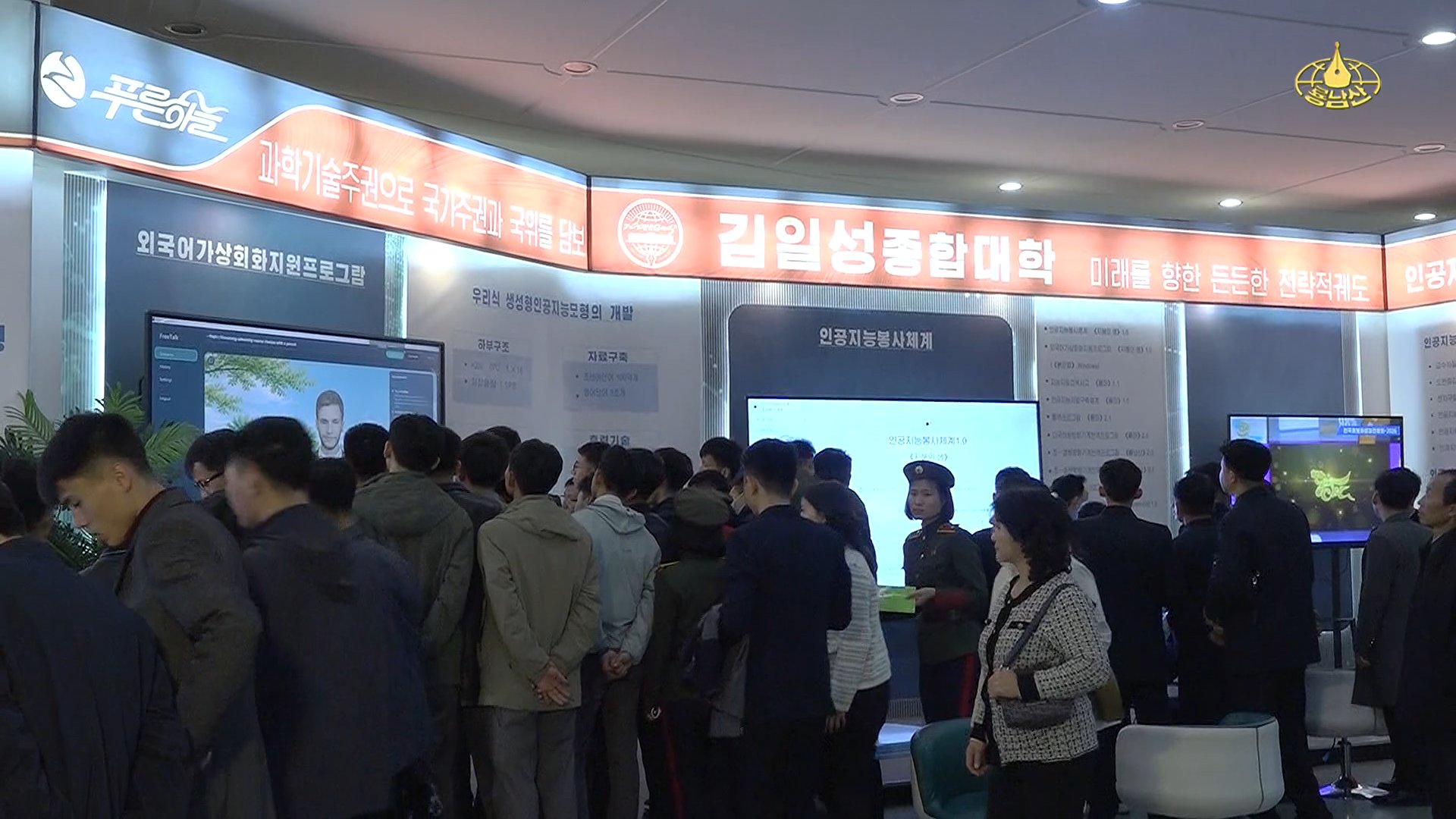
North Korea appears to have entered the AI chatbot era. At a recent national IT exhibition, the country’s top university displayed a chatbot that can answer questions about science and technology, according to footage broadcast on state television.
Development of the chatbot is further evidence that the country is keen to embrace the artificial intelligence era and is actively working on projects that harness its power. The availability of open weight models from major AI labs provides a ready-made foundation on which North Korean engineers can build domestic systems like the one demonstrated.
The “Fountain of Wisdom”
The newly revealed chat bot bears the name “AI Service System 1.0, Fountain of Wisdom” (인공지능봉사체계 1.0 《지혜의 샘》) and was developed by the Artificial Intelligence Technology Research Institute at Kim Il Sung University and Phurunhanul Trading Co., a Pyongyang-based software developer that also sells smartphones.
The AI Technology Research Institute is the former Faculty of Information Science at Kim Il Sung University. It took its new name in July 2025—another sign that the country was beginning to take AI seriously.
Alongside the chatbot display at the event was a banner declaring “Development of our style generative AI model” (우리식 생성형인공지능모형의 개발). The phrase “our style” is a common term in North Korea to mean something developed internally.
It was on display at the National Exhibition of IT Successes, an exhibition is an annual showcase for North Korea’s IT sector, that took place in Pyongyang from October 19 to October 30. It was also the subject of a recent report on the educational Ryongnamsan TV channel.
Television images showed that the chatbot interface looks similar to that popularized by ChatGPT, with a “new chat” button and list of conversations on the left and the main chat window to the right.
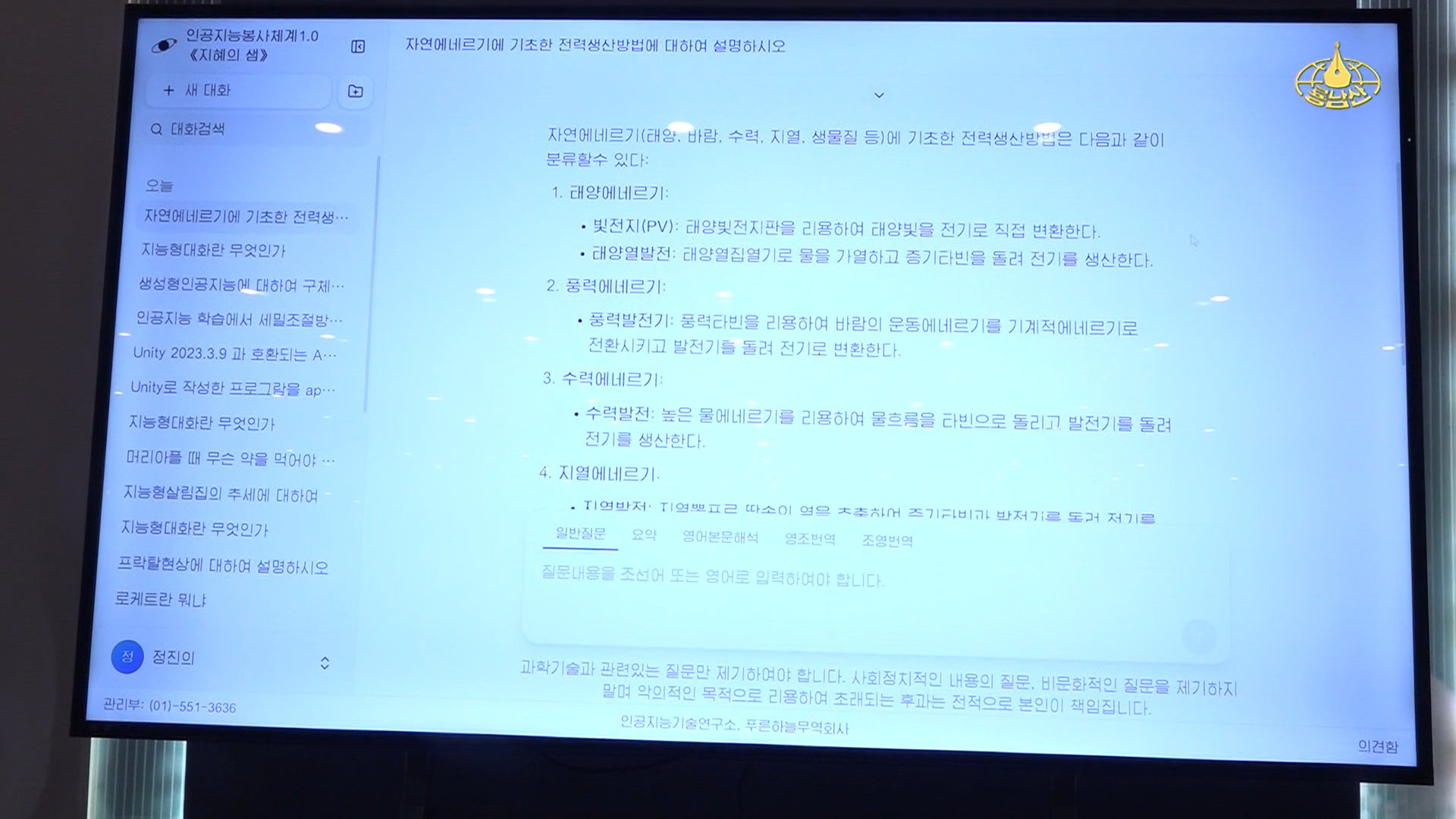
The chatbot accepts questions about science and technology topics in Korean or English and can also handle translations, according to the video.
System and Controls
While it may look familiar, the interface was likely developed domestically and simply modeled after the popular ChatGPT interface, which is also used by other AI chatbots. The more interesting question is what is running behind the screen. An entirely domestic AI chatbot would be a major undertaking, although it is more likely the “brain” of the chatbot is an open weight model from a US or Chinese AI lab, such as Google’s Gemma or Alibaba’s Qwen.
The hardware for the chatbot is not mentioned in the report. Some open weight models can run on modest PCs, albeit with an impact on the complexity and fullness of their results. Larger and more complex models require more powerful hardware.
The television video appears to show a classifier running in front of the AI engine that categorizes the input question. At one moment in the video, the chatbot says it is “analyzing” and labels the question a “factual knowledge question.” The classifier could also screen out questions on certain subjects.
At the bottom of the computer screen is a warning that seems to hint that the underlying AI engine is capable of more than just science and technology but prohibits users from asking such questions. It says: “Only questions related to science and technology may be asked. Do not ask questions with socio-political content or uncultured questions. The user alone is fully responsible for any consequences of using it for malicious purposes.”
In the chatbot demo shown on TV, the chat history shows topics such as “Unity 2023.3.9 compatibility,” “building programs with Unity,” and which medicine to take for a headache. Unity is a computer games engine.
Implications
Although this appears to be the first chatbot model touted in state media, North Korean hackers, cyber criminals and IT workers have been detected using AI chatbots for some time to help plan and execute their work. Given the little coverage of its content controls, it appears that this chatbot is intended primarily for the scientific field, or for more encyclopedic-type of knowledge.
Going forward, we can expect to see further developments around the use and implementation of AI in North Korea, although the lack of any large-scale data centers could hamper deployment of the most advanced models.