

Kim Jong Un’s Letters to Moscow: A Window Into DPRK-Russia Relations
This article was written and researched as part of the first cohort of 38 North’s Emerging Scholars Fellowship Program, under the mentorship of senior experts on North Korean affairs. The program and series were made possible through generous support by the Henry Luce Foundation. For more papers in this series, click here.
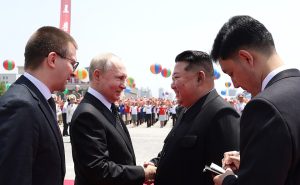 “Greetings diplomacy” describes a diplomatic practice where state leaders send letters to their foreign counterparts to either strengthen or establish partnerships. Existing research explains that official letters hold greater significance in closed societies with centrally-controlled public messaging not only as tools of diplomacy, but also as an important barometer of the regime’s foreign policy priorities and its position on key partners and allies. This also applies to the Democratic People’s Republic of Korea (North Korea or DPRK).
This brings us to a question about one of the most popular topics today: North Korea-Russia relations, and whether Kim Jong Un’s letters to Russian President Vladimir Putin are indicative of the state of this relationship.
Analysis of his letters show a clear arc: a gradual shift from boilerplate formalities to assertive alignment, reflecting Pyongyang’s pivot back to Russia since the latter’s invasion of Ukraine in 2022.
Kim’s letters in recent years have often highlighted Russia as a stalwart friend, bolstering the domestic narrative of standing strong with powerful allies against Western “hostile policy.” Especially after 2022, emphasizing Russia’s camaraderie has helped justify North Korea’s continued armament and hardship: North Koreans find strength by comparing their own fight against the “imperialists” to Russia’s battle against US- and Western-backed Ukraine. During times of diplomatic successes or abundance, Kim’s correspondence showed less urgency but when the domestic situation was difficult, such as during the first year of pandemic lockdown in 2020, he used strong language of solidarity.
The reinvigorated relationship between the two in 2019 showed a change in tone, and the Russian invasion of Ukraine marked the clearest inflection point. The correspondence that followed in 2022 demonstrates more than mutual appreciation between nations but reveals their shared ideological stance within a fragmented global context. North Korea demonstrates its alignment with Russia through Kim’s use of the terms “multipolar world” and “smashing imperialism,” which resonate with Russian rhetoric.
The consistent rhetorical alignment and heightened honorifics since 2022 signal that, at least in Kim’s worldview, the relationship has moved beyond short-term transactional exchanges toward a camaraderie rooted in personal rapport and shared opposition to perceived Western hegemony. This development merits close consideration by Seoul and Washington, as the prospect of continued Russian military and technological support to the DPRK presents enduring implications for the regional security environment.
| Scope and Methodology
This article analyzes Kim Jong Un’s correspondence to Russian President Vladimir Putin from 2012, the first full year of his reign, to 2024, to understand the ups and downs of this bilateral relationship. The author reviewed Kim’s annual letters to Putin on Russia Day (June 12) and Korea’s Liberation Day (August 15) during this 12-year period. The author also examined Kim’s ad hoc letters to Putin, including on Putin’s birthday (October 7) in 2022 and 2024; Russia’s Victory Day (May 9) in 2015 (70th anniversary), 2020, and 2022-2024; and Putin’s reelections (2012, 2018, and 2024). In addition to examining the titles and honorifics Kim uses for Putin and Russia and the structure and length of each letter, the author analyzed how Kim addressed the following four recurring themes:
|
Breakdown by Period
2012–2013: Seeking Status Quo
Despite signs that Russia under Putin was seeking a stronger relationship with Kim Jong Un’s North Korea, the new leader’s letters in his early years reflected a desire to maintain the status quo. They focused on reaffirming existing ties without promoting further engagement, suggesting limited incentive or interest in elevating bilateral relations.
Accordingly, Kim’s letters during this period were brief (none exceeded five sentences) and reserved, using stock diplomatic language and avoiding any personal tone. For example, Kim’s letters simply addressed Putin as “Your Excellency,” a standard honorific for state leaders. Absent from Kim’s letters to Putin on Russia Day and Korean Liberation Day were any criticism of the West or references to shared hostility toward common adversaries, sticking to conventional language about historical friendship instead. For instance, in his first Russia Day greetings after assuming power, Kim only highlighted the “long-standing relations of friendship and cooperation” between Pyongyang and Moscow.
Notably, in the 2012-2013 period, Kim consistently noted that the bilateral ties “are expanding and developing… in the spirit of the joint documents” signed in the past by North Korea and Russia. This signaled Kim Jong Un’s inclination to continue his father’s policy on Russia rather than pursuing a new strategy.
2014–2017: Post-Crimea Shift
During this period, Kim started to mention broadening and advancing the bilateral relationship, even subtly signaling a shared resistance to the West. For example, on Russia Day in 2015, Kim expressed conviction that bilateral ties would develop to “a higher stage.” On Korean National Liberation Day in 2015, he expressed confidence that advancing DPRK-Russia cooperation would contribute to “ensuring peace and security in Northeast Asia and the rest of the world,” signaling a broader geopolitical framing of the relationship.
This trend continued through 2016, with Kim emphasizing that cooperation is in line with the “aspiration and desire of the peoples” of the two countries. Importantly, even as Russia supported successive UN Security Council sanctions in response to North Korea’s nuclear tests, the tone and themes of the letters remained mostly unchanged.
These letters, which followed UN sanctions on North Korea in 2013 for a satellite launch and a nuclear test, and Western sanctions on Russia for its annexation of Crimea in early 2014, seem to have given Kim a sense of unity with Russia. Kim’s warmer tone toward Russia also may have had to do with deteriorating North Korea-China relations in the wake of North Korea’s weapons tests and Kim’s execution of his uncle Jang Song Thaek.
2018: Continuity
Although this was a year of North Korea’s diplomatic overtures, as witnessed by Kim’s summits with his Chinese, South Korean, and US counterparts, there was no notable progress in North Korea-Russia relations. This explains why Kim’s letters to Putin in 2018 largely mirrored previous years in theme and tone.
2019–2021: Post-Summit Era
Kim’s letters to Putin following their April 2019 summit became longer and more personal toward the Russian people and his characterizations of the bilateral relationship became more positive.
Kim’s letters also became significantly warmer about bilateral relations and prospects for development. For example, in his first post-summit message to Putin in June 2019, Kim said the meeting “served as a significant and important occasion that made a sincere and good close relationship between ourselves and opened a new history of the DPRK-Russia friendship as required by the changing international situation and the times.” Two months later, in his Korean Liberation Day letter, Kim took a step further and said bilateral relations “have entered a new high stage” and “would steadily expand and develop in several fields including politics, economy and culture in the future, too.” Even during the 2014-2017 period, when Kim’s notes to Putin became more positive, Kim merely expressed his hope that the relationship would grow in the future.
2022–2025: Strategic Convergence
Russia’s invasion of Ukraine in February 2022 was a major turning point in DPRK-Russia relations, and this is reflected in the multiple significant changes in Kim Jong Un’s correspondence to Putin compared to past years. These changes may be summed up as unreserved expressions of support for and solidarity with Russia against the West; significantly more positive references to bilateral relations; and warmer and personal references to Putin. The language grew stronger since then Russian Defense Minister Sergei Shoigu’s rare visit to Pyongyang for North Korea’s Armistice Day celebrations and Kim Jong Un’s summit with Putin in the Russian Far East, both in 2023.
For example, in Kim’s first letter to Putin after the invasion of Ukraine on the 77th anniversary of Russia’s Victory Day in May 2022—this itself being a break from past practice of congratulating Putin on the event’s 70th and 75th anniversaries, considered major anniversary years— Kim “extended firm solidarity to the cause of the Russian people to root out the political and military threat and blackmail by the hostile forces.” Similar expressions of solidarity continued into 2023 and 2024, with virtually every Kim letter to Putin voicing support for Russia.
The language of solidarity became stronger following Shoigu’s visit to Pyongyang in July 2023. In his letter to Putin the following month, Kim said: “The militant friendship and solidarity established between the armies and peoples of the two countries … are now fully demonstrating their invincibility and might in the struggle to smash the imperialists’ arbitrary practices and hegemony.” In this same letter, Kim also mentioned “strongly supporting and cooperating with each other in the course of achieving their common goal and cause.”
It is important to note that Kim’s portrayal of DPRK-Russia relations has become significantly more positive following his summit with Putin in the Russian Far East in September 2023. In his note to Putin on Russia Day in June 2024, Kim said “the DPRK-Russia friendly and cooperative relations developed into an unbreakable relationship of comrades-in-arms and a long-standing strategic relationship and are steadily developing into the higher-level state relations” owing to the summit.
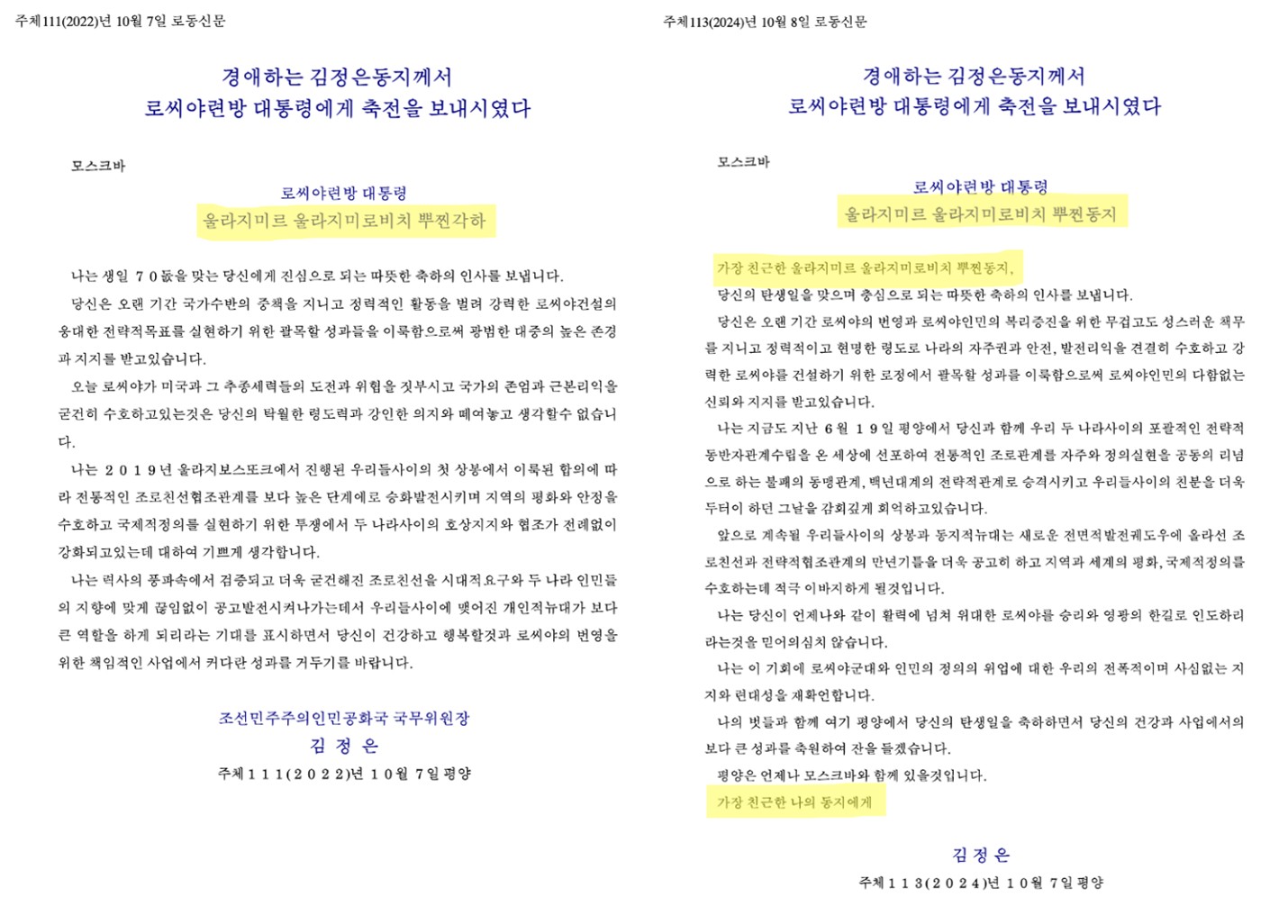
One of the most striking features of Kim’s letters since 2023 is his use of personal and ideological honorifics to refer to Putin, including “comrade [tongji;동지],” a term typically reserved for leaders of allies and partners sharing an ideological cause. In August 2023, for example, Kim began addressing Putin as “Comrade President Putin.” By October 2024 following the forging of the new DPRK-Russia treaty in June that year, Kim was referring to Putin as “the closest Comrade Vladimir Vladimirovich Putin.” This is a major shift from the stock diplomatic title of “Your Excellency” Kim used in his past letters to Putin.
Conclusion
The evolution of Kim Jong Un’s letters to Moscow from 2012 to 2024 charts a remarkable evolution: from a functional relationship to a full-bodied alliance. During his early years, Kim’s letters to Kim served as mere diplomatic formalities. North Korea’s top leadership appears to have reassessed the country’s policy toward the United States following the collapse of the second DPRK-US summit in Hanoi. What it perceived as a decline in US global leadership probably also played a part. Russia’s invasion of Ukraine in early 2022 seems to have been the final straw in North Korea’s decision to realign with Russia. This decision is reflected in Kim’s correspondence to his Russian counterpart, as examined above. As such, Kim’s letters are a reliable barometer of DPRK foreign policy trends.
While the durability and depth of the DPRK-Russia cooperation remain contested, the evolution of tone and content in Kim’s correspondence signals that the bilateral relationship has reached new heights. Kim’s recurrent references to ideological solidarity, shared anti-Western narratives, and honorifics such as “comrade” show that he considers President Putin as transcending a mere transactional counterpart. Such rhetorical evolution corresponds with notable developments in bilateral cooperation, including high-level diplomatic exchanges, mutual military and technological assistance, and the 2024 DPRK-Russia treaty providing a legal basis for joint consultations in the lead-up to or in the early stages of a military conflict (Article 3), as well as military intervention (Article 4)—mechanisms absent in earlier stages of the relationship.
As DPRK continues to refine its advanced weapons system and accumulate combat experience through its involvement in the warfronts of Ukraine, and Moscow seeks alternative partnerships to counterbalance Western isolation, both nations are building the institutional and military infrastructure conducive to sustained cooperation. This trajectory carries direct implications for regional actors. It suggests that the relationship may take root in a more durable foundation than what was initially perceived as a short-term transactional exchange, increasing the probability that Russia could assume a supportive or active role in any future conflict involving the DPRK. In sum, the convergence of rhetorical alignment evident in Kim’s correspondence and institutionalized DPRK-Russia military cooperation necessitates that Seoul and Washington carefully calibrate their regional strategy to adapt to this evolving alliance.