

North Korea Emphasizes Corporate Management and Legal Regulations, Cultivates Japan-Based Korean Students
This article is from the second edition (July-September 2025) of 38 North’s new quarterly product, North Korea Briefing, that monitors key internal developments in North Korea. For the full series, click here.
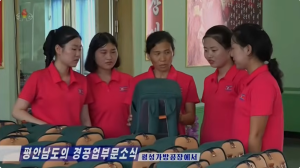
During the third quarter, North Korea’s selection of its “top 10 outstanding companies” indicated tighter state controls and pro-market practices continue to coexist despite the trend of greater centralization in recent years. The North Korean parliament enacted new grain management and intellectual property laws, seeking to ensure stable grain distribution in local provinces and establishing a legal framework to defend North Korea against outside influence as it expands exchanges and cooperation with foreign countries. Meanwhile, visits by Japan-based Korean students to high-profile tourist sites appear to reflect Pyongyang’s efforts to cultivate diaspora ties with an eye toward potential future investment.
“Top 10 Outstanding Companies of 2024” Selected
In early September, the North Korean Party daily reported on the selection of “top 10 Outstanding Companies of 2024.”[1] These units are: Tanchon Smeltery; Taean Heavy Machine Complex; Rason Hyesong Consolidated Development Corporation (also known as Rason Hyesong Trade Company); Pyongyang Electric Cable General Factory 326; Samchong Mine of the Sangwon Cement Complex; Kangso Sprayer Factory; Pyongyang Hosiery Factory; Pyongsong Bag Factory; Huichon Silk Mill; and Ryongchon Mine of the General Bureau of the Tanchon Area Mining Industry. This event, held annually since 2023, has promoted selection criteria that consider not only production scale and growth but also “corporate management.”
Context and Implications
The general assessment among North Korea watchers is that the country has strengthened central control over the economy in recent years to overcome the economic downturn caused by international sanctions and North Korea’s COVID-19 lockdown.[2] As evidence, they have commonly pointed to Pyongyang’s emphasis on the execution of state economic plans and a rollback of state-run enterprises’ operational autonomy and non-state sectors’ freedoms.[3]
However, the criteria for selecting exemplary companies since 2023 shows that North Korea is not only emphasizing contributions to national economic policy but is also encouraging corporate management expertise, which includes innovative approaches to business operations and the ability to achieve results despite challenging conditions. What this indicates is that, despite North Korea’s post-COVID shift toward greater centralization, the regime continues to emphasize corporate management in line with on-the-ground conditions. This means that tighter state controls and pro-market tendencies, which defined Kim Jong Un’s economic policy until 2016, continue to coexist.
Fall Parliamentary Session Held
During its two-day session on September 20 and 21, the Supreme People’s Assembly (SPA) enacted grain management and intellectual property laws and approved the decision “On Thoroughly Executing the Law of the DPRK on Urban Management.” According to the meeting report, Kim Jong Un designated the construction of city- and county-level grain management stations as one of three essential projects under the “20×10 Regional Development Policy,” which calls for building industrial factories in 20 cities and counties each year over the next decade, with their construction to be carried out under state responsibility.
Context and Implications
The issues of grain administration in rural areas can be broadly divided into: a) purchasing grain from producers, and b) ensuring a stable supply to the non-agricultural population. The SPA’s mention of the 20×10 policy likely stems from an assessment that consistent state grain management as mandated by the grain management law cannot be achieved without constructing facilities to ensure a stable grain supply as some cities and counties lack such infrastructure.
The new intellectual property law is notable for its potential connection to the expansion of foreign economic relations. Contrary to conventional wisdom, North Korea places importance on projecting itself as a responsible, law-adhering member of the international community. In his SPA speech, Kim remarked:
“With the promotion of our exchanges with other countries in recent years, law-enforcement organs should work out a better strategy for, and adopt an aggressive, comprehensive and rigorous approach towards, frustrating the enemy’s moves to undermine our system and degenerate our citizens and combatting all manner of crimes that disturb social and political stability.”
Kim was clearly stressing the importance of the law to defend the North Korean system against outside influence as the country expands exchanges and cooperation with foreign countries, while also recognizing the significant role the law plays in promoting external economic relations.
Japanese-Korean Students Visit Various Tourist Attractions in North Korea
According to Choson Sinbo, a newspaper operated by the pro-DPRK General Association of Korean Residents in Japan (GAKRJ; Chongryon), a first delegation of Korea University (Japan) students visited Wonsan, Kangwon Province and Yangdok County, South Pyongan Province from September 2 to 4 and visited various tourist sites, including the Wonsan-Kalma Coastal Tourist Area that opened on July 1, and the Yangdok Hot Spring Cultural Resort.
Context and Implications
The students’ visit appears to reflect North Korea’s new policy on the role of Chongryon organizations. Kim Jong Un did not send his customary New Year’s message to the GAKRJ in 2025. Instead, he sent a letter in May to ethnic Koreans in Japan, including GAKRJ officials, to mark the 70th founding anniversary of Chongryon. Kim’s letter emphasized the importance of Koreans in Japan visiting North Korea both to preserve their national identity and to ensure that “the rising generations can witness the development of their homeland with their own eyes.”
Ethnic Korean-Japanese students’ recent visits to new tourist sites prioritized by North Korea indicate these sites boast high-quality facilities that can potentially open to more foreigners in the future. Furthermore, it seems North Korea’s propaganda targeting younger generations of ethnic Koreans in Japan is at least partly aimed at shaping their future decisions on direct investments in the DPRK. We should note that overseas Chinese investments greatly contributed to China’s economic development during the early stages of its reform and opening up. In this regard, we should continue to closely monitor North Korea’s policy toward younger generations of the GAKRJ.
- [1]
Ri Chol Ok, “2024년 10대최우수기업이 선정되였다[Top 10 Outstanding Companies of 2024 Selected],” Rodong Sinmun, September 2, 2025.
- [2]
See, for example, Ruediger Frank, “Key Results of The Eighth Party Congress in North Korea (Part 1 of 2),” 38 North, January 15, 2021, https://www.38north.org/2021/01/key-results-of-the-eighth-party-congress-in-north-korea-part-1-of-2/; Sang Yong Lee, “Beyond State Control: The Struggle Over North Korea’s Markets,” 38 North, September 9, 2025, https://www.38north.org/2025/09/beyond-state-control-the-struggle-over-north-koreas-markets/.
- [3]
The non-state sector includes the retail of produce from agricultural workers’ private plots, individual transactions, commerce in regional markets, and the wholesale and distribution businesses supplying them. It also encompasses factories and real estate developers that operate as state-owned enterprises or cooperatives but originated from private investment.