

Quick Take: North Korea’s Post-Summit Public Messaging on China
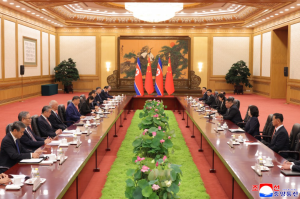
North Korean media coverage of China following Kim Jong Un’s September 4 talks with President Xi Jinping reaffirms Pyongyang’s commitment to improve ties and even indicates some progress. However, the post-summit coverage—its reporting of Foreign Minister Choe Son Hui’s visit to Beijing and Kim Jong Un’s two letters to Xi—lacked warmth despite the recent summit, suggesting distance remains between the two countries.
Summit Coverage
North Korea’s official report on the Kim-Xi summit suggested that, while the two countries have taken the first steps to mend frayed ties, their relationship has not yet been fully restored. Although the report included some positive references to the bilateral ties, it was brief, vague about the topics discussed, and lacked language pointing to alignment between the two leaders compared to North Korea’s reporting on past Kim-Xi summits.
Post-Summit Messaging
This same pattern caried over to North Korean media’s coverage of Choe’s meetings with Chinese Foreign Minister Wang Yi and Premier Li Qiang in Beijing, as well as Kim’s two letters to Xi—Kim’s reply to Xi’s congratulatory message on North Korea’s founding day and Kim’s congratulatory letter on China’s founding anniversary (October 1).
The North Korean report on the Choe-Wang meeting stated the two officials “reached a full consensus of views [완전한 견해일치]” on “international and regional issues,” without expounding on them.[1] This was notable progress from North Korea’s Kim-Xi summit report, which was altogether devoid of language on alignment. However, the civil but aloof tone of the North Korean reports on Choe’s meetings indicated that distance persists despite the apparent progress in relations. For example, they did not describe the talks’ atmosphere, nor was there pro forma opening language praising bilateral relations typically found in reports on meetings with the Russians.
Both of Kim’s letters reaffirmed his commitment to improving ties with Beijing, with much of the language on cooperation lifted or slightly modified from the recent summit readout.[2] The letters, therefore, were more positive compared to 2024, when the relationship was at a low point, and in some ways the summit report. For example, Kim’s reply to Xi brought back China’s “invariable support” for North Korea, stock language that was absent from his same letter in 2024. “Relations of friendship and cooperation between the DPRK and China,” while a standard formulation, was a step-up from Kim’s reference to simply “DPRK-China relations” during his latest talk with Xi. Kim’s congratulatory letter to Xi said he “has a willingness to make … efforts” to “defend peace and stability in the region and the rest of the world,” which was absent from the summit report and his 2024 message. This formulation is near-identical to his letters in 2021, 2022, and 2023, although this year’s “has a willingness to make … efforts [노력할 용의가 있습니다]” is weaker than “will strive [적극 노력할것입니다]” in 2022 and 2023.
On the whole, however, both messages remain cool compared to the same letters Kim sent Xi from 2018 until even 2023, when relations were better. To start, this year, Kim thanked Xi’s North Korean founding day congratulations without an adjective. However, between 2018 to 2023, Kim’s thanks were enforced by adjectives such as “deep” or “heart-felt.” Moreover, this year’s letters mentioned “cooperation” but did not use formulations suggesting stronger solidarity, such as “comradely unity [동지적단결]” or “precious common wealth … and strategic option [공동의 귀중한 재부이며 전략적선택].”
Curiously, in both his messages this year, Kim departed from past practice by avoiding the standard first-person pronoun “I” when pledging stronger cooperation with China or Xi. Instead, he employed the collective formulations of “the DPRK together with the Chinese comrades” or “The DPRK side … together with the Chinese side.” Until 2024, Kim consistently used “I” in reference to joint efforts with Xi in most years on October 1. For example, Kim’s congratulatory letter to Xi in 2023 said, “I, together with you, will strive to consolidate and develop the DPRK-China friendly relations…” The meaning of this shift toward depersonalizing Kim-Xi cooperation remains unclear. If intended to signal Kim’s uncertainty about Pyongyang-Beijing ties, North Korea’s handling of the Kim-Xi summit “consensus” may be of relevance. North Korea has not attributed any “important common understanding [중요한 공동인식]” reached by Kim and Xi to its officials, leaving such references solely to Chinese counterparts, which is consistent with the absence of alignment language in its own summit report.[3]
Looking Ahead
The rank of the Chinese delegation attending North Korea’s October 10 military parade marking the Party’s 80th founding anniversary will likely serve as another litmus test for Pyongyang-Beijing relations.
- [1]
While North Korea did not provide details on the topics of this discussion, the Chinese report said the two officials talked about stepping up communications and working together to resist “unilateralism and power politics” and promote “a fairer and more just world order.” See “Chinese FM holds talks with DPRK FM,” Xinhua, September 29, 2025, https://english.news.cn/asiapacific/20250929/443feb918ecf4d6fa2ec1ba8a58ece1b/c.html.
- [2]
Kim’s reply to Xi said: “It is the steadfast stand of the Workers’ Party of Korea and the government of the Democratic People’s Republic of Korea to further strengthen and develop the traditional relations of friendship and cooperation between the DPRK and China as required by the times.” Kim’s congratulatory letter pledged to “steadily develop the traditional DPRK-China friendship no matter how the international situation may change” and mentioned “further strengthen[ing] and develop[ing] the friendly and cooperative relations… through the close strategic communication and cooperation.” This language resembles North Korea’s report on the Kim-Xi summit, which stated that Kim affirmed “the friendly feelings between the DPRK and China can not change no matter how the international situation may change and it is the steadfast will of the WPK and the government of the DPRK to steadily develop the DPRK-China relations,” while noting the two leaders discussed strategic cooperation and communication.
- [3]
“DPRK FM Choe Son Hui Holds Talks with Chinese FM Wang Yi,” Korean Central News Agency (KCNA), September 29, 2025, http://www.kcna.kp/en/article/q/cc0bac221b683b116ec2f6795d97c824.kcmsf; “DPRK Foreign Minister Meets with Premier of State Council of China,” KCNA, September 30, 2025, http://www.kcna.kp/en/article/q/f7460c67f6500449acd579bfb104f69e.kcmsf. According to China’s official readout of its Wang Yi’s meeting with Choe Son Hui, Choe mentioned “the consensus reached by the top leaders of the two parties and the two countries,” but this was omitted from the North Korean version. See “Chinese FM holds talks with DPRK FM,” Xinhua, September 29, 2025, https://english.news.cn/asiapacific/20250929/443feb918ecf4d6fa2ec1ba8a58ece1b/c.html.