

North Korea Rebuilds Anti-American Rhetoric and Education
This commentary draws on a corpus of Democratic People’s Republic of Korea (DPRK) state media spanning 1998 to 2025, with a preliminary check of early 2026 data.
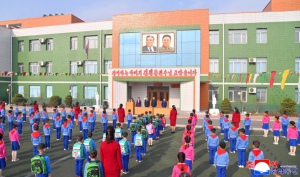
On April 18, North Hamgyong Province’s education bureau reportedly directed schools to integrate anti-American content across a range of classroom subjects. A DailyNK source described the cross-subject mandate as “the first of its kind,” though the directive itself has not appeared in official North Korean (Democratic People’s Republic of Korea or DPRK) media. Far from an isolated measure, this directive (hereafter, the April 18 directive), fits into a broader pattern in North Korea’s public anti-American messaging, which shifted first during and again after summit diplomacy.
The most dramatic narrative change was observed in 2018, after the first US-DPRK summit in Singapore. At that time, Korean Central News Agency (KCNA), North Korea’s main externally-focused state media outlet, largely dropped the core anti-American lexicon from its reporting for a period of about four years. Based on a 145,381-article corpus of Korean-language KCNA, the standard epithet 미제 (“American imperialists”) appeared on 84 percent of publication days in 2017, fell to only 16 percent in 2018, and stayed near zero from 2019 through 2021. The corpus captures only public-facing output, and the timing alone does not establish causation. Regardless, the scale of the change is difficult to dismiss.
The parallel question is what happened to anti-American education during the same period. Did the educational channel mute its messaging alongside external diplomacy, or did it follow a different trajectory? Although public reporting on anti-American educational messaging contracted, available evidence from textbooks, internal party materials, and state media reporting on class-education institutions indicates that the broader infrastructure and internal messaging for anti-American education persisted during 2018–2021. In contrast to the near-total disappearance of anti-American terminology in KCNA’s diplomatic reporting, the educational record shows institutional continuity rather than a documented rollback.
Since around 2022, anti-American terminology has resurged in KCNA reporting and new laws and mandates, such as the April 18 directive, have emerged to bolster anti-American education. These new educational initiatives are intended to shape the ideological framing of DPRK’s relations with the US for generations. A sustained alignment between public rhetoric and educational narratives can help reinforce a more durable identity framework. However, a mismatch of messaging, such as what was observed during the summit period, risks generating confusion and undermining these frameworks. Understanding and monitoring whether and how anti-American education develops alongside shifts in public messaging may therefore be useful for assessing North Korea’s longer-term diplomatic intentions.
The KCNA Vocabulary Gap
The corpus, built from the kcna.co.jp archive, tracks these anti-American rhetorical shifts in KCNA’s public-facing output. KCNA is best understood as an externally oriented state-media channel rather than as a direct measure of domestic media consumption. As Rachel Minyoung Lee notes, KCNA transmits items through feeds for outside subscribers and websites accessible from outside North Korea, while domestic print outlets such as Rodong Sinmun may carry selected KCNA-bylined items deemed appropriate for internal readers. Average North Koreans are unlikely to encounter this Internet-based output directly; any domestic exposure would be mediated through selected republication or adaptation in domestic outlets.
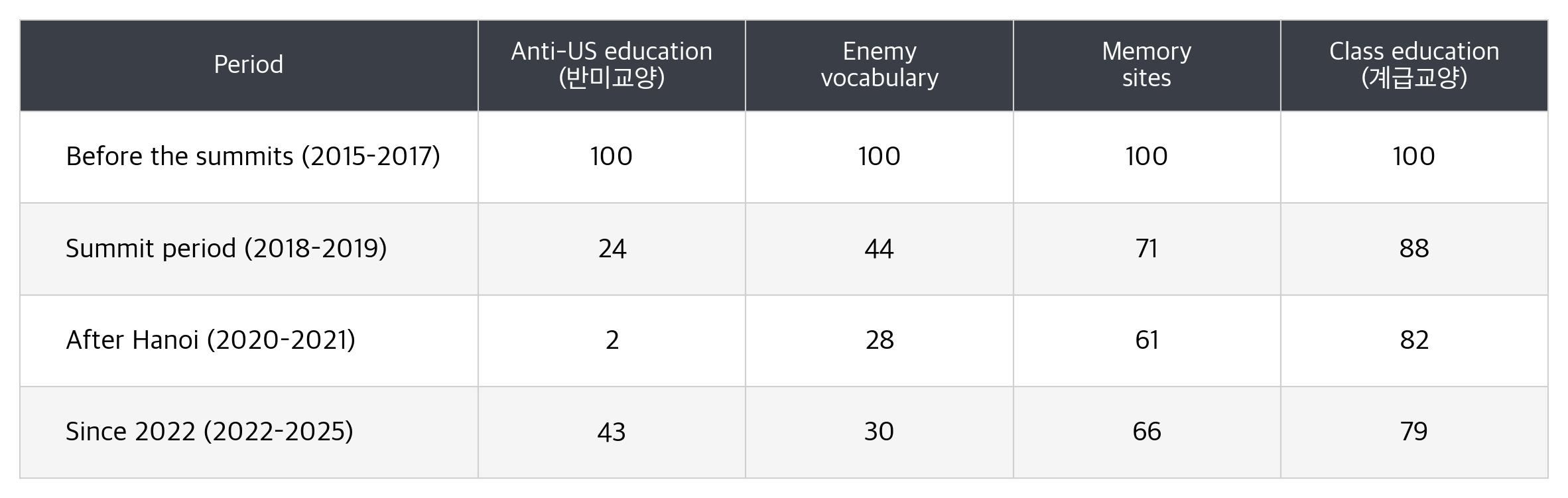
While KCNA provides the external, diplomatic baseline shown in Figure 1, reporting on education is concentrated in the domestic daily Rodong Sinmun, which supplies the measures presented in Table 1.[1]
Because article segmentation within KCNA daily files is inconsistent across years, the unit of analysis is the publication day: whether a given keyword appeared at least once on a given day. This measure better reflects changes in editorial line while being less affected by fluctuations in daily output volume.
Figure 1 tracks two enemy-label terms: 미제 (“American imperialists”) and 괴뢰 (“puppet,” used chiefly for South Korean authorities). Figure 1 also includes 통일 (“unification”) as a reference term from the same peninsular political vocabulary, providing a reference point for how a major non-enemy term moved during the same period.
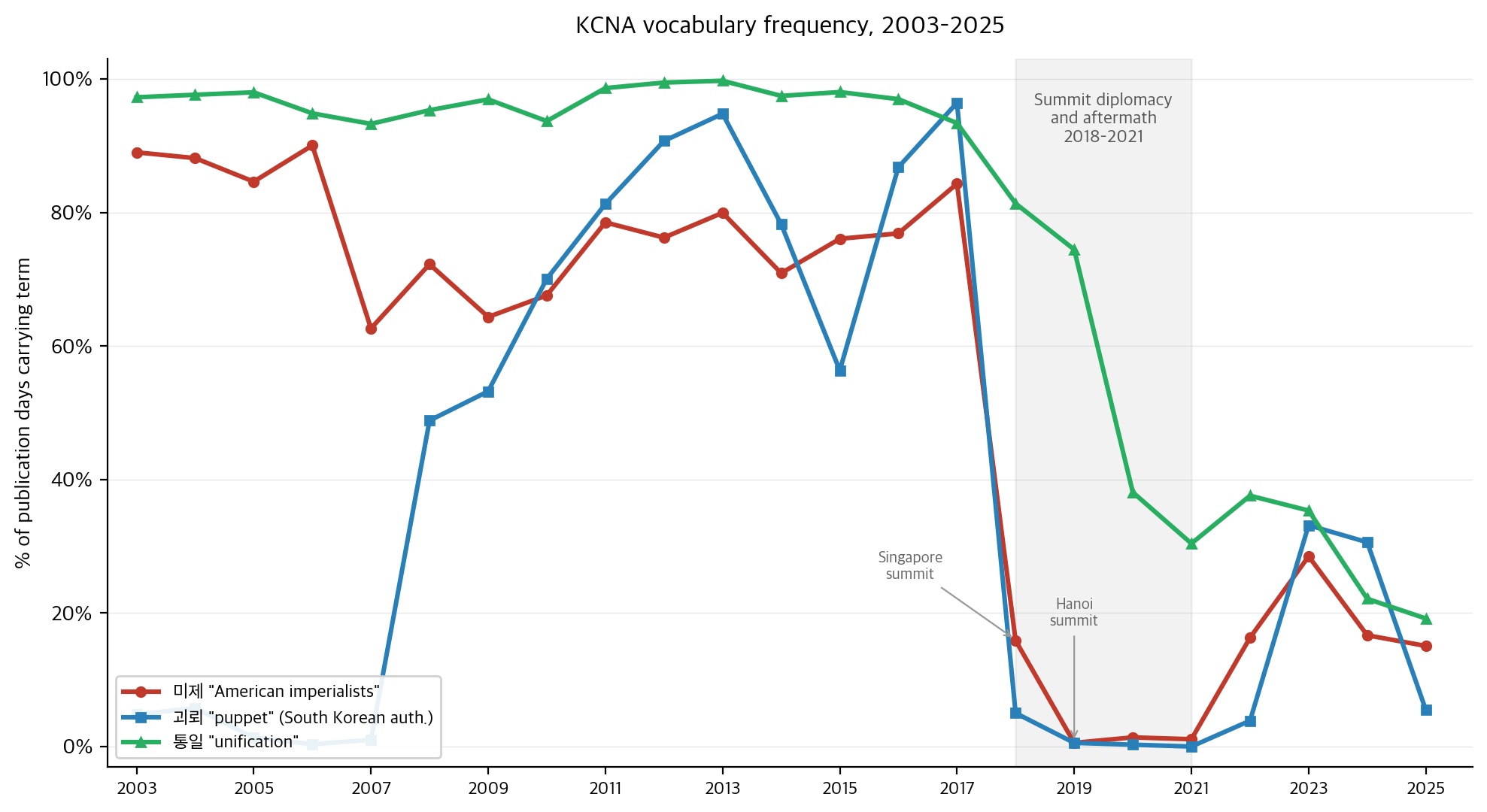
In 2017, 미제 appeared on 306 out of 363 publication days. However, following the Singapore summit in June 2018, that figure fell to 16 percent. By 2019, the year of the Hanoi Summit, both 미제 and 괴뢰 (“puppet,” used for South Korean authorities) hit 0.5 percent, appearing on only two publication days each out of 364 for the entire year. They stayed near zero through 2020 and 2021.[3] Before 2018, both 미제 and 괴뢰 had been prolific terms in KCNA’s daily vocabulary. Their nearly total disappearance marked a temporary suspension of the pre-summit threat lexicon.
Not only were these negative terms removed from KCNA coverage, but positive characterizations of the relationship with the US were added. For instance, on June 13, 2018, KCNA declared that the two countries would “bury the unhappy past” as “an era of DPRK-US cooperation” (조미협력의 시대) unfolded.[4] However, this positive shift in language did not last long after the failure to reach an agreement with the United States.
The timing of KCNA’s initial decision to drop this language aligns with an editorial adjustment to create space for engagement with Trump. It is less clear why the vocabulary stayed suppressed through 2020 and 2021, although restoring it would likely have required deliberate planning. After the Hanoi Summit failed, COVID isolation set in, and KCNA narratives shifted toward self-reliance and pandemic mobilization. These conditions may help explain why the regime had little immediate incentive to restore terms it had so recently dropped.
The reemergence, when it came, was partial. By 2023, 미제 appeared on 28 percent of publication days. By 2025, amid renewed speculation about a possible Trump-Kim channel and Pyongyang’s conditional language toward Washington, the occurrence had hovered around 15 percent.[5] The post-2022 spike also coincided with geopolitical realignment. The four-month gap between Russia’s February 2022 invasion of Ukraine and the resumption of anti-American military propaganda in June 2022 suggests that the shifting external environment may have eased the earlier restraint on Pyongyang’s rhetoric, though the correlation does not prove causation.
By 2025, KCNA reports on school instruction were once again carrying a familiar warning: students, it said, were being taught that “illusions about the enemy mean death.”[6] The line echoed Kim Jong Un’s 2015 field guidance at the Sinchon Museum of American War Atrocities, a site built for anti-American class education, where he warned that anyone harboring “even the slightest illusion about the enemy cannot escape death.”[7] While the state newswire’s return to such language does not reveal what actually takes place in classrooms, it does mark the reappearance of explicit anti-American messaging in the regime’s public account of its educational work. Whether the educational channel moved in tandem with KCNA’s diplomatic vocabulary is difficult to determine from open sources. What can be examined, however, is the available record of textbooks, internal materials, and institutional activity during the summit period.
Why Classrooms, Not Newspapers
State media, especially externally-focused messaging, can omit and restore vocabulary as needed and as conditions change. But this flexibility operates on a different track from the kind of cognitive framework schools are meant to build, which are slower to change and harder to reverse. Ideological education itself is not new; it has long been woven into the regime’s identity and survival narrative.
Seventy-seven textbooks published between 2013 and 2015 were smuggled out of North Korea and analyzed in April 2017, when the same editions were confirmed in use under the twelve-year compulsory education system. A first-grade morality textbook included an image of a soldier shooting at American-soldier targets, captioned “beat the American bastards” (미국놈 때려잡기), and a high-school classical-Chinese textbook called 미제 (“American imperialists”) a “sworn enemy” of the Korean people (철천지 원쑤). Similar material appeared across art, history, and other subjects.[8]
While newer editions have since been printed, no available reporting has documented a systematic removal of anti-American content from the curriculum during the summit period. Sources with access to the North Korean educational environment at the time focused primarily on the suspension of public rallies rather than on curriculum changes. No reporting of a curriculum-level rollback has emerged in either the summit years or the post-2022 intensification of ideological sessions
Internal party materials from the early phase of the summit period present a similar picture. A January 2019 DailyNK report, based on party-lecture materials circulated in late 2018, described the United States as “imperialist” and South Korea as an American “colony,” even as KCNA had largely dropped such language from its public reporting. Although drawn from a single source, the report is consistent with the broader pattern: the public signal softened while the internal ideological pipeline continued to carry anti-American content.
The institutional infrastructure for class education predated the summit period. Kim Jong Un, in his 2015 field guidance at the Sinchon Museum of American War Atrocities, designated anti-imperialist class education as “an important direction of our Party’s ideological work,” warning that with “new generations who have not experienced the trials of war” forming the revolution’s main force, such education was “an urgent matter that cannot be neglected for a single moment.”[9] A year later, the regime renovated and reopened the Central Class Education Hall (중앙계급교양관) in Pyongyang.[10]
During the 2018-2021 period, this institutional infrastructure remained in place. Although KCNA’s coverage of class-education halls fell by two-thirds, Rodong Sinmun continued to carry reporting on them at a largely steady rate,[11] NK Pro also documented continued weekday bus activity at the Sinchon Museum from early 2018 through mid-2019, even after foreign tour groups were barred from the site, though the visitors could not be independently identified. This divergence indicates that although external messaging softened, the institutional infrastructure for anti-American class education remained operational and visible in domestic reporting. However, students who attended secondary school between 2018 and 2021 spent those formative years in a media environment largely scrubbed of the explicit anti-American messaging that had helped shape previous generations. How this affected their understanding of the United States and the regime’s relationship with it is not yet clear from open sources.
Since 2022, it appears that efforts to reinforce anti-American narratives in educational settings have intensified. KCNA has reported class-education activities at universities across multiple cities, as well as model school activities and student rallies in Pyongyang during the annual June 25 anti-US struggle period in 2025.[12] [13] On the ground, the measures appear more intensive: schools in North Pyongan province reportedly shifted from quarterly to daily ideology sessions, with students checked for comprehension rather than attendance. Cross-subject integration of political-ideological content has long been a principle of DPRK socialist education, but the April 18 directive in North Hamgyong province schools reportedly made the anti-American component more explicit, requiring it to be embedded across Korean language, English, music, and art. These efforts have taken place alongside a broader tightening of ideological control over young people. The 2020 Reactionary Ideology and Culture Rejection Law and the 2023 Pyongyang Cultural Language Protection Act, both enacted after US-DPRK negotiations had stalled, expanded the legal basis for targeting foreign cultural influence among youth. Neither law specifically mandates anti-American education and the evidence for implementation remains unevenly distributed. The most detailed accounts come from two Chinese-border provinces, while Pyongyang’s official coverage tends to highlight model activities and ceremonial mobilization. That imbalance may reflect stronger enforcement in border regions, easier information leakage, or both.
Table 1 reinforces this picture of institutional continuity from the domestic media side. In Rodong Sinmun, explicit anti-US education vocabulary fell to 2 percent of its pre-summit level after the Hanoi failure, while the broader class-education frame barely moved, remaining above 80 percent throughout. What returned after 2022 was selective: anti-US education terms re-emerged at roughly two-fifths of their pre-summit level, while broader enemy vocabulary stayed flat, suggesting that the post-2022 push has been targeted rather than a wholesale restoration of pre-summit rhetoric.
How Education Frames Diplomatic Outcomes
The resumption of anti-American education does not necessarily negate future diplomacy with the United States. There are ways in which the regime can frame diplomatic outcomes to fit the broader narrative goals. For instance, if a summit between Kim and Trump does eventually take place and produces an agreement, classrooms can present the compromise as evidence that North Korea’s nuclear resolve forced Washington to abandon its historical hostile policy toward Pyongyang. If negotiations fail, the same classrooms can present failure as confirmation of what they already teach: that American hostility is structural rather than situational. Either outcome reinforces the underlying lesson. Recent regime statements treating the Iran strikes as validation of Pyongyang’s nuclear path suggest how quickly external events can be absorbed into this logic, and there is little reason to expect future summit outcomes to be treated differently.
Indicators to Watch
Given all these trends, three thresholds may indicate whether the post-2022 intensification of anti-American education is a temporary course correction or becoming national policy.
The first is geographic spread. The kind of cross-subject integration mandated by the April 18 directive has so far been reported only in North Hamgyong, though intensified ideology sessions have separately been documented in North Pyongan. Similar orders in other provinces would suggest coordination, and a national-level directive from Pyongyang would confirm that the campaign has moved beyond provincial implementation.
The second threshold is administrative embedding: revised textbooks, standardized lesson plans, anti-American content folded into examinations. A June 2025 KCNA article documents class-education activities at Pyongyang primary and secondary schools, but describes them as discrete events, not a coordinated curriculum rollout. KCNA’s coverage of routine pedagogical work is partial at best, and an absence in reporting should not be read as an absence on the ground. However, formalization at the primary-school level, particularly with anti-American content built into grading, would likely indicate a deeper stage of implementation.
The highest threshold is implementation capacity: whether teachers are trained, monitored and disciplined to deliver the campaign. Teacher reliability appears to have become a regime concern. In 2025, DailyNK reported public criticism sessions at Chongjin Medical College, also in North Hamgyong province, against instructors who skipped mandatory ideological sessions, with inspectors describing non-compliance as “a grave act that blocks the progress of the revolution.” That such sessions are being held at all suggests the problem is not isolated, although how widespread teacher non-compliance has become is difficult to gauge from open sources. Large-scale retraining of teachers, if it materializes, would suggest the campaign has moved from directive to delivery.
Overall, despite the changes in anti-American vocabulary during the summit and early-post summit period, it does not seem to have changed the ideological framing in North Korea’s educational curriculum. As the public narrative is reintegrating the anti-American terminology, and if the April directive holds, it appears this will be intensified in classrooms as well. While the summit period produced a temporary divergence between how the enemy was publicly named in state media and how class-education activity continued to be reported, it was only temporary. However, the educational investment is likely to outlast any single US presidency and color North Korean perceptions and political will toward the US long into the future.
- [1]
The main corpus was assembled from the public KCNA archive at kcna.co.jp, covering daily output from 1998 to 2025 (145,381 articles). Coverage is consistent from 2003 onward; before 2003 the archive carries roughly half the daily text volume of later years, a pattern visible in both the Korean and English editions, so the day-level series begins in 2003 to avoid a discontinuity that reflects archive density rather than a change in KCNA’s editorial line. 2025 coverage is complete, with 365 publication days. A preliminary 2026 check adds 929 articles from the first 98 publication days. The term 괴뢰 is used almost exclusively for South Korean authorities in the corpus; rare instances targeting other actors do not materially affect the trend data. The full methodology and aggregated data are available upon request.
- [2]
A preliminary check of the first 98 KCNA publication days in 2026 shows 미제 appearing on 4.1 percent of days, a pattern consistent with continued restraint in KCNA’s public-facing enemy-label vocabulary. Because this is a partial-year sample, it is not included in the annual comparison.
- [3]
미제 was not literally absent from KCNA during 2019–2021 (2 publication days in 2019, 5 in 2020, 4 in 2021). 괴뢰 followed a similar trajectory (2 publication days in 2019; 1 in 2020, and none in 2021). Both terms continued to appear in commemorative and historical contexts, including a June 25, 2020 article on Sinchon massacre atrocities. The suppression applied to routine daily usage, not to the concepts themselves.
- [4]
“김정은위원장 력사상 첫 조미수뇌상봉과 회담, 공동성명 채택” (Kim Jong Un Holds First-Ever DPRK-US Summit Meeting and Talks, Joint Statement Adopted), Korean Central News Agency, June 13, 2018. Archived in the author’s KCNA corpus.
- [5]
A preliminary check of the first 98 KCNA publication days in 2026 shows 미제 appearing on 4.1 percent of days, a pattern consistent with continued restraint in KCNA’s public-facing enemy-label vocabulary. Because this is a partial-year sample, it is not included in the annual comparison.
- [6]
“평양시안의 보통교육단위들에서 반제반미계급교양 전개” (Anti-Imperialist, Anti-American Class Education Unfolds in General Education Units within Pyongyang), Korean Central News Agency, June 13, 2025, KCNA Watch. The article names three senior middle schools and two elementary schools across four Pyongyang districts conducting class-education activities. The phrase “illusions about the enemy mean death” (적에 대한 환상은 곧 죽음) appears verbatim in the article. Archived in the author’s KCNA corpus.
- [7]
Kim Jong Un’s field guidance at the Sinchon Museum of American War Atrocities: KCNA, “경애하는 김정은동지께서 새로 건설한 신천박물관을 현지지도하시였다” (Respected Comrade Kim Jong Un Gives Field Guidance to the Newly Built Sinchon Museum), July 23, 2015, KCNA Watch. Korean originals: “반제반미계급교양을 우리 당사상사업의 중요방향으로” (important direction); “전쟁의 시련을 겪어보지 못한 새 세대들이 우리 혁명의 주력으로 등장한 오늘…한순간도 소홀히 할수 없는 절박한 문제” (new generations/urgent matter); “원쑤들에 대하여 털끝만 한 환상이라도 가진다면 죽음을 면치 못한다” (illusion about the enemy/cannot escape death).
- [8]
Ishimaru Jiro, “North Korean Textbook Reveals Indoctrination,” Asia Press / Rimjin-gang, July 8, 2016; RFA, “북한 개정 교과서, 반미교육 여전,” April 14, 2017. The collection of 77 textbooks (교육도서출판사, 2013-2015) was smuggled out of North Korea and digitized by Asia Press. KCNA confirmed nationwide supply of twelve-year-system textbooks on April 11, 2017. The Grade 1 socialist-morality textbook (사회주의 도덕, “우리 생활과 건강” section) captions the shooting image “미국놈 때려잡기도 함께 합니다”; the Grade 3 classical-Chinese (한문) textbook reads “미제는 조선인민의 철천지 원쑤”.
- [9]
See note 7.
- [10]
KCNA, “새로 꾸려진 중앙계급교양관 개관” (Newly Renovated Central Class Education Hall Opens), June 24, 2016, KCNA Watch. The Hall predates this renovation; KCNA references to the institution appear as early as 2004; also archived in the author’s KCNA corpus.
- [11]
Article counts for 계급교양관 (class-education halls): KCNA 33 (2015–2017), 11 (2018–2021), 69 (2022–2025); Rodong Sinmun 128, 124, and 206 over the same periods. Period lengths differ (3, 4, and 4 years respectively); see Table 1 and note 14 for period-normalized rates across the broader term set. KCNA’s coverage fell by two-thirds in raw article counts across the first two periods while Rodong Sinmun remained the larger share.
- [12]
KCNA articles reporting anti-imperialist class education at multiple institutions: “각지 대학청년동맹조직들에서 반제반미계급교양 심화” (Anti-Imperialist, Anti-American Class Education Deepened at University Youth League Organizations across Regions), March 18, 2024, KCNA Watch, naming universities in Pyongyang, Chongjin, Haeju, Sariwon, Hamhung, Sinuiju, and Pyongsong; “각지 대학청년동맹조직들에서 사상사업에 주력” (University Youth League Organizations across Regions Focus on Ideological Work), October 28, 2024, KCNA Watch Chongnyon Chonwi. Both archived in the author’s KCNA corpus.
- [13]
See note 6.
- [14]
Table 1 figures are indexed to each series’ 2015-2017 rate (= 100), computed from articles per 1,000 carrying each term in the author’s Rodong Sinmun corpus: 127,747 articles of daily output for 2015 to 2025, archived by KCNA Watch (kcnawatch.org) and de-duplicated by URL. As the domestic daily, Rodong Sinmun carries substantially more educational-institution reporting than KCNA’s externally facing wire, which has too few such items to index. Pre-summit (2015-2017) rates per 1,000 articles were: anti-US education 2.5, enemy vocabulary 230, memory sites 37, and class education 10.2. “Anti-US education” tracks 반미교양; “class education” tracks 계급교양; “enemy vocabulary” tracks any of 미제, 반미, 반제, 원쑤, 침략자, or 적대세력; “memory sites” tracks any of 신천박물관, 계급교양관, 혁명사적지, 혁명전적지, or 혁명박물관. Total articles per period: 32,406 (2015-2017), 24,374 (2018-2019), 24,498 (2020-2021), 46,469 (2022-2025). Because the index is based on rates per 1,000 articles, it accounts for the different period lengths and output volumes. The table uses complete calendar years only; preliminary 2026 data are excluded from the period comparison and discussed separately. The full data file is available upon request.