

North Korea’s Posturing Toward China Ahead of Xi’s Visit
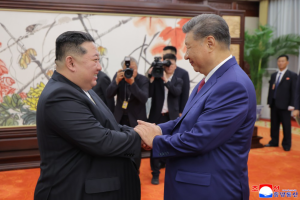 Chinese President Xi Jinping’s upcoming state visit to North Korea—his first since June 2019 and following meetings with the US and Russian presidents in May—has sparked widespread speculation about China’s timing and motives.
One overlooked dimension is Pyongyang’s effort to shape the agenda before Xi arrives. In the weeks leading up to the summit, North Korea has pursued a dual-track strategy: showing greater support for Beijing’s positions on Taiwan and Japan—issues central to China’s regional security concerns—while simultaneously warning that its nuclear status is non-negotiable. Together, these signals suggest that Pyongyang is seeking not merely improved ties with Beijing but a relationship aligned with its own strategic priorities, above all Chinese acceptance of North Korea’s nuclear status.
Context: Pyongyang-Beijing Ties After Wang Yi Visit
Although the Kim-Xi summit in Beijing in September 2025 was a first step toward repairing frayed ties, it produced little visible progress at the top leadership level. That seemed to change with Chinese Foreign Minister Wang Yi’s talks with Kim Jong Un in Pyongyang in early April, which North Korean media portrayed in unusually positive terms. Kim Jong Un told Wang that the North would “fully support all the internal and external policies” of China, and North Korean media took the rare step of reporting Kim’s explicit support for China’s “‘one-China’ principle.”
One key indicator of North Korea’s strengthened foreign policy coordination with China following the Kim-Wang meeting is an uptick in its anti-Japan rhetoric. Criticism of Japan increased after the Ninth Party Congress, reflecting a broader foreign policy adjustment, but it intensified further after Wang’s Pyongyang visit. The shift has been qualitative as well as quantitative.
This is notable because North Korea did not align itself with Beijing during the diplomatic dispute that followed Japanese Prime Minister Sanae Takaichi’s remarks on Taiwan in November 2025. North Korea regularly reported developments without explicitly endorsing China’s position. Recent commentary has gone further, however, framing Japanese security policy in ways that mirror Chinese concerns. Shortly after Wang Yi’s visit, a Party daily article blamed the Takaichi cabinet for the “steadily deteriorating” China-Japan relations, noting it has “forcibly implemented policies that provoke China’s core interests.”[1]
Siding With Beijing on Key Security Issues
In the weeks before Xi’s scheduled arrival, North Korea issued official and media commentaries on Taiwan and Japan that appeared directed at China. Although Pyongyang has long expressed support for China’s core interests, the timing and content of these statements suggest deliberate signaling than routine diplomatic solidarity.
A May 21 KCNA (Korean Central News Agency) commentary, for example, introduced a North Korean Foreign Ministry spokesperson’s comment that US arms exports to South Korea, Japan, and Taiwan constituted “a cause of ever-escalating regional military tensions including the Korean Peninsula and Taiwan Strait.” North Korea tends to mention the Taiwan Strait by citing third-party sources such as the Chinese government, but voicing concern in its own commentaries is less common. The piece also warned that such exports “can never be overlooked by the other party and it is clear that the latter will take corresponding measures.” Although the title and conclusion make clear that “the other party” refers to North Korea, the phrasing is ambiguous enough to be read as encompassing China—and perhaps as implicitly endorsing Chinese countermeasures.
A May 28 Foreign Ministry spokesperson’s “answer” to KCNA on a recent QUAD foreign ministers’ meeting led with QUAD’s targeting of “specific countries,” citing tensions in the South and East China Seas, “Japan’s moves for rearmament,” and a US bid for “a hegemonic position” in global supply chains—all issues of central concern for Beijing. Notably, QUAD’s call for “denuclearization” appeared only later in the pronouncement, in contrast to the Foreign Ministry’s 2024 and 2025 statements on QUAD, which had foregrounded that issue.
On June 3, North Korea published two signed articles. One focused on Japan’s loosening of weapons export restrictions, echoing China’s repeated criticism of the same policy. The other, by “international affairs analyst” Kim Myong Chol, criticized the evolving role of US Forces Korea and the US-South Korea alliance as targeting China and other regional adversaries, concluding:
The U.S. attempt to bolster up the collective deterrence against the anti-imperialist independent forces in the Asia-Pacific region will inevitably invite security concerns of neighboring powers and promote increased cooperation to offset it. [Emphasis added by author.]
The reference to “neighboring powers” countering US-led “collective deterrence,” coming on the eve of Xi’s visit, raises the possibility that greater security cooperation may be on the Kim-Xi summit agenda. Kim Myong Chol’s articles have occasionally foreshadowed important foreign policy themes. For example, his September 2021 commentary criticizing US and South Korean “double-dealing” preceded a broader messaging campaign centered on the same theme.
Warning Against Denuclearization
If Pyongyang’s Taiwan- and Japan-related messaging represented support for Beijing, its nuclear-themed messaging served as a warning. Even as it offered greater rhetorical solidarity, North Korea made clear that its nuclear status is non-negotiable.
Kim’s two latest appearances at a “newly-inaugurated nuclear materials production factory” and aboard the destroyer Kang Kon carried messages for multiple audiences. For the United States, South Korea, and Japan, in particular, they were a reminder that North Korea’s nuclear capabilities have grown and are intended to not only deter war but also to “fight a war.” The Kang Kon visit likely reminded them that once deployed, the ship would pose a direct threat, particularly Japan.
China, however, appears to have been the primary target of these nuclear-themed reports. The timing was striking: state media revealed Kim’s nuclear factory visit one day before Xi’s visit was officially announced, and reported the Kang Kon appearance the day after, or two days before Xi’s expected arrival. Although Beijing has not publicly mentioned denuclearization since summer 2023, Pyongyang likely remains suspicious of Chinese intentions—a suspicion probably sharpened by the US fact sheet on the May US-China summit, which stated that the two presidents “confirmed their shared goal to denuclearize North Korea.”[2]
Pyongyang has consistently rejected denuclearization since Kim publicly renounced it in September 2022, a position it reinforced by codifying continued nuclear development into the constitution in September 2023. Russia appears to have offered tacit recognition of North Korea’s nuclear status behind closed doors. At the Ninth Party Congress, North Korea also called on the United States to respect “the present position of our state specified in the Constitution of the DPRK”—a reference to that status.
At a minimum, Pyongyang appears to be seeking a clearer signal that Beijing understands denuclearization is no longer a realistic policy objective. More ambitiously, it may be pressing for tacit Chinese recognition of its nuclear status. Direct evidence is unavailable, but the timing and content of North Korea’s recent messaging are consistent with that goal.
Conclusion
Taken together, North Korea’s recent messaging suggests that Pyongyang is approaching Xi’s visit from a position of greater confidence than at any point in recent years. Rather than simply soliciting Chinese support, it appears to be leveraging its growing relevance to advance its own priorities by offering greater support for Beijing on Taiwan and Japan while pressing it to accept the reality of North Korea’s nuclear status.
Whether Beijing is willing to move in that direction remains to be seen. What does seem increasingly clear is that Xi’s visit is unlikely to yield meaningful progress on denuclearization or create new space for US-North Korea engagement. Instead, the visit may reveal how far China is willing to adapt to North Korea’s evolving posture and how both sides envision their relationship within a rapidly shifting regional security environment.
———–
[1] Un Jong Chol, “중일관계를 악화시키는 장본인은 누구인가 [Who Is the Main Culprit Behind the Deterioration of China-Japan Relations?],” Rodong Sinmun, April 16, 2026.
[2] The official Chinese readout, however, only said the US and Chinese presidents “exchanged views” on the Korean Peninsula, without any mention of North Korea or denuclearization. See “President Xi Jinping Holds Talks with U.S. President Donald J. Trump,” Chinese Ministry of Foreign Affairs, May 14, 2026, https://www.fmprc.gov.cn/eng/xw/zyxw/202605/t20260514_11910330.html.