

The Fourth Chair: Vietnam’s Pyongyang Showing
After spending years watching North Korea’s parades, usually half awake at odd hours, counting missiles on a grainy livestream, they rarely surprise me anymore. But this year’s did. Something about the lighting, the rain, and the way Kim lingered with his guests felt off, as if he were signaling a shift that only made sense if you already knew how Pyongyang talks without words.
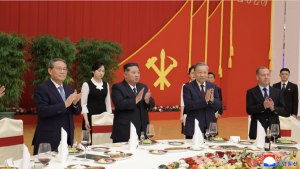
The heavy rain turned Kim Il Sung Square into a glossy mirror. Missiles rolled under floodlights, soldiers stomped through puddles, and the orchestra didn’t miss a beat. You could almost forget it was real. But one small detail, barely noticed outside North Korea, stood out. At the banquet afterward, Vietnam’s General Secretary Tô Lâm sat to Kim Jong Un’s left.
In Pyongyang, that iss not a coincidence. It is choreography. That seat usually goes to China’s envoys or, lately, Russian officials who bring oil or artillery deals. Giving it to Vietnam may sound like a minor protocol tweak, but in North Korean diplomacy, placement is policy. It was a quiet signal that Kim, who is always calculating, may be testing new diplomatic geometry.
In what can be described as “fourth-partner diplomacy,” Kim seems to be searching for a sliver of room between his two patrons—China and Russia—by pulling Vietnam closer, adding a new vertex to what used to be a closed triangle. Whether it turns out to be strategy or just a gesture is yet to be seen, but it fits his habit of making small, symbolic moves that later turn out to matter.
Protocol as Policy
North Korean media often reveals codes. Who stands next to Kim, who claps first, who vanishes—it is a visual language. Back in 2019, Xi Jinping had that seat of honor. Last year, it went to a Russian representative. This year, despite both China and Russian representatives in attendance, it was Vietnam’s turn.
That does not necessarily mean Kim is drifting from Beijing or Moscow. It could just be him reminding both that he still controls the stage. In tightly choreographed regimes, symbolism often replaces statements. Sometimes a chair says what a communiqué will not.
A Subtle Re-Mapping
When Vladimir Putin made his 2024 Asia tour, Pyongyang first then Hanoi, it felt at the time like nostalgia: old comrades, new photos. But in hindsight, it appears to have pointed to something more layered, a slow knitting together of what you might call a mini-bloc of pragmatic authoritarians. China, Russia, Vietnam, and North Korea are not perfectly aligned, but they share a similar instinct for hedging and a shared skepticism of Western sermons.
While far from an alliance, it reflects the current mood, with countries trying to find breathing space in a world that seems to be narrowing. The last century’s dividing line was ideology. This one’s is autonomy—how to modernize without becoming dependent.
Kim has learned that lesson the hard way. The famine of the 1990s left him at China’s mercy. The 2020s tied him to Russia catalyzed by Russia’s war needs. Both lifelines came with strings. Vietnam, on the other hand, managed to join ASEAN, sign defense agreements with Washington, and still keep the Communist Party firmly in charge. That is not freedom exactly, but it is balance, and balance is what Pyongyang appears to be chasing.
The Vietnam Temptation
For Kim, Vietnam’s path must look like an escape hatch that somehow worked. Since Đổi Mới in 1986, Hanoi has transformed itself into one of Asia’s fastest-growing economies without giving up one-party rule. It normalized relations with the United States, hosted American carriers, and now trades more with Washington than with Beijing. All while the Party stayed firmly in command.
Kim reportedly said that Vietnam’s model proves “reform and control can coexist.” It is an idea he seems to admire, even if “reform” in North Korean terms might mean tweaking a few market rules or tolerating smugglers for a season. The appeal is obvious: a socialist country that opened up without losing control of the narrative.
Still, copying Vietnam is harder than admiring it. Hanoi’s success came from bureaucratic grit and collective leadership. Kim’s system depends on instinct and fear. There is no committee that tells him when he is wrong.
Equidistance as Strategy
Underneath all the theater lies what you could call equidistance socialism, keeping everyone close enough to extract favors but no one close enough to dominate.
In practical terms, each partner fills a different need. China keeps the economy alive, supplying most of North Korea’s trade, fuel, and basic goods. Russia covers the gaps Beijing will not, providing oil and sometimes military technology in exchange for shells and sympathy at the United Nations. Vietnam, while smaller in scale, offers something rarer: legitimacy. It shows that socialism can survive global trade and that modernization does not have to mean surrender.
During Tô Lâm’s October visit, the two sides went further than the usual photo op. They signed agreements on defense and economic cooperation. The wording was vague, but the intent seemed clear enough. Hanoi is becoming part of Kim’s balancing act, a southern counterweight to his northern patrons.
Maybe it will go nowhere. Then again, that is how a lot of North Korean diplomacy starts: quietly and at dinner.
What It Might Mean for Everyone Else
From Washington’s perspective, this is a reminder that North Korea does not sit still. Years of “maximum pressure” have left Pyongyang few choices other than finding new friends. Vietnam fits that call neatly: ideologically safe, diplomatically agile, and far enough away not to provoke China. If Hanoi ends up as Kim’s unofficial go-between with the outside world, it will be a problem Washington created for itself.
South Korea faces a subtler test. Policymakers in Seoul often talk about North Korea as if it is frozen in amber, unmoving and unchanging. But the regime adapts in its own way. Even limited exchanges with Southeast Asia—trade delegations, cultural visits, small training programs—could slowly chip at the edges of isolation. Vietnam’s model suggests that transformation rarely begins with politics; it starts with markets, with quiet deals, with habits that accumulate.
Beijing and Moscow probably noticed too. Both like to imagine Pyongyang as a loyal junior partner. Watching Kim toast a Vietnamese guest at the head table must have stung a little.
A Cautious Reading
Of course, none of this guarantees a Vietnamese future for North Korea. The systems are worlds apart. Hanoi’s reform era was pragmatic and collective. Kim’s rule is brittle and personal. Still, the gesture matters. In Pyongyang, nothing happens by chance, not the fireworks, not the camera pans, and certainly not who sits beside the leader.
If Kim is looking south for inspiration, it is probably not about copying Vietnam’s economic reforms. It is about adopting its mindset: flexible when necessary, stubborn when survival demands it. In his own way, Kim may be trying to prove that he too can bend without breaking.
For now, the fourth chair is just a symbol, another piece of North Korean theater. But symbols in Pyongyang have a habit of growing teeth. And sometimes they start with something as simple as where Kim decides to sit.