

North Korea’s Odd Reticence on China-Japan Tensions
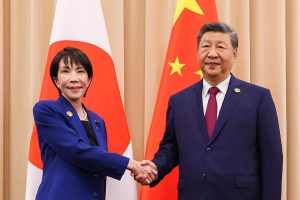
North Korea has shown a muted response to the ongoing China-Japan diplomatic spat over Japanese Prime Minister Sanae Takaichi’s early November comments on Taiwan. This is at odds with the rare public support for China’s Taiwan policy by the North Korean cabinet premier in October, as well as North Korea’s previous official endorsements. While the reasons for Pyongyang’s reluctance to extend explicit support—official or media—for Beijing remain unclear, this represents a potentially meaningful data point for tracking North Korea’s foreign policy.
Constant Interest but No Explicit Support
North Korean media have regularly reported on China-Japan tensions since their initial November 12 report on Takaichi’s Taiwan comment, primarily citing the Chinese Foreign Ministry. North Korea has published only one article beyond its usual news reports on this issue—in the cabinet daily Minju Joson, which carries less authority than the Party newspaper Rodong Sinmun. The article presents both Chinese and Japanese positions, offering at best implicit criticism of Tokyo while avoiding explicit support for Beijing. Moreover, it concludes in a virtually neutral tone, borrowing the voice of unattributed “analysts” for its commentary:
Saying that the confrontation between China and Japan is not a simple dispute arising from differences in the two countries’ positions on a single issue but rather a strategic confrontation, political analysts predict that the deterioration in bilateral relations will be prolonged.[1]
Why This Is Worth Noting
North Korea’s apparent sensitivities over the ongoing China-Japan tensions are remarkable considering the resumption of high-level North Korea-China exchanges that began in September with Kim’s first summit with Chinese President Xi Jinping in more than six years. According to North Korea’s official readout of that summit, the two leaders “referred to the issue of strengthening strategic cooperation and defending common interests in international and regional affairs.”
Building on that, in October, the North Korean Cabinet premier offered his rare public support for Beijing’s position on Taiwan to his visiting Chinese counterpart. A commentary by North Korea’s official Korean Central News Agency (KCNA) in November implicitly supported China by accusing the United States and South Korea of “deny[ing] territorial integrity and core interests of sovereign states in the region” regarding Taiwan.
Pyongyang’s response also contrasts with the past. Between 2021 and 2023, the Foreign Ministry and the Workers Party of Korea (WPK) explicitly voiced support for Beijing on the Taiwan issue.[2] For example, in a rare “solidarity letter” to the Communist Party of China following US House Speaker Nancy Pelosi’s visit to Taiwan in August 2022, the WPK said it “will as ever fully support the just stand and all the determinations of the CPC over the Taiwanese issue and always be with the Chinese comrades on the road for its realization.” In August 2023, the North Korean ambassador to China published an article on the Foreign Ministry website stating: “… [North Korea] strongly supports all the measures taken by China to achieve the national reunification on the principle of one China. Taiwan is a part of China forever and there will always be one China on the land of the Chinese nation.”
Conclusion
The reasons for North Korea’s behavior are unclear. For now, there are three possible explanations.
First, it may be pacing relations with China. North Korea’s treatment of China since the recent Kim-Xi summit suggests progress in ties, though not yet a full recovery. Second, Pyongyang may be preserving room to maneuver with Japan, though it has remained silent on Takaichi’s offer to meet with Kim—unlike early 2024, when it responded to Kishida’s similar calls. Third, North Korea may be maintaining a low profile on key issues as it prepares to unveil its foreign policy for the next five years at the upcoming Ninth Party Congress.
North Korean intentions will require further analysis as events unfold, beginning with the Ninth Party Congress.
- [1]
Translated from Kim Hong Hwi, “대만문제를 둘러싸고 격화되는 중일사이의 대립 [Intensifying China-Japan Confrontation Surrounding the Taiwan Issue],” Minju Joson, December 4, 2025.
- [2]
See “Press Statement by Pak Myong Ho, Vice-Minister of Foreign Affairs of the DPRK,” Ministry of Foreign Affairs, October 23, 2021; “Spokesperson for DPRK Foreign Ministry Stresses that U.S. Attempt at Hindering Implementation of the Chinese Cause of Unification Is Doomed to Failure,” Ministry of Foreign Affairs, August 3, 2022; “C.C., WPK Sends Solidarity Letter to C.C., CPC,” KCNA, August 10, 2022; “Press Statement by Director General of Asian Affairs Department 1 of DPRK Foreign Ministry,” Ministry of Foreign Affairs, August 4, 2023; “DPRK Ambassador to China Publishes Article,” Ministry of Foreign Affairs, August 24, 2023.