

What Draws Trump to Kim Jong Un? The Answer Is Personal
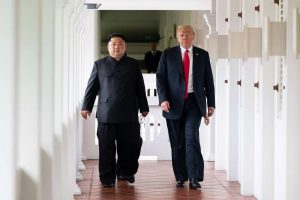 Why is the president of the United States courting a meeting with North Korea? Donald Trump has never hidden his fondness for the encounter. He has spoken many times about his “very good relationship” with Kim Jong Un. He has repeatedly called North Korea a nuclear power rather than a rogue state to be disarmed. And he has signaled, again and again, that he would welcome another summit. During his visit to South Korea for last autumn’s APEC gathering, he made his interest plain, yet the meeting never came. On June 14, as the war in Iran was thought to be close to a resolution, Trump posted on Truth Social an uncaptioned photograph of himself walking beside Kim at their 2018 Singapore summit. No policy accompanied the image, and none seemed to be required. The gesture was the message.
Trump’s continued push for a summit with Kim, despite North Korea’s continued dismissals, appears to lie less in strategy and more in Trump’s personal worldview, which shapes how he sees Kim Jong Un. This article makes three claims that follow from that view. First, Trump seeks the meeting as an end in itself for the affirmation it gives him, not as a means to disarm the North. Second, because the meeting is the prize, the substance bends to secure it. Denuclearization gives way to quasi-arms control that freezes the missiles aimed at the American homeland while leaving the rest of the arsenal in place. Third, that bargain may likely protect the United States while leaving South Korea, whose cities remain within range, exposed, which is why close alliance coordination and a continued push for denuclearization matter now more than ever.
An Eager Suitor and a Reluctant Partner
The asymmetry is the place to begin, because most accounts skip past it. In the usual picture, a great power offers diplomacy to a smaller adversary from a position of strength, and the smaller party seeks the opening. Here the order is reversed. It is Washington that reaches, and Pyongyang that holds back.
Kim has reason to hold back. He has set one standing condition for any new engagement. The United States must give up denuclearization as its goal. He has also built a position that does not depend on American attention. A deepening partnership with Moscow, a patron in Beijing, and an arsenal that keeps growing all give him the freedom to wait. When Trump wanted to meet Kim Jong Un during APEC meeting last year North Korea did not answer with warmth. It answered with new attacks on the idea of denuclearization. A sitting American president who pursues a meeting that his counterpart can take or leave is not showing a strategic posture, but one driven by personal ambitions rather than doctrine.
Why Trump Wants to Meet Kim
Trump’s own words gathered over years point to a consistent explanation. Five impulses appear again and again. Each one points to the meeting as a prize rather than a tool.
The first is Trump’s belief in his own singularity. Trump has long presented himself as the one leader who could do what no predecessor could accomplish. He is, in his telling, the only person who could deal with Kim, and the only thing standing between the peninsula and war. In his first term he told audiences that he and Kim “fell in love,” and that the chairman wrote him “beautiful letters.” This is not the language of statecraft. It is the language of a man who treats the relationship as proof of his own uniqueness. For Trump, the summit works as a mirror. It reflects the exceptional figure he believes himself to be. What he seeks in a second meeting is not an outcome but that reflection. He is drawn back to Kim because no one else returns the image so completely.
The second is his hunger for recognition, especially when measured against those who came before him. Trump returns often to the contrast between how Kim treated him versus how Kim treated his predecessors, above all Barack Obama and Joe Biden. By Trump’s own account, Kim met him with warmth, refused even to sit down with Obama, and held Biden in contempt. In this framing, Kim is less a counterpart than a witness. He is there to confirm that Trump stands above the presidents who came before him and above the Washington establishment that doubted him. The summit is the stage where that confirmation takes place before a global audience. What Trump wants from the meeting is therefore an audience as much or maybe more than an agreement. An accomplishment that the world does not witness would not satisfy his need for recognition.
The third impulse is admiration. Trump tends to judge foreign leaders by the rawness of their power rather than the legitimacy of their rule, and by that measure Kim ranks highly. He has praised the chairman as tough, smart, and fully in control, and groups him, by implication, with Putin and Xi, whose unchecked power he openly envies. Part of the summit’s appeal is simply that Kim is a man Trump wants to be seen beside. Where another president might treat a meeting with Kim as a grim necessity, Trump treats it as a reward, a sign that he belongs among the strong. The summit draws him not in spite of who Kim is but because of it.
The fourth impulse follows the third. If Kim belongs among the admired strongmen, he cannot belong among the enemies. Trump saves his hostility for those he sees as weak, his predecessors, his domestic rivals, and the allies he views as freeloaders. Kim is quietly moved out of the category of a threat to be deterred and into the category of a partner to be engaged. This shift is almost unconscious, but its effect is large. Once Kim is a partner rather than an enemy, a meeting with him needs no defending, and Trump can pursue the summit without the fear that he is rewarding a hostile state. The same reclassification lets substance be traded away later, without Trump feeling that he has given anything to an adversary.
The fifth impulse is his transactional worldview, which predates his politics. It was formed in real estate, where the world is a set of assets to be bought, developed, and sold. Trump treats North Korea’s nuclear program as a chip in such a deal, and North Korea itself as the property waiting to be developed. As early as the 2018 Singapore summit, he described the country in the language of a developer, imagining hotels and condominiums along its “great beaches” once the weapons were set aside. In this frame, a nuclear negotiation is not a security goal but the price of admission to a development opportunity. The arsenal that others treat as an existential danger, Trump treats as leverage to be packaged, traded, and closed.
These five impulses pull in the same direction. Each one makes the meeting itself the reward, and none of them depends on solving North Korea’s nuclear weapons program. Trump seeks the summit because it confirms what he believes about himself, that he is singular, admired, superior to those who came before him, and master of the deal. The encounter is therefore an end in itself, valued for the affirmation it returns rather than for any problem it settles. This is a claim about disposition, not a moral judgment, and it lets us predict what kind of bargain such a man would accept.
How the Want Shapes the Bargain
If the meeting is the prize, then its price is whatever Kim asks in return for attending. Kim has already named that price. Denuclearization, the goal that has guided American policy for decades, is the first thing to go. Continued insistence on it is deal breaker and the surest way to prevent another summit from taking place. What remains then is a narrower agenda. At its center is the demand Kim cares about most, a formal acknowledgment that North Korea is a nuclear weapons state.
Trump’s eagerness makes him more willing than most presidents to consider it. Because he wants the summit so badly, he may treat even a dangerous concession as a fair price for the meeting. Yet formal recognition would not come easily, even for him. It would cross a line that Congress, the allies, and much of his own government would resist, and it would give Kim a major win just to get to the negotiating table. The impact of such recognition would be felt far beyond a summit table. On the Korean Peninsula, it would lock in a permanent nuclear threat to the South, harden the divide between the two Koreas, and weaken Seoul’s leverage in any future negotiation with a North that no longer needs to bargain its weapons away. Beyond the Peninsula, it would damage the global nonproliferation regime. North Korea would stand as the first state to sign the Nuclear Nonproliferation Treaty, withdraw from it, build a working nuclear arsenal, and then win American acceptance of the very status the treaty was meant to deny. That precedent could signal to other aspiring proliferators that a determined bid for the bomb can end not in isolation but in recognition.
This is where the imbalance of desire begins to shape the terms. A negotiator who wants the meeting more than his counterpart will pay more to secure it, and Trump has advertised his eagerness in advance. The risk is not that he will be outwitted at the table. The risk is that he will give ground, step by step, simply to keep the meeting alive. Each concession is easier to make because, in his mind, he is dealing with a partner rather than surrendering to an enemy. What makes this dangerous is not any single concession but their order. The largest is made not at the table but at the entrance. North Korea has pressed for public acknowledgment of its nuclear status, or at least an explicit abandonment of denuclearization as a goal, as the price of sitting down at all. Once that price is paid up front, the terms that follow no longer draw Kim to the table, since he is already there. They serve instead to deepen a concession already made and to move both sides along a path toward normalized relations. Washington could, for instance, ease the sanctions Pyongyang wants most, in part or in full, and in return North Korea might halt further development of its intercontinental missiles, which can strike the United States, and stop testing additional weapons. Each step makes the last harder to reverse, as eased sanctions build new dependencies and every move toward normal relations entrenches the recognition granted at the outset. The result is a quasi-arms control process, not disarmament, a freeze on the threat to the American homeland that leaves the arsenal in place, its status quietly upgraded along the way.
The Ally Outside the Frame
This is the part of the bargain that should worry Seoul. A freeze on the missiles that can reach America does nothing about the shorter missiles aimed at Seoul, or about an arsenal that grows more advanced each year. Those are the weapons that hold South Korea hostage, and they are exactly the ones a homeland first deal leaves untouched. A deal that caps the weapons targeted toward San Francisco, for example, while leaving in place the weapons targeted toward Seoul, secures one ally while leaving the other still exposed. It also raises a quieter question on which every alliance rests: If the United States has removed the threat to its own territory, how much risk will it still accept to defend its partner in a contingency? Extended deterrence holds only when the answer is the same for Seoul as for San Francisco, and a deal that separates the two begins to pull that promise apart. The gravest risk to the alliance may arrive not as a deliberate policy but as the byproduct of one man’s wish for a personal triumph.
That is why coordination between Seoul and Washington matters now more than ever. South Korea should make sure that its own security sits on the table from the day one of any process, rather than an afterthought when the cameras are gone. In practice this means insisting that there is no separation between North Korea’s strategic and tactical capabilities at the negotiating table. It means close and constant consultation, so that Washington does not discover Seoul’s red lines only after it has crossed them. And it means that the United States should listen closely to South Korea’s position on denuclearization. For Seoul, a North Korea without nuclear weapons remains a core security interest, and Washington should not quietly abandon that goal in its eagerness for a meeting. The same holds, in different measure, for the wider regional order that American deterrence underwrites.
In the end, the lesson is a classic realist axiom: Power is read not only in capabilities but in the intentions of those who wield it, and intentions begin in the mind of the leader. To protect the alliance, Seoul must read the man before it reads the policy, because on this issue, the man is the policy. Understanding what Trump wants from Kim, and why, is the first step of strategy for dealing with this complex security dilemma and to anticipate what might come next, especially if a meeting is set.
The president courting a meeting with a reluctant Kim Jong Un is not chasing a strategy. He is chasing a reflection of himself, and the ally most likely to pay for that reflection is the one standing just outside the frame.