

The Northeast Asian Security Dilemma: Does European Experience Show the Way Out?
 Faced by growing insecurity and destabilizing uncertainties, Northeast Asia lacks a regional mechanism to establish guardrails to manage the risks. European experience in the 1970s offers an interesting model—but only if that model is properly understood.
Shifting Sands, Rising Tensions
Japan and South Korea (Republic of Korea or ROK) have long-benefitted from US extended deterrence not only for security, but also because the strategic weight of America’s regional presence keeps their differences in check. Both countries face uncertainties now arising from the behavior and imputed policy preferences of President Trump and the conditions that might be placed on continuing to offer extended deterrence. It is possible if not (yet) probable that the US will not play either the protective or the balancing role so willingly, successfully, or consistently in coming years.
Meanwhile, North Korea (Democratic People’s Republic of Korea or DPRK) has successfully edged out from under the most intrusive version of China’s wing. Its support for Russia’s aggression in Ukraine provides many benefits, both direct and indirect. It had already succeeded in developing and deploying its own nuclear missile force, which was long-opposed by its allies and adversaries alike. Today, Russia seems to support, and China has stopped publicly condemning, DPRK’s possession of nuclear weapons.
The most worrisome possible consequence of this is the prospect that either the ROK or Japan or both may withdraw from the Nuclear Non-Proliferation Treaty and develop their own nuclear forces. This is, presumably, more likely if the US commitment to regional stability and its allies’ security is seen to falter or weaken.
If either country pursues this path, it would weaken the international nuclear non-proliferation regime at best; at worst, it could shatter it and exacerbate regional arms racing. All the ingredients are in place—clashing national interests, divisive politics and rhetoric, sufficient economic resources, and the industrial and technological capacity to ramp up a nuclear weapons program relatively quickly and sustain it over time.
If that happens, the region will lock itself into a classic version of the security dilemma. The concept was coined—or, at least, given a name—in 1950 by John Herz in explaining what he called ‘the heartbreaking plight’ of the nuclear-armed world. It entails what US Defense Secretary Robert McNamara in 1967 referred to as the ‘action-reaction phenomenon.’[1] Actions undertaken for security look threatening to the other side, whose response looks threatening, so the first side counter-responds. And so on. Herz depicted this as “the extreme manifestation of a dilemma with which human societies have had to grapple since the dawn of history.”
Breaking the Cycle
Properly understood, the big challenge in Northeast Asian security is not how to respond to the other’s provocations, but how to break the logic of the security dilemma. Facing this challenge, one deficiency in the region is the lack of a regional security framework. There is a need for guardrails to minimize risk—or at least manage it—but no regional mechanism for establishing them. This deficiency is becoming widely evident, leading to a variety of proposals for rectifying it.[2] In this discussion, a common reference point is the European experience from a half-century ago in constructing a security framework in the form of the Conference on Security and Cooperation in Europe (CSCE). The reference is sometimes implicit or oblique, sometimes explicit.[3]
Its relevance to Northeast Asia is easy to grasp. For all the differences between the regions and the times, there was in Europe and is in Northeast Asia a prolonged military confrontation with a divided country, militarized borders, nuclear weapons, and mutual hostility and distrust. Despite all this, Europe found a means to keep enmity and hostility within bounds. Could Northeast Asia do likewise?
Notwithstanding the collapse of neighborly relations in Europe in the last decade, that experience is still potentially instructive. In the 1990s, the European precedent was used with fewer reservations than seems appropriate today.[4] Indeed, the ‘Sunshine Policy’ towards the North launched by ROK President Kim Dae-jung and reiterated in some form by subsequent progressive presidents was explicitly inspired by European experience.[5]
However, the parallel needs to be handled with care. In the current issue of Foreign Affairs, President Alexander Stubb of Finland bluntly states that the Helsinki Final Act of 1975 played a key part in bringing the Cold War to an end. He is one of many who make that argument. But it has a political downside when applied to Northeast Asia. The end of the Cold War and the end of the Soviet Union were approximately coterminous, so the idea of recreating something like the CSCE might just sound to Pyongyang like a plan for regime change. And that is unlikely to encourage their participation in a regional framework, which would lack purpose if any one of the relevant states stays out of it.
More importantly, perhaps, Stubb’s view is, in any case, a severe misreading of history—a classic case of teleology, looking at the past through a lens shaped by later events. Part of my own intellectual formation was in a school of thought that believes that the words ‘History teaches us that’ are generally followed by poor logic and worse history. Even so, interesting reflections can be drawn from the past. In this case, the most interesting is to do with borders and sovereignty.
Understanding Precedents in Context
The CSCE was not the West’s brainchild. The USSR wanted it so as to formalize borders. The West’s aim was to achieve conventional arms reductions to address what NATO saw as the Soviet bloc’s overwhelming superiority in land forces. There were numerous reasons for skepticism about that claim, but we need not go into that here.
In May 1972, Soviet leader Brezhnev and US President Nixon met in Moscow to sign the first bilateral nuclear arms control agreement. They also agreed to open two sets of talks on relations in Europe. One was to explore the political aspects—the CSCE—while the other focused on conventional forces.
The arms conference started in January 1973. There was a problem with the name. The NATO side opted for Mutual and Balanced Force Reductions (MBFR). However, at the first meeting, the USSR rejected the “B” in that equation and argued for calling the talks simply for “MFR,” because the word “balanced” was thought to imply that Warsaw Pact forces should be reduced more than NATO’s. That disagreement was never resolved.
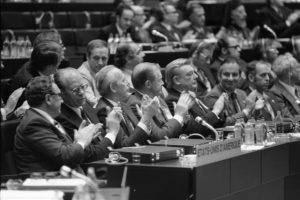
The CSCE opened six months later. In two years, the diplomats agreed to ten guiding principles, starting with recognition of all parties’ sovereignty on an equal basis. The principles were articulated in the Helsinki Final Act in August 1975.
The CSCE’s pre-history is important and was all about borders and sovereignty. German Chancellor Willy Brandt took office in 1969 and set out to ease tensions with the War Pact countries—the policy described then and ever since as Ostpolitik. A series of agreements regularized European relations starting with the Treaty of Warsaw in 1970. It acknowledged Poland’s western border with what was then East Germany. The 1971 Quadripartite Agreement on Berlin stabilized the divided city’s status, easing tensions that had been nagging since the Berlin Wall was built in 1961. Finally, in December 1972, six months after the Brezhnev-Nixon Moscow summit, West Germany and East Germany signed the Basic Treaty to develop normal good neighborly relations with each other. The principle of mutual recognition of sovereignty as the basis for peaceful relations was then incorporated into the CSCE.
In short, the CSCE process recognized and treated as permanent the borders and division of the Cold War. It was not intended to bring either the Cold War or the USSR to an end. It was neither transformational nor revolutionary. It was pragmatic and cautious, aimed at finding a way for two hostile alliance systems to co-exist reasonably safely. It was about guardrails, reducing risks, building confidence through political and economic interaction and through measures such as advanced warning of military maneuvers. If it didn’t quite break the logic of the security dilemma, it reduced the tightness of its grip.
The Organisation for Security and Cooperation in Europe (OSCE) is the CSCE’s more ambitious offspring. It emerged only once the Cold War was over. A secretariat that opened in February 1991 became the vehicle for remaking the CSCE as a new organization. Until then, there was no organizational structure. The CSCE functioned only as a series of meetings at which the participating governments reviewed commitments, monitored implementation, and occasionally added to them. The framework the CSCE had provided for regional security was important but skeletal. Indeed, it was important and effective because it was skeletal.
Implications for Northeast Asia
In the 1970s and 1980s, the end of the Cold War was a dream for some but it was not the business of the CSCE. The CSCE’s history can usefully be called in aid of the idea of a regional security framework for Northeast Asia precisely because—and only because—of the modesty of its aims and work. It did not end the Cold War but made it appreciably less dangerous. It seemed more than worthwhile at the time and still does, looking both retrospectively at Europe 50 years ago and currently at Northeast Asia.
- [1]
From a speech by US Defense Secretary Roibert McNamara on 18 Sept 1967: “Whatever be their intentions, whatever be our intentions, actions—or even realistically potential actions—on either side relating to the build-up of nuclear forces, be they either offensive or defensive weapons, necessarily trigger reactions on the other side. It is precisely this action–reaction phenomenon that fuels an arms race.” Read into the Congressional Record the same day by Congressman Carl Albert: https://www.cia.gov/readingroom/docs/CIA-RDP70B00338R000300100105-8.pdf.
- [2]
See Jong Kun Choi, “Toward Mutual Reassurance on the Korean Peninsula and in Northeast Asia,” Toda Policy Brief No. 257, November 2025, https://toda.org/assets/files/resources/policy-briefs/tr-257_summary-report_toward-mutual-reassurance-on-the-korean-peninsula-and-in-northeast-asia_choi.pdf?utm_source=newsletter&utm_medium=email&utm_campaign=20251126; Frank Aum, ”Building Mutual Reassurance on the Korean Peninsula through Stable Coexistence,” Toda Policy Brief No. 254, October 2025, https://toda.org/assets/files/resources/policy-briefs/t-pb-254_building-mutual-reassurance-on-the-korean-peninsula-through-stable-coexistence_aum.pdf.
- [3]
SeeKyung Hwan Cho, “Feasibility of Regional Security Framework in Northeast Asia,”, Journal for Peace and Nuclear Disarmament, 2019, 3:1, 129-143, https://www.tandfonline.com/doi/epdf/10.1080/25751654.2020.1747906?needAccess=true; and Han-UI Chang, ‘’The lessons of the Ostpolitik and successive Sunshine Policies in modern inter-Korean relationships,” Korean Monitor (Warsaw Institute), July 2025, https://warsawinstitute.org/wp-content/uploads/2025/07/RS_05-2025_EN.pdf.
- [4]
See J Dean, “Arms Control on the Korean Peninsula: How Is the European Experience Applicable?” Korean ]ournaI of Defense Analysis, 8(1), 67—84, https://www.tandfonline.com/doi/abs/10.1080/10163279109464230; and Trevor Findlay, :The European Cooperative Security Regime: New Lessons for the Asia-Pacific,” in Andrew Mack, ed, Pacific Cooperation (New York, Routledge, 1995).
- [5]
As well as drawing on scholarly studies to support that point—e.g., Jeong-yong Kim, South Korea’s Sunshine Policy, 1998-2002. Domestic Imperatives and Private Interests, May 2002, pp. 196-199, https://wrap.warwick.ac.uk/id/eprint/78614. Here, I can cite my own experiencing of hearing Kim Dae-jung talk on this topic in Oslo in 1994, explicitly referring to European détente and the Helsinki Final Act.