

Is Kim Jong Un Headed for “DPRK President” Title?
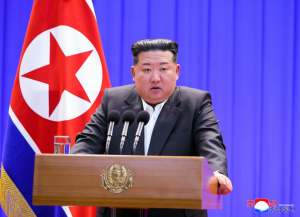
Much is at stake at the approaching Ninth Party Congress in the Democratic People’s Republic of Korea (North Korea or DPRK). This quinquennial multi-day event will offer insights into Kim Jong Un’s domestic and foreign policy calculus over the next five years at a critical time domestically and externally.
At home, Kim Jong Un faces the dual challenge of defense and economic development while apparently still grappling with how best to balance centralization with economic units’ autonomy.[1] Abroad, Kim pledges to bolster both the country’s conventional and nuclear weapons amid a rapidly evolving global order and regional security environment, including the modernization of the US-South Korea alliance and the evolving role of US Forces Korea.
However, another potential point of interest is whether Kim Jong Un will gain an additional state title: “DPRK president [주석; chusok],” the top leadership role held by his grandfather Kim Il Sung.[2] Since September 2024, North Korea has referred to Kim Jong Un as the “head of state [국가수반; kukka suban]”—exactly mirroring the role of “DPRK president” stipulated in the 1972 and 1992 constitutions. Given North Korea’s calibrated approach to the Kim leader’s titles and designations, this is almost certainly not a coincidence.
Should North Korea reintroduce the “DPRK president” title in the constitution and appoint Kim to that role at the Supreme People’s Assembly (SPA) session following the Party Congress or at another future SPA meeting, the implications could extend beyond prestige or a ceremonial upgrade for a leader who already heads the Party, state, and the military. It could affect the country’s decision-making structure, including on defense and foreign policy, as well as succession planning, whether a campaign is currently underway or anticipated in the future.
Rollout of “Head of State”
“Head [수반; suban]” is a widely used term in North Korean literature, most commonly to note that the Workers’ Party of Korea (WPK) is (or was) “headed” by one of the three Kim leaders, or to report on diplomatic interactions, such as Kim Jong Un’s exchanges of greetings with foreign “heads of state.”
However, state media treat this terminology with far greater caution when used as a descriptor or appellation for the Kim leader himself. During the Eighth Party Congress in January 2021, North Korea began describing Kim Jong Un as “the great head [위대한 수반; widaehan suban] of our Party, state and people,” or its variations. The Party charter, revised during that congress, stipulated that “the head [suban; 수반] of the WPK is the general secretary of the WPK,” apparently providing the legal justification for “the head” characterization.[3] North Korean media virtually stopped attributing this description to Kim from early 2023 onward, with one notable exception: the introduction of Kim Jong Un as the “great head” in the Party daily Rodong Sinmun masthead in early 2023.
After a hiatus of more than a year, North Korea escalated from modifying Kim Jong Un’s name with “the head” variations to sometimes using the direct appellation “head of state [국가수반; kukka suban]” in place of his name and titles. This began with a Kim Yo Jong statement in September 2024 that mentioned an intelligence organ “directly under the head of state of the Democratic People’s Republic of Korea.” Since then, North Korea has referred to Kim Jong Un as “head of state”—sometimes prefaced with “our” or “DPRK”— across diverse issue areas, ranging from foreign policy statements to news reports on Party, state, and military events. For example, a North Korean media report on the September 2025 SPA session said “the head of state made an important speech” and “all the deputies expressed full support for and approval of the administrative policy of the head of state.”[4]
Given North Korea’s deliberate handling of leadership titles—demonstrated by its rollout of “the great head” around the 2021 Party charter revision—the use of “head of state” likely has a legal basis as well. In that vein, North Korea may have changed the description of Kim Jong Un’s title as chairman of the State Affairs Commission (SAC), the leading state organ, in its constitution during the October 2024 and/or January 2025 SPA sessions. State media reported on constitutional revisions at both meetings but did not mention any title change, a practice they have used before when withholding information they deemed too sensitive.
Possible Interim Step Toward “DPRK President”
Article 100 of the 2023 North Korean constitution—the most current version available in open source—stipulates:
The chairman of the DPRK SAC is the supreme leader [최고령도자; choego ryongdoja] of the DPRK, who represents the state.[5]
If there was a constitutional revision, one possibility is that “the head of state” replaced “the supreme leader,” so the provision would potentially read: “The chairman of the DPRK SAC is the head of state of the DPRK, who represents the state.” This would align with a broader trend: the “supreme leader” formulation effectively vanished from Kim Jong Un’s appellations following the 2021 Party charter revision, which replaced “the supreme leader of the Party” with “the head of the WPK” in the WPK general secretary provision.[6]
The “head of state” appellation appears to be a touchy subject, given that it is identical to the North Korean constitution’s description of the “DPRK president” title held by North Korea’s founding father, Kim Il Sung, from 1972 until his death. This could well explain why North Korean media would have maintained silence on any related change in Kim Jong Un’s title.
Article 89 of North Korea’s 1972 constitution stipulated:
The DPRK president is the head of state and represents the national sovereignty of the DPRK.[7]
Article 105 of the 1992 constitution said:
The DPRK president is the head of state and represents the DPRK.[8]
On the other hand, this identical terminology suggests that Kim Jong Un may be moving toward assuming the DPRK president title.
North Korea appears to have taken the first step toward this goal in 2019—when it conducted unprecedented back-to-back constitutional revisions in a single year, in April and August, to grant Kim Jong Un additional powers. In April, it added the “who represents the state” function to the SAC chairman’s role. That language appeared rooted in the DPRK president’s “represents the DPRK” function under the 1992 constitution. North Korea did not disclose this major change until August, when state media reported on a second round of revisions. This belated allusion to Kim’s new function, coupled with the two-stage constitutional amendments, seemed to reflect both the sensitivity and careful strategy required for elevating Kim Jong Un’s status and role.
Context and Implications
North Korea’s introduction of the “head of state” appellation in fall 2024 comes amid several notable domestic and foreign policy developments. Progress in Kim leadership propaganda, reported economic growth, and North Korea’s vastly changed security environment may have both boosted Kim Jong Un’s confidence and justified stronger leadership in uncertain times, facilitating the rollout of a title associated with “DPRK president.”
North Korea has steadily elevated Kim Jong Un’s leadership over the years, with particularly intensive campaigns preceding the Seventh and Eighth Party Congresses, around the 10th anniversary of his rule, and following the collapse of the Hanoi summit in early 2019. In 2024, additional milestones aligned with the “head of state” rollout, including the appearance of a solo Kim Jong Un badge and the precipitous drop in use of “the Day of the Sun”—for years a popular and symbolic designation for Kim Il Sung’s birthday.
Economically, Kim Jong Un claimed at the end of 2023 that GDP grew 40 percent compared to 2020 (South Korea’s Bank of Korea estimated 3.1 percent growth in 2023) and confirmed in June 2024 that the economy was “achieving a positive trend and growth speed, clearly distinguishable from the past ones.” In January 2024, he launched the “20×10 policy for regional development,” a major 10-year regional development initiative whose first year was reportedly successful.
On defense and foreign policy, North Korea in September 2023 codified “developing nuclear weapons to a higher level” in its constitution, one year after the revision of its nuclear law and Kim Jong Un’s renunciation of denuclearization. Relations with Russia improved significantly after its February 2022 invasion of Ukraine, culminating in a new bilateral treaty in June 2024 and Kim’s decision that fall to send troops supporting Russia’s war. Notably, Kim Jong Un in December 2023 announced a two Koreas policy, renouncing Kim Il Sung’s seminal 1972 “Three Principles of National Reunification” and later claiming to have cast off “the fetters” through the new policy.
The practical impact of Kim Jong Un’s potential presidency remains unclear. Yet the title change may have implications beyond further leadership consolidation in two ways. First, it could reshape dynamics among state organs, altering institutional functions and roles in line with presidential powers. It may also change the leadership’s decision-making structure. For example, Kim may rely more on the SAC given his elevated state title and less on Party meetings, or adopt alternative consultation mechanisms. In that vein, the absence of a reported WPK Political Bureau meeting since July 2024—an unusually long gap for Kim Jong Un—could signal greater changes ahead. These shifts could affect how North Korea develops and implements policies, including those related to defense and foreign affairs. Second, elevating Kim’s status will almost certainly impact succession planning, whenever that begins.
Conclusion
If Kim Jong Un has been working toward the “DPRK president” title, economic progress, which lags behind defense development, will likely be key to attaining it.
North Korea claimed at the 2025 year-end Party plenum to have attained its five-year economic plan from the Eighth Party Congress. Yet Kim has since made a string of economic appearances—even dismissing a vice cabinet premier on the spot during a machine complex visit–suggesting not everything is up to par as the Party Congress approaches. This may explain state media’s daily propaganda surge hailing Kim Jong Un’s achievements, particularly in regional development—critical if the plan is to further elevate him at the Party Congress and subsequent SPA session. Either way, we will not have to wait long to find out.
- [1]
For example, a September 2025 editorial in the cabinet daily Minju Joson called for establishing “realistic and rational economic management methods”—“economic management” is a term associated with market-oriented measures in North Korea—while simultaneously demanding “strict financial discipline across all state work.” This seems to reflect the country’s ongoing dilemma: central control versus greater autonomy for lower-level economic units. See “경애하는 김정은동지께서 제시하신 시정방침을 철저히 관철하여 국가발전의 새로운 단계를 확신성있게 열어나가자 [Let Us Thoroughly Implement the Policy Presented by the Respected and Beloved Comrade Kim Jong Un and Confidently Open a New Stage of National Development],” Minju Joson, September 25, 2025. The editorial echoed Kim Jong Un’s speech to the parliament a few days earlier, where he stressed the importance of “establishing realistic and rational methods of economic management.”
- [2]
“DPRK president” should be distinguished from Kim Jong Un’s current State Affairs Commission (SAC) English title of “President of the State Affairs of the DPRK.” Since the end of January 2021, approximately two weeks after the Eighth Party Congress, North Korean English-language outlets have called Kim “President of the State Affairs of the DPRK,” though his title remains unchanged in Korean: “chairman [wiwonjang; 위원장] of the DPRK SAC.” This article uses “SAC chairman” to avoid confusion with “DPRK president.”
- [3]
This passage was translated from “조선로동당 규약 (2021.1) [WPK Charter (January 2021)]” in 북한법령집, 상 [Collection of North Korean Laws and Regulations, Part 1], National Intelligence Service, August 2024, https://www.nis.go.kr/AF/1_2_1.do. The 2016 WPK Charter said, “The WPK chairman is the supreme leader [최고령도자; choego ryongdoja] of the Party.”
- [4]
For additional examples, see “Treaty on DPRK-Russia Comprehensive Strategic Partnership Ratified,” Korean Central News Agency (KCNA), November 12, 2024, http://kcna.co.jp/item/2024/202411/news12/20241112-01ee.html; “Press Statement of Spokesperson for DPRK Ministry of National Defence,” KCNA, February 11, 2025, http://kcna.co.jp/item/2025/202502/news11/20250211-08ee.html; “Respected Comrade Kim Jong Un Inspects Kang Kon Military Academy,” KCNA, February 26, 2025, http://kcna.co.jp/item/2025/202502/news26/20250226-01ee.html; “Kim Yo Jong, Vice Department Director of C.C., WPK, Censures Seoul Authorities for Deceptive Attempt at ‘Appeasement Offensive’,” KCNA, August 20, 2025, http://kcna.co.jp/item/2025/202508/news20/20250820-10ee.html; “Miltary [sic] Parade Marks 80th Founding Anniversary of WPK,” KCNA, October 11, 2025, http://kcna.co.jp/item/2025/202510/news11/20251011-01ee.html.
- [5]
This passage was translated from “조선민주주의인민공화국 사회주의헌법 [DPRK Socialist Constitution]” in 북한법령집, 상 [Collection of North Korean Laws and Regulations, Part 1], National Intelligence Service, August 2024, https://www.nis.go.kr/AF/1_2_1.do. North Korea revised the constitution twice more since 2023—during the SPA sessions in October 2024 and January 2025—but state media and other open sources have not been observed to publish the full text of the latest constitution.
- [6]
North Korea stopped calling Kim Jong Un “supreme leader” in late January 2021, shortly after the Party charter revisions at the Eighth Party Congress. However, North Korea continues to use this term in reports on its relations with China, not as part of Kim’s title but in reference to the top leaders of the two countries.
- [7]
This passage was translated from the 1972 “조선민주주의인민공화국 사회주의헌법 [DPRK Socialist Constitution],” Institute for Peace Affairs, August 12, 2010, https://www.ipa.re.kr/?mId=30&tId=32&cId=80&mode=view&lang=kr&theme=ipa&bNo=116&aCate=&aType=&aKey=&aPage=1&bId=23288&bApp=c. The 1998 constitutional revision abolished the DPRK president title, giving Kim Il Sung the title of “eternal president of the Republic” in the preamble instead—a stipulation that was replaced with “eternal leader [수령; suryong] of Juche Korea” in the June 2016 constitutional revision. Both the Seventh Party Congress (May 2016) and the subsequent constitutional revision focused on empowering Kim Jong Un. Although no longer stipulated in the constitution, North Korean media continue to refer to Kim Il Sung as the “eternal president,” though the frequency has declined over the years.
- [8]
This passage was translated from the 1992 “조선민주주의인민공화국 사회주의헌법 [DPRK Socialist Constitution],” Institute for Peace Affairs, August 12, 2010, https://www.ipa.re.kr/?mId=30&tId=32&cId=80&mode=view&lang=kr&theme=ipa&bNo=116&aPage=1&bId=23289&bApp=c.