

Kim Yo Jong’s Discourse as Signaling: Managing External Interpretation in DPRK Foreign Policy
This article was written and researched as part of the second cohort of 38 North’s Emerging Scholars Fellowship Program, under the mentorship of senior experts on North Korean affairs. The program and series were made possible through generous support by the Henry Luce Foundation. For more papers in this series, click here.
Kim Yo Jong has occupied a unique position in external assessments of North Korea’s leadership. Between 2018 and early 2021, her rising visibility generated speculation that Kim Jong Un was elevating her as a potential successor or contingency figure. This attention has since faded.[1] In recent commentary, she is more often described simply as a “powerful sibling,” rather than as a political actor in her own right.
These developments, however, do not capture Kim Yo Jong’s actual significance in North Korea’s foreign policy signaling. Her functional importance has remained high, particularly with respect to South Korea and the United States, the two primary targets of Pyongyang’s foreign policy messaging. Since 2020, Kim Yo Jong has been the most consistent messenger of full-length public statements addressing issues related to these two countries. Her public comments, therefore, constitute a continuous and unusually rich corpus unmatched by that of any other senior North Korean official.
Furthermore, the significance of Kim Yo Jong’s public comments lies in her special status as Kim Jong Un’s sister and the Kim regime’s expectation that they will be given special meaning by their intended recipients: the North Korean domestic public, the United States, South Korea, or some combination thereof. Kim Jong Un remains the unchallenged center of authority, and although the United States and South Korea are typically among multiple topics in his public speeches, his remarks about these two countries, for example during his military appearances, are often reported as summaries rather than full transcripts. Kim Yo Jong’s statements, by contrast, are released in full text, often several paragraphs long, and contain detailed rhetorical framing. They are not simply reactions to events but instruments through which Pyongyang manages how outside observers read its position.
North Korea uses Kim Yo Jong’s statements in ways distinct from other official commentary. Because of her unique positioning, her messaging shapes how the regime wants outside observers to understand its foreign policy and inter-Korean position, not simply for registering a reaction to events. When she issues a public message, the aggressive tone can be meaningful, but it does not always reveal what the statement is trying to convey. The more important question is what interpretation she is trying to foreclose. And when she goes silent, that silence can be a signal as well, one that outside observers have consistently misread as disengagement or openness.
Previous Studies and Methodology
Systematic analysis of Kim Yo Jong’s statements remains limited. The two most directly relevant prior works are a typological study and a computational text analysis.
Kim Jongwon examined 22 statements by Kim Yo Jong from March 2020 to November 2022, categorizing them by topic into four groups: responses to South Korean commentary on North Korean behavior, inter-Korean issues, ROK-US joint exercises, and DPRK-US relations.[2] He further classified them by type: positive trust expression, simple opinion, active regret, and serious threat or warning. In sum, he recommended that Seoul respond selectively rather than reacting to every statement. His framework organized statements by their substance and tone. The limitation of Kim’s paper was that he did not interrogate what each statement was trying to accomplish or why some external developments produced no response at all.
Suh, Yoo, Kang, and Hong analyzed 52 statements across three leadership periods using semantic network analysis, tracking how Kim Yo Jong’s vocabulary changed over time.[3] They found that dialogue-related words nearly disappeared by the Biden-Yoon period while adversarial and military terms dominated discourse. They interpreted this, unsurprisingly, as North Korea hardening its posture in response to the external environment. The authors acknowledged that their methodology could not fully capture the irony, emotional tone, or implicit meanings embedded in the text. Because the analysis only covered issued statements, it could not account for what North Korea signaled by staying silent either.
Both studies treat Kim Yo Jong’s statements as reactions to events or as evidence of shifting rhetoric. Neither asks what function a given statement serves within North Korea’s broader strategic signaling, or whether silence at certain moments could be a deliberate choice. These are the lacunae this study addresses.
This article analyzes 67 statements Kim Yo Jong issued between March 3, 2020, and February 13, 2026. It asks three related questions. First, when does Kim Yo Jong issue public statements? Second, how do the tone, structure, and timing of her statements vary? Third, what role does Kim Yo Jong’s silence and omission play in North Korea’s signaling toward South Korea and the United States?
To address these questions, the article combines a chronological narrative with a functional categorization of Kim Yo Jong’s discourse. Rather than treating her statements as expressions of personal influence or emotional intensity, the analysis focuses on how speech and silence are used to manage uncertainty, shape interpretation, and advance North Korea’s external posture over time.
Categorization and Analysis of Kim Yo Jong’s Discourse
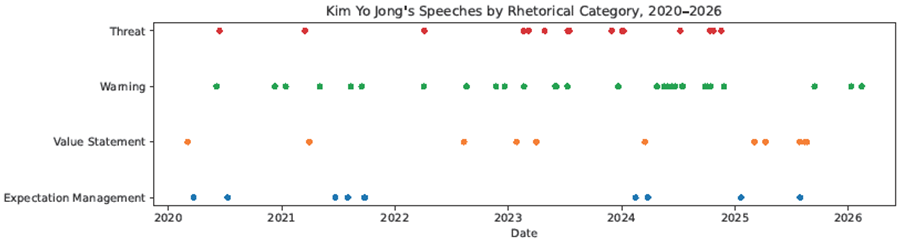
Existing analyses of DPRK statements often rely on tone-based or event-driven readings, treating the texts as reactions to provocations or as indicators of emotional escalation. Such approaches miss a recurring pattern in Kim Yo Jong’s discourse that the same harsh language appears in situations where North Korea has no intention of acting, while relatively restrained statements have preceded concrete escalation. To address this problem, this study categorizes Kim Yo Jong’s statements into the following: what each statement is designed to accomplish, whether it is foreclosing a particular interpretation, if it is applying pressure without commitment, or if it is making future steps appear inevitable.
These four categories were devised by the author based on a systematic review of Kim Yo Jong’s statements. The categories do not represent stages of escalation or emotional states. Instead, they identify a set of tools North Korea uses selectively depending on uncertainty, the political cost of making a public statement, and the risk of being misread. This framework allows subsequent findings to explain why North Korea sometimes speaks harshly without acting, sometimes acts after limited rhetoric, and sometimes remains silent despite major external developments.
Expectation Management: Expectation management statements are issued to preempt external actors’ reading of North Korea’s restraint, silence, or symbolic gestures as a sign of diplomatic openness. In a July 29, 2025 statement, Kim Yo Jong stressed “If the U.S. fails to accept the changed reality and persists in the failed past, the DPRK-U.S. meeting will remain as a “hope” of the U.S. side.”
Value Statements: Value statements declare what North Korea views as fixed and non-negotiable. Notably, these include its self-declared nuclear state status, the definition of inter-Korean relations as those between two hostile states, and its strategic alignment with Russia. Their function is to set the terms on which subsequent statements and actions are to be understood, terms that North Korea presents as closed to outside intervention. In an August 11, 2022, statement, for example, Kim Yo Jong described the South Korean authorities as a “permanent enemy.”
Warnings: Warnings express dissatisfaction and assign responsibility while maintaining discretion. They imply negative consequences but avoid specifying the next steps. Their function is to apply pressure without necessarily committing to action. In a June 10, 2024 statement, Kim Yo Jong responded to the resumption of South Korean leaflet-scattering and loudspeaker broadcasting along the border, in which she signaled serious dissatisfaction without specifying what action North Korea would take.
Threats: Threat statements establish a direct linkage between a trigger and an outcome, framing a specific action as an inevitable consequence of a specific trigger. In a June 13, 2020, statement, Kim Yo Jong announced the destruction of the Kaesong inter-Korean liaison office, which was subsequently carried out.
Two methodological caveats apply to this typology. First, a single statement can serve more than one function. For example, a speech that issues a warning may also embed a value statement, and a threat may double as expectation management. The categories used in this study are not mutually exclusive. Where a statement serves multiple functions, it was assigned a classification based on what the author deemed its main purpose.
Second, the lack of statement (silence) became also an apparent tool, requiring the analysis to treat periods of non-response not as gaps in the data but as deliberate choices shaped by timing and context.
Establishing Kim Yo Jong as the External Messenger
Kim Yo Jong emerged as a central figure in North Korea’s external messaging in early 2020. Although she had served as a deputy director of the Workers’ Party Propaganda and Agitation Department since 2014, her March 3, 2020 statement was the first full-length public statement issued under her own name.[4] Her role as North Korea’s key voice on South Korea and foreign policy issues became clear during the June 2020 crisis, which was triggered by South Korean NGOs’ leaflet campaigns. Starting on June 4, Kim Yo Jong issued a series of statements condemning the South Korean government, including a threat on June 13 that the Kaesong inter-Korean liaison office would be destroyed. North Korea demolished the Kaesong inter-Korean liaison office on June 16, marking a major setback to inter-Korean relations.
The significance of this episode is the alignment between threat and action. Kim Yo Jong’s statements were no longer merely expressive, they were validated through execution. When Kim Jong Un subsequently decided to halt further military measures at a Party Central Military Commission meeting, this did not undermine her credibility. Rather, it revealed a division of roles in which Kim Yo Jong exerted public pressure and set the terms, while Kim Jong Un stopped further escalation without walking back what she had said.
By contrast, Kim Jong Un had previously contributed more directly to escalation, as seen during the 2017 exchange of personal insults and threats with President Donald Trump, especially Trump’s “rocket man” and Kim Jong Un’s “mentally deranged U.S. dotard” retort. Such direct, leader-level rhetoric more tightly bound Kim to escalation, making it harder to step back. When escalation was instead articulated through other channels, such as Kim Yo Jong or other institutional statements, Kim Jong Un had room to decide whether or not to follow through. In the current pattern, Kim Yo Jong can deliver high-authority escalatory messages without Kim Jong Un being personally committed to them. This gives him the flexibility to later choose to either carry through or halt escalation without reversing her statements.
After the June 2020 crisis, Kim Yo Jong appeared to release official statements less frequently; however, her formal positions within the party confirmed that her public statements carried institutional weight.
With the exception of her sharp reaction on March 16, 2021 to South Korea’s launch of joint military exercises, which framed the exercises as actions that would inevitably provoke a corresponding response, Kim Yo Jong’s statements for the rest of that year tended to be warnings without threatening specific actions. This was evident in her responses to President Moon Jae-in’s criticism of DPRK missile tests and calls for dialogue on March 30, to speculation surrounding the restoration of inter-Korean communication lines on August 1, and to President Moon’s end-of-war declaration proposal at the UN General Assembly on September 24. In each case, there was no threatened action but instead a warning against reading North Korean restraint as a sign of diplomatic openness.
Kim Yo Jong’s selective use of silence seemed equally significant during this period. Pyongyang appeared to be waiting for greater clarity on US and South Korea policies toward North Korea. This included leadership transitions in the United States and South Korea. Issuing a public statement under such conditions would have locked North Korea into a position before it was able to properly assess the new US and South Korean governments’ policies toward Pyongyang, thereby potentially limiting its room to maneuver. The period from September 25, 2021, until April 3, 2022, was the longest uninterrupted period of silence by Kim Yo Jong in the dataset. She broke her silence on April 3, 2022, only after the North Korean Party’s Politburo signaled in January 2022 that it no longer pinned hopes on the Biden administration and North Korea resumed ICBM testing in March.
In the statement issued on August 11, 2022, Kim Yo Jong defined South Korean authorities and affiliated forces as a permanent enemy and dismissed dialogue as a meaningful policy option, reinforcing hostile signaling without committing to a specific course of action. She outright rejected the Yoon administration’s “Bold Initiative” and in successive statements issued on January 27, February 19, 20, and March 7, 2023, responding to UN discussions, US–ROK military activities, and joint exercises, she clarified that South Korean hostility was assumed as constant and that the South was an adversary, not a counterpart.
In her April 28, 2023 statement in response to the Washington Declaration, Kim Yo Jong framed US-ROK nuclear cooperation as evidence that any future engagement would have to reckon with North Korea as a nuclear-armed state—not as a denuclearization target. Statements issued in the latter half of 2023 reiterated this irreversible status. Her July 10 statement was particularly notable: by referring to South Korea as the “ROK” rather than “South Korea,” she signaled a shift that foreshadowed Kim Jong Un’s declaration of a two-state policy. When Kim Jong Un formally declared inter-Korean relations to be those of two hostile states at the 2023 Party Plenum, this formalized what Kim Yo Jong’s statements had already established rather than marking a sudden change in direction.
On January 5, 2024, North Korea conducted artillery fire toward waters near Yeonpyeong Island, and Kim Yo Jong’s subsequent statements framed the incident as a justified action within an existing hostile interstate relationship.
Kim Yo Jong, like other North Korean officials and media outlets, refrained from commenting on the South Korean president’s declaration of martial law and the National Assembly’s impeachment of him in December 2024. Whether to not disrupt the process or due to a lack of stake in the outcome is unclear, but the restraint appeared deliberate.
Kim Yo Jong’s shift from threat signaling to doctrinal reaffirmation became clearer in 2025. Her statements consistently reiterated the two hostile state policy when referencing South Korea and the country’s irreversible nuclear status and rejection of denuclearization, regardless of new administrations in the US or South Korea. For example, in her July 28, 2025 press statement, she dismissed all of the Lee Jae Myung government’s confidence-building gestures as unworthy of acknowledgment and declared that DPRK-ROK relations had “irreversibly gone beyond the time zone of the concept of homogeneous,” formally closing the door to any form of engagement regardless of Seoul’s policy choices.
Findings
How Does Kim Yo Jong Respond?
Kim Yo Jong’s signaling operates through a limited but flexible set of rhetorical tools rather than through a linear escalation of emotion. The analysis identifies five such tools: expectation management, value statements, warnings, threats, and strategic silence. These are not stages of intensity, but instruments selected according to how uncertain the situation is, how costly a public statement would be, and how tightly North Korea needs to control what outside observers conclude from the situation.
Expectation management statements function to preempt the misinterpretation by external actors of North Korea’s restraint, silence, or symbolic gestures as openness to engagement. Value statements establish how North Korea sees itself, who it sees as adversaries, and what the relationship between them looks like, providing the context for other statements to be understood. Warnings apply rhetorical pressure while preserving discretion, signaling dissatisfaction without committing to action. Threats present an unambiguous action as the consequence of a specific trigger. Silence constitutes a fifth and critical instrument. Periods of non-response occur not in the absence of events, but when the meaning of those events has not yet settled. In such situations, issuing a statement would likely prematurely lock interpretation and narrow future options. Silence therefore enables maximum flexibility until a situation becomes clearer.
What Does Kim Yo Jong Respond to?
This study shows that Kim Yo Jong responds not simply to events themselves, but to what those events might allow outside observers to conclude about North Korea’s position, intentions, or the terms of the relationship. Through Kim Yo Jong’s statements between 2020 and early 2026, a common thread is where North Korea stands in inter-Korean and US–DPRK relationships.
This pattern is evident in both action and omission. Not all events elicit an immediate response, such as diplomatic proposals, summits, or symbolic gestures. When responses do occur, they rarely focus on the event itself. Instead, they clarify what the event does not mean for North Korea’s position, intentions, or future direction. Conversely, developments that threaten to change the basic terms of the relationship consistently produce a direct public response, such as challenges to North Korea’s control over inter-Korean relations, South Korean talk of preemptive strikes, the formalization of US-ROK nuclear cooperation, or attempts to redefine the nature of inter-Korean relations.
The June 2020 leaflet crisis illustrates this logic. Kim Yo Jong’s response was not directed at the material act of leaflet distribution alone, but at its implications for authority and control over inter-Korean relations. The subsequent suspension of communication lines and the destruction of the North-South Kaesong Liaison Office confirmed that North Korea treated the leaflet issue and the broad terms of North-South relations as a structural violation rather than a symbolic irritation. By contrast, repeated dialogue proposals and conciliatory gestures were often met with silence or expectation management because their implications for North Korea’s position were unclear as well as their practical consequences limited.
What Matters to North Korea in Kim Yo Jong’s Speeches?
Three priorities recur consistently across Kim Yo Jong’s discourse. First is the definition of relational status. Whether inter-Korean relations are framed as intra-national, adversarial, or state-to-state is treated as a foundational issue. The 2022 declaration that dialogue was no longer a viable option and the 2023 articulation of “two hostile states” both indicate that redefining the category of the relationship itself was more consequential than negotiating within it.
Second is interpretive authority. North Korea is acutely sensitive to who gets to define what a situation means. Kim Yo Jong’s frequent rejection of speculative interpretations, her emphasis on expectation management, and the strategic use of silence all indicate a strong preference to prevent outside actors from setting the terms of the relationship. Even silence is actively managed to prevent outside observers from reading it as a sign of openness for engagement, underscoring the regime’s concern with interpretive control.
Third is the irreversibility of commitment. Statements that could lock North Korea into a specific course of action are issued selectively. When uncertainty is high, silence and abstract framing predominate. This suggests that North Korea treats public statements such as Kim Yo Jong’s press statements not as cheap talk, but as commitments that can limit future options.
How Does North Korea Signal Through Kim Yo Jong’s Speech Amid Uncertainty?
The analysis suggests that North Korea’s clearest signal of uncertainty is not unusually aggressive language but a shift in what its statements intend. When confidence is high and future action is intended, North Korea issues threats that normalize execution. When pressure is desired without commitment, warnings predominate. When uncertainty is greatest, silence and expectation management replace escalation, particularly during political transitions, policy realignments, or crises whose outcomes remain unclear.
Such periods are marked by prolonged non-response, increased reliance on expectation management, a turn toward statements about what North Korea is and what it stands for rather than what it intends to do, and deflective statements that address third countries rather than directly confronting South Korea or the United States. This pattern is observable in the extended silence of 2021–2022 and in non-response during South Korea’s domestic political crises in 2025.
Rather than indicating indecision or passivity, these shifts reflect an effort to avoid premature commitment while keeping control over how the situation is read. In this sense, silence functions not as absence, but as a form of signaling under conditions of high uncertainty.
Conclusion
This study does not identify new DPRK policy positions. Instead, it offers a different way of reading North Korean signaling, particularly through Kim Yo Jong’s discourse. Existing analyses tend to treat DPRK statements as reactions to specific events or as indicators of emotional escalation, assuming that aggressive language directly reflects the severity of the crisis at hand. This study challenges that assumption.
Shaping and controlling how audiences read a situation is a core function of state propaganda. What this study contributes is a more granular account of how North Korea performs that function through Kim Yo Jong’s statements—and why her unique positioning as Kim Jong Un’s sister—lends particular authority to that purpose. The findings show that she responds less to events themselves than to what those events might allow outside observers to conclude about North Korea’s position.
This approach helps explain why rhetorically harsh statements do not always precede action, while moments of prolonged silence often coincide with periods of policy transition when the basic terms of the relationship were being reset. Treating silence as absence or disengagement risks misreading some of the most consequential signaling moments in DPRK behavior.
These findings also help illuminate Kim Yo Jong’s institutional function within the DPRK signaling system. Her role has largely become to control how outside observers read North Korea’s position, to deliver public pressure on behalf of Kim Jong Un, and to keep the adversarial terms of the relationship fixed while insulating Kim Jong Un from rhetorical over-commitment. Her statements should therefore be read as tools for setting the terms of the relationship, preempting unwanted interpretations, and making coercive action appear routine once the political situation has settled.
- [1]
Several developments contributed to this reassessment. In January 2021, Kim Yo Jong was excluded from the list of alternate members of the Politburo at the Eighth Workers’ Party Congress. In July of the same year, South Korea’s National Intelligence Service reported that Kim Jong Un, whose health had previously prompted speculation, had largely recovered, reducing concerns about leadership instability. From 2023 onward, the public appearances of Kim Jong Un’s daughter further shifted external focus toward dynastic succession rather than sibling authority.
- [2]
Kim Jongwon, “Analysis of Kim Yo-Jong’s Statements,” INSS Strategic Report No. 199 (Institute for National Security Strategy, December 2022).
- [3]
Jungho Suh, Seung-Chul Yoo, Jiyoung Kang, and Sanghee Hong, “Kim Yo-jong’s Strategic Rhetoric: A Semantic Network Analysis of North Korea’s Diplomatic and Strategic Communication,” The Korean Journal of Defense Analysis, Vol. 37, No. 2 (June 2025), pp. 295–329.
- [4]
Kim Yo Jong had served as a vice director of the Workers’ Party Propaganda and Agitation Department (PAD) since approximately November 2014, until she was promoted to director of the Party’s General Affairs Department in February 2026.