

From Party Congress to Supreme People’s Assembly: Kim’s Power Consolidation, Self-Reliance Strategy, and New Five-Year Plan
This article is from the fourth edition (January – March 2026) of 38 North’s quarterly product, North Korea Briefing, that monitors key internal developments in North Korea. For the full series, click here.
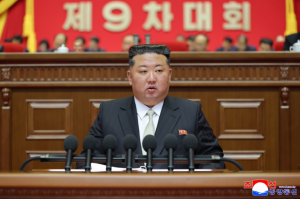
In the lead-up to the Ninth Party Congress, Kim Jong Un criticized cadre incompetence across both the industrial and agricultural sectors, reflecting a tendency to deflect blame for the limitations of his self-reliance policy. The Ninth Party Congress report presented a goal of achieving the “overall development of socialism” by 2035 and announced a new five-year plan. The report, a summary and not the full text of Kim Jong Un’s “report” to the Party Congress, offered no detail of any new or substantive measures to improve the economy, addressing only reinforced internal control, self-reliance, and mass mobilization. The subsequent First Session of the 15th Supreme People’s Assembly (SPA) built on the Party Congress’s decisions by reelecting Kim Jong Un as the head of the State Affairs Commission (SAC) and adopting measures to implement the new five-year economic plan.
Sharp Criticism of Problems in Socialist Construction Ahead of the Ninth Party Congress
In the run-up to the Ninth Party Congress, cadre accountability and the policy shortcomings of Kim Jong Un’s predecessors were brought into sharp focus. In January and February 2026, Kim used his speeches at the inaugural ceremonies for the first-stage modernization project of the Ryongsong Machine Complex and the Samgwang Livestock Farm to highlight two main problems in socialist construction: the incompetence and irresponsibility of officials, and the failures of “past” rural policies, an implicit criticism of Kim Il Sung and Kim Jong Il.[1] He lambasted Party and cabinet officials for defeatism, irresponsibility, passivity, and self-preservation, arguing that these attitudes had prevented work from being carried out properly. He also pointed out that past rural construction efforts were nothing more than empty, unenforceable slogans.
Context and Implications
In his two speeches, Kim Jong Un raised the same concerns across different sectors, industry and agriculture, revealing that serious problems persist in the socialist construction process.
He attributed the problems of socialist construction to the officials themselves, placing responsibility squarely on their shoulders. His criticism of the cadres reflects a tendency to assign blame for the limitations of his self-reliance policy to officials rather than to his own strategic misjudgments. References to external factors, such as the COVID-19 border closure and UN Security Council sanctions, or his own strategic decisions were conspicuously limited. This represents a classic response aimed at managing internal discontent and maintaining regime stability at a time when economic growth is clearly constrained. Kim Jong Un’s criticism of Kim Il Sung’s and Kim Jong Il’s policies is also intended to further consolidate his absolute grip on power.
Ninth Party Congress’s Socialist Development Strategy and Its Limitations[2]
At the Ninth Party Congress, North Korea set a goal of achieving the “overall development of socialism” by 2035 and announced a second-stage five-year plan (2026-2030). The Party Congress defined the period of the new five-year plan as “a phase of stabilization and consolidation, a phase of gradual and qualitative development.” It presented the “three revolutions”—ideological, technological, and cultural—and self-reliance as the central guiding principles for the implementation of the new five-year plan.[3]
Context and Implications
Based on North Korea’s summary report of Kim’s “report” to the Party Congress, the Workers’ Party presented a development strategy that relies on mass mobilization, such as tightened discipline and ideological work, rather than offering substantive solutions like working to have sanctions lifted or pursuing market-oriented measures.
As the self-reliance line is grounded in state control, Kim Jong Un’s absolute power and Party-centered governance will be further reinforced. To start, the Ninth Party Congress defined Kim Jong Un as a leader (suryong) who has fulfilled century-old aspirations that the two previous leaders failed to achieve. Furthermore, North Korea will further strengthen the Party through the five-point Party-building program, which emphasizes Party leadership and discipline.
In conclusion, the Party Congress’s socialist development strategy maintains a closed self-reliance model, one that pursues economic development through reinforced internal control, self-reliance, and mass mobilization, apparently without any prospects of working toward the lifting of sanctions against North Korea. Economic results achieved through this strategy will be limited. On the other hand, this strategy, aimed at strengthening Kim Jong Un’s power and Party-centered governance, is highly likely to contribute to maintaining political stability in North Korea.
First Session of the 15th SPA Held[4]
North Korea convened the First Session of the 15th SPA on March 22, 2026. The SPA reelected Kim Jong Un as the chairman of the State Affairs Commission (rendered in North Korea’s official English as “president of the State Affairs”), elected state leadership bodies, amended and supplemented the constitution, and adopted an ordinance on implementing the new five-year economic plan put forward by the Ninth Party Congress.
Context and Implications
Reelected as the SAC chairman, the top leadership position of the state, Kim Jong Un will present new lines and policies while continuing to criticize those of Kim Il Sung and Kim Jong Il. Along these lines, North Korea will emphasize Kim Jong Un’s ideas and further bolster his cult of personality to consolidate his absolute power.
North Korea underscored the responsibility and role of the cabinet, as per Cabinet Premier Pak Thae Song’s remarks during the SPA session that socialist economic construction will be carried out under “the guidance and management by the Cabinet-Responsibility System, Cabinet-Centred System.” The cabinet-responsibility system is Kim Jong Un’s strategy to evade accountability for economic construction, meaning he will not bear responsibility for economic outcomes himself but will instead limit his role to holding the cabinet accountable.
Kim Jong Un emphasized the legitimacy of his socialist construction strategy, which centers on strengthening nuclear forces and the country’s self-reliance—both prerequisites for appealing to the population to endure the hardships of persistent UN Security Council sanctions, and for suppressing the discontent of cadres and the people.
A significant change within the cabinet is the transfer of the SEC, which oversees the defense industry, under the cabinet’s jurisdiction. This appears to be an effort to place both the civilian economy and the munitions industry under the cabinet premier’s control. However, it remains uncertain whether the cabinet premier will be able to effectively exercise control over the SEC, which had previously operated with relative independence. Furthermore, as long as Pyongyang maintains its policy of prioritizing the munitions industry, the practice of allocating the cabinet’s limited resources preferentially to that sector will not change.
In his policy speech, Kim Jong Un put forward measures to strengthen control over the population, including reinforcing the lowest administrative units—the dong (neighborhood unit) and inminban (“people’s units”)—and establishing a police force. At the same time, Kim proposed measures to alleviate public discontent with the regime, instructing the dong and inminban to “eliminate such practices as imposing extra economic burdens on the inhabitants and fostering discontent,” and calling on party cadres to combat abuse of power, bureaucratism, and other anti-people practices. These measures are intended to suppress popular unrest and pro-South Korea sentiment fueled by the spread of outside information, as well as discontent stemming from economic hardship under prolonged UN sanctions. North Korea will intensify the detection and punishment of non-socialist behavior, including the influx and spread of outside information.
This chapter was originally drafted in Korean. The initial translation was produced using AI tools and subsequently reviewed word-for-word and refined by a bilingual subject-matter expert to ensure accuracy and readability.
- [1]
The Ryongsong Machine Complex is a special-grade enterprise with approximately 10,000 employees, located in the Ryongsong District of Hamhung City, South Hamgyong Province. The complex serves as the parent enterprise of the machine-building industry and is known as the “mother factory.” Its main products include power generation equipment, iron and steel production equipment, cement equipment, chemical engineering equipment, cast and forged products, and other machine tools.
- [2]
For more on this author’s initial assessment of the Ninth Party Congress, see Rachel Minyoung Lee, Kibum Han, Vann H. Van Diepen, Gyeong Seob Oh, Michael Madden and Mitsuhiro Mimura, “Expert Takes on North Korea’s Ninth Party Congress,” 38 North, February 27, 2026, https://www.38north.org/2026/02/expert-takes-on-north-koreas-ninth-party-congress/.
- [3]
The “three revolutions” are Kim Il Sung and Kim Jong Il’s socialist development strategy, devised to advance socialist construction through the ideological remolding of Party members and the people, along with mass mobilization campaigns, in response to international isolation and economic crisis in the 1970s.
- [4]
This segment was previously published in Rachel Minyoung Lee, Gyeong Seob Oh, Mitsuhiro Mimura and Kibum Han, “Expert Takes on Opening Session of the 15th Supreme People’s Assembly,” 38 North, March 25, 2026, https://www.38north.org/2026/03/expert-takes-on-opening-session-of-the-15th-supreme-peoples-assembly/.