

With Little Incentive to Engage the US, North Korea Deepens Russia and China Ties
This article is from the fourth edition (January – March 2026) of 38 North’s quarterly product, North Korea Briefing, that monitors key internal developments in North Korea. For the full series, click here.
At the Ninth Party Congress, Kim Jong Un signaled a more assertive and secretive foreign policy posture, claiming that North Korea (also the Democratic People’s Republic of Korea or DPRK) now stands at the center of a multipolar world and vowing to expand its international influence while keeping adversaries in the dark.[1] In the wake of the Middle East crisis, Kim appeared intent on demonstrating that North Korea, unlike Iran, possesses credible military deterrence, overseeing cruise missile tests and calling for “peace with strength” while deepening anti-Western alignment with Russia and Belarus. North Korea also is likely to gradually expand economic cooperation with China, though political calculations on both sides will likely keep the pace measured. Meanwhile, Kim Yo Jong’s rebuff of Japan’s interest in a bilateral summit seems to underscore Pyongyang’s confidence in its enhanced international standing.
North Korea Claims “Important Changes to the Position and Influence of the DPRK”
According to North Korean media’s summary of Kim Jong Un’s report to the Ninth Party Congress—a review of the Workers’ Party’s work over the past five years—Kim claimed that “the building of a fair and just multi-polar world will be further promoted” and that North Korea stood “right at the centre of” that movement. He also stressed the need to “expand and strengthen the external prestige and influence of our state more broadly,” adding that the “Party Central Committee’s direct involvement in the external activities of the state is an essential requirement.” Notably, he emphasized the clandestine nature of external activities, saying: “Now our enemies don’t know what we’re planning and calculating. They can’t and shouldn’t know.”
Context and Implications
At the Eighth Party Congress in 2021, too, Kim Jong Un mentioned the need to “extensively develop the foreign relations on a par with the strategic position of our state.” However, Kim went further in his opening address to the Ninth Party Congress, playing up Pyongyang’s increased global influence by declaring that “the position of our state was firmly consolidated as an irreversible one, bringing about a great change in the global political landscape and in the influence on our state.” It is also rare for North Korea to call for the Party’s “direct guidance and involvement” and for strengthened security in the foreign policy domain considering North Korea’s “remarkably enhanced” international standing. In this context, North Korea’s diplomatic flexibility and pragmatism likely will be diminished further, as Kim Jong Un will play a more dominant role in North Korea’s external activities going forward. The covert and irregular nature of those activities will likely continue to increase, and Pyongyang will further assert its status as a self-declared “nuclear weapons state.”[2]
Kim Likely to Continue Flaunting Military Capabilities and Deepen Russia Ties Amid Middle East Tensions
On March 1, a North Korean Foreign Ministry spokesperson’s press statement condemned the US-Israeli airstrikes on Iran as a “shameless rogue act.” The Foreign Ministry followed up with a spokesperson’s answer to a journalist on March 10 to once again “strongly denounce the acts of aggression by the U.S. and Israel” and support Iran’s election of a new Supreme Leader.
North Korean state media have refrained from criticizing US President Donald Trump by name so far, but that does not mean talks are close. After the Party Congress, Kim Jong Un appeared to reinforce the notion that North Korea is different from Iran because it has nuclear weapons, and demonstrated those capabilities. For example, he oversaw or observed strategic cruise missile test launches conducted from the 5,000-tonne destroyer Choe Hyon on March 4 and 10 ahead of its commissioning, emphasizing the need to “maintain and expand the powerful and reliable nuclear war deterrent.” In his policy speech to the opening session of the 15th SPA, Kim called for “peace with strength” while referring to US “acts of state-sponsored terrorism and aggression in various parts of the world.”
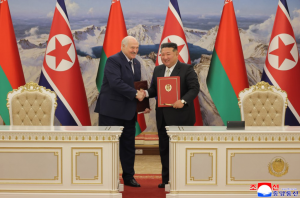
Meanwhile, on March 26, Kim held a summit with visiting Belarusian President Alexander Lukashenko, signing a Treaty on Friendship and Cooperation and agreements on cooperation in the fields of diplomacy, information, agriculture, education, and public health.
Context and Implications
Some analysts have argued that North Korea’s restraint in reporting on the Iran situation and in criticizing Trump by name signal Kim Jong Un will adopt a positive attitude toward dialogue with the United States. In this author’s view, however, North Korea’s incentive to come to the negotiating table will only diminish further. This is because engaging in dialogue while still refusing to denuclearize would expose North Korea to greater pressure—whether through US follow-up actions or a further worsening of US-North Korea relations—than refusing both dialogue and denuclearization altogether.
Instead, North Korea will likely continue to demonstrate that it is different from Iran in three key respects: its status as a “nuclear weapons state,” its backing by Russia, and the geopolitical difference between the Far East and the Middle East in that both South Korea and China oppose a war. In particular, North Korea will further step up its diversification of nuclear and missile capabilities while strengthening its own defensive posture. To that end, it will likely press forward with military cooperation with Russia and reinforce the anti-Western trilateral alignment with Russia and Belarus.
North Korea to Expand China Ties While Keeping Its Pace
Unlike at the Eighth Party Congress, Kim Jong Un’s “report” to the Ninth Party Congress made no explicit mention of Pyongyang’s relations with Russia or China, simply remarking that it “should steadily develop the traditional relations of friendship and cooperation with neighboring countries onto a higher stage.”[3] However, the Ninth Party Congress’s claim that North Korea had made “remarkable achievements” in the foreign policy domain appeared intended to signal that a) the country has risen to the status of a “nuclear weapons state” on par with China and Russia, and b) its solidarity with these two nations has deepened. Though not publicized, the Party Congress is presumed to have shown off Kim Jong Un’s diplomatic accomplishments, for example in Foreign Minister Choe Son Hui’s speech.
Context and Implications
North Korea will likely maintain its close relationship with Russia for the military reasons cited above, while expanding exchanges and cooperation with China out of economic necessity, including importing goods in short supply for the implementation of the new five-year economic plan. North Korea-China trade reached approximately $2.73 billion in 2025, up 25 percent from the previous year, and passenger train service between Pyongyang and Beijing resumed on March 12 for the first time in six years. With its major political events now behind it, North Korea will likely gradually expand economic cooperation with China, though Pyongyang will also likely pace itself, guided by the political calculations of both leaderships. Kim Jong Un’s visit to China in September 2025 and the Chinese premier’s visit to Pyongyang the following month set the stage for restoring bilateral relations, but the two sides still remain at the level of the top leaders exchanging diplomatic correspondence and resident embassies trading platitudes about strengthening friendship and cooperation. Notably, Kim Jong Un’s recent speech to the SPA hints at a possible recalibration of Pyongyang’s relations with friendly countries, which could include China:
We should continue to improve and strengthen, from a developmental point of view, the relations with the countries with which we have traditional friendly ties in line with the requirements of the new era, and at the same time readjust and redefine diplomatic preference and adroitly translate it into practice by prioritizing our national interests on the principle of ensuring medium- and long-term and strategic national interests.
Kim Yo Jong Rebuffs Japanese Prime Minister’s Desire for a Summit
In a March 23 press statement, Workers’ Party Department Director Kim Yo Jong responded to Japanese Prime Minister Sanae Takaichi’s interest in holding a North Korea-Japan summit, saying that it was “not the one that comes true, as wanted or decided by Japan.” She added: “If the prime minister of Japan seeks to resolve its unilateral matter not recognized by us, our state leadership will have no intention to meet or sit face to face with her.”
Context and Implications
The “unilateral matter” refers to the issue of Japanese abductees, which was discussed at the March 19 US-Japan summit. The statement’s main point—that dialogue may be possible only if Japan does not raise the abductees issue—appears to reflect Pyongyang’s confidence that its international standing has improved.
This chapter was originally drafted in Korean. The initial translation was produced using AI tools and subsequently reviewed word-for-word and refined by a bilingual subject-matter expert to ensure accuracy and readability.
- [1]
For this author’s initial assessments of the Ninth Party Congress and the First Session of the 15th Supreme People’s Assembly, see Rachel Minyoung Lee, Kibum Han, Vann H. Van Diepen, Gyeong Seob Oh, Michael Madden and Mitsuhiro Mimura, “Expert Takes on North Korea’s Ninth Party Congress,” 38 North, February 27, 2026, https://www.38north.org/2026/02/expert-takes-on-north-koreas-ninth-party-congress/; Rachel Minyoung Lee, Gyeong Seob Oh, Mitsuhiro Mimura and Kibum Han, “Expert Takes on Opening Session of the 15th Supreme People’s Assembly,” 38 North, March 25, 2026, https://www.38north.org/2026/03/expert-takes-on-opening-session-of-the-15th-supreme-peoples-assembly/.
- [2]
At the Ninth Party Congress, North Korea elevated Kim Song Nam, director of the Party’s International Department to a Party secretary. While reporting on the election of Minister of State Security Ri Chang Dae as a member of the State Affairs Commission (SAC) during the First Session of the 15th Supreme People’s Assembly (SPA), the Party daily Rodong Sinmun identified him as the director of the National Intelligence Bureau, indicating that the “Ministry of State Security” was renamed the “National Intelligence Bureau.” Following the close of the SPA session, Kim Jong Un posed for a commemorative photograph with North Korea’s overseas ambassadors, who had traveled to Pyongyang to attend the meeting. See “Press Release of First Plenary Meeting of Ninth Central Committee of WPK,” Korea News Service (KNS), February 24, 2026, https://koreanewsservice.com/en-news/press-release-of-first-plenary-meeting-of-ninth-central-committee-of-wpk/; “조선민주주의인민공화국 국무위원회 제1부위원장, 부위원장, 위원들 [DPRK State Affairs Commission First Vice Chairman, Vice Chairman, and Members],” Rodong Sinmun, March 23, 2026; “Respected Comrade Kim Jong Un Meets and Encourages Newly-Appointed Cabinet Members and Deputies to SPA,” KNS, March 24, 2026, https://koreanewsservice.com/en-news/respected-comrade-kim-jong-un-meets-and-encourages-newly-appointed-cabinet-members-and-deputies-to-spa/.
- [3]
In his “report” to the Eighth Party Congress in January 2021, Kim Jong Un touted creating “a trend towards peace and the atmosphere of dialogue” with the United States, holding “five rounds of the DPRK-China summits,” and developing “friendly and cooperative relations with Russia,” which he claimed led to the “rapid development of the DPRK’s external position.” He then called on “the field of foreign affairs to further develop the relations with socialist countries” over the next five years.