

What Health Diplomacy Can Offer US-DPRK Engagement
After years of stalled talks, health cooperation could give Washington a practical way to restore working-level contact with Pyongyang and help reduce regional health risks.
US-DPRK diplomacy has remained largely frozen since the second summit between Donald Trump and Kim Jong Un ended without an agreement in Hanoi in February 2019. Working-level talks in Stockholm collapsed that October, leaving the two governments without a sustained negotiating channel.
The diplomatic environment has only become more difficult since then. North Korea has continued developing its weapons programs, expanded its relations with Russia and China, and rejected negotiations centered on denuclearization. Recent developments indicate renewed interest in direct US-DPRK engagement, but Pyongyang’s guarded response and significantly higher threshold for talks suggest that any new efforts would begin under far more constrained conditions than in 2018 and 2019. Years of interrupted contact, including the COVID-era border closure, have also weakened many of the working-level relationships and institutions that once provided channels for engagement.
Health cooperation could be a way to begin rebuilding that missing layer. Gaps in disease detection and treatment inside North Korea create risks beyond its borders. Sustained technical cooperation would give US institutions regular contact with North Korean counterparts and better knowledge of conditions inside the country, while leaving the larger political discourse for the highest levels.
For that to happen, however, cooperation measures would need to move beyond previous humanitarian efforts centered on emergency relief or one-time deliveries. Its focus should instead work toward establishing programs that North Korean institutions help shape, implement and sustain. Professional exchanges and shared technical work would give both sides repeated reasons to remain in contact.
Starting With Shared Priorities
North Korea has repeatedly emphasized development and self-reliance in its health policy. The expansion of the 20×10 Regional Development Policy to include hospitals, along with recent medical exchanges with Russia, points to an interest in strengthening domestic capabilities rather than relying indefinitely on external relief.
Closer ties with Russia may provide short-term resources, but they do not resolve the DPRK’s limited access to wider technical networks. Cooperation with American and multilateral institutions would open additional channels for medical expertise while supporting the domestic capacity Pyongyang seeks to build.
A sustained health initiative would be more likely to endure if it focused on areas where American and North Korean interests overlap. A multilateral or regional institution acceptable to both sides could help identify projects serving shared health needs and North Korean priorities. External partners could contribute financing and expertise through that framework, with Washington facilitating any required licenses or exemptions. North Korean institutions would retain responsibility for implementation and long-term operation.
Tuberculosis (TB) provides one obvious starting point due to both the severity of North Korea’s continuing TB burden and the record of collaborative success already established. The DPRK remains among the World Health Organization’s (WHO) high-burden countries for both TB and multidrug- or rifampicin-resistant TB; in 2024, only 1.6 percent of bacteriologically confirmed pulmonary cases were tested for rifampicin resistance. Past Global Fund-supported programs provide a useful precedent for renewed cooperation. More importantly, unchecked drug-resistant TB in North Korea could add to the global burden of drug-resistant disease.
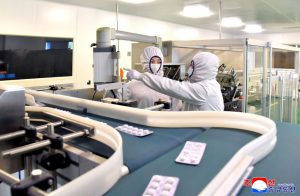
Potential new projects could work to strengthen provincial diagnostic laboratories, infection-control capacity, reliable drug supply, treatment follow-ups and, where feasible, negative-pressure facilities. Vaccine cooperation could focus on cold-chain management, storage, surveillance and quality control. Other initiatives could support selected medical supplies or protective equipment that North Korean facilities could eventually produce or maintain domestically. These projects could produce benefits beyond their immediate targets. Stronger tuberculosis diagnostics, for example, would also improve laboratory capacity for other diseases.
North Korea itself also offers evidence that repeated cooperation can gradually expand local responsibility. The Eugene Bell Foundation, an American-South Korean organization that has worked in North Korea since 1997, later developed a program for multidrug-resistant tuberculosis. By 2019, it was treating approximately 1,800 patients, with a reported cure rate near 75 percent. Its teams initially removed GeneXpert diagnostic machines after each visit, later stored them at the British Embassy and eventually left them with North Korean caregivers. This allowed local diagnosis to continue between foreign visits, demonstrating that technical responsibility could expand even while the broader political relationship remained strained.
A new health framework should deliberately seek this kind of institutional progression: from delivery, to joint operation, to maintenance, to greater North Korean responsibility. This would make cooperation more practical to sustain while turning external assistance into a durable institutional partnership.
Building Reciprocity Into the Program
Successful health cooperation between political adversaries has historically depended on giving each participant a substantive role, helping create conditions for improved relations.
During the Cold War, the World Health Organization’s campaign to eradicate smallpox created a narrowly defined area of cooperation between the United States and Soviet Union. Moscow supplied large quantities of heat-stable, freeze-dried vaccine, while the United States contributed epidemiologists, financing and operational expertise. Their governments remained strategic adversaries, but specialists from both countries could contribute capabilities the campaign required. This allowed both parties to participate with improved parity on an apolitical issue, while helping to reduce diplomatic tensions.
This kind of model should be followed for North Korea as well. North Korean physicians and public health officials possess their own expertise, including experience delivering tuberculosis treatment, vaccination and clinical care under severe resource constraints. Regional or international meetings could give them opportunities to contribute that knowledge alongside opportunities to receive training. Such opportunities have long provided a way for states to maintain technical contact across political boundaries: the first International Sanitary Conference in 1851 brought diplomats and physicians from twelve states together around common health problems decades before durable international health institutions emerged, and in an age where nations are noted to “have forgotten their former rivalries and join hands”.
Cuba provides a more contemporary example of how medical expertise can itself become an international contribution. For decades, Havana has deployed physicians and other health workers abroad as part of its foreign engagement; during the 2014 West African Ebola outbreak, Cuba committed 165 health professionals to Sierra Leone through the WHO response. Studies of Cuban medical diplomacy have argued that these missions gave a relatively small state international visibility and influence through a capability it could offer other countries.
North Korea has its own history of sending medical personnel abroad. Eight North Korean doctors, including a surgeon and pediatrician, arrived in Mozambique in 1975, and decades later, the UN Security Council’s Panel of Experts documented DPRK medical workers in countries including Angola, Nepal, Nigeria and Tanzania. Rather than treating North Korean clinicians only as recipients of training, a future framework could similarly allow North Korean clinicians to contribute through internationally supervised medical work in third countries rather than treating them only as recipients of training.
Professional exchanges could become a basis for two-way cooperation. North Korean physicians and public health officials could participate in short courses, observerships, case conferences, research workshops and technical-English training in the United States or neutral locations. Foreign specialists could conduct scheduled visits or provide remote consultation. Over time, North Korean clinicians might also participate in internationally administered medical missions abroad. Any such exchanges or missions, however, would require a specific public-health exemptions from UN restrictions on information exchanges and income-earning work by DPRK nationals abroad.
The WHO has already worked with the DPRK Ministry of Public Health on workforce development, laboratory quality, surveillance, and noncommunicable diseases.[1] Similarly, UNICEF maintains operational ties, partnering with the North Korean government in September 2024 to launch a nationwide vaccination campaign that delivered over four million doses and trained more than 7,200 local health workers.
Rather than create a separate diplomatic framework, Washington could organize its participation through existing multilateral mechanisms, leveraging institutions like UNICEF where the United States already holds an Executive Board seat.
Making Cooperation Feasible and Durable
Even technically sound health programs can stall if institutions cannot move equipment, transfer money, arrange travel, or obtain licenses. Targeted sanctions relief or exemptions for approved health projects could ease these constraints while serving as a limited concession from Washington in support of renewed engagement. Alongside such measures, a neutral international body could manage funding, technical standards, and monitoring, with hospitals, universities, and specialists retaining responsibility for individual projects.
Multi-year financing would make this framework more durable by insulating programs from annual political changes and allowing institutions to plan beyond a single delivery or visit. Progress could then be measured by whether equipment remains operational, treatment continues without interruption, and counterpart institutions continue meeting as scheduled.
What Washington Would Gain
The most immediate benefit to America would be a channel of regular contact with North Korean institutions. Security diplomacy typically concentrates interaction among a small number of senior officials meeting under enormous political pressures. Health cooperation would involve a broader range of institutions with programs designed to remain operational despite political shifts. Such working-level relationships would help rebuild knowledge of North Korean institutions that remote observation cannot.
The US President’s Emergency Plan for AIDs Relief (PEPFAR), started in 2003 under the George W. Bush administration, illustrates how health assistance can produce both health-system strengthening and diplomatic returns. By 2021, its HIV investments supported nearly 300,000 health workers and more than 3,000 laboratories across 50 partner countries, creating a workforce and laboratory network that later supported responses to Ebola and COVID-19. Research on PEPFAR and US health assistance more broadly has linked such programs to more favorable perceptions of the United States. Repeated professional contact could likewise give North Korean participants a basis for judging American institutions through direct experience rather than solely through the context of military and political confrontation.
Stronger health capacity on the Korean Peninsula would also improve regional preparedness. Faster diagnosis and more reliable treatment inside North Korea would help neighboring countries and international organizations assess and respond to cross-border threats.
Leading such a framework could also help rebuild the United States’ role in global health at a time when confidence in American reliability has weakened in many countries. Sustained cooperation with a traditional adversary could provide a concrete example of American medical and scientific institutions’ ability to address shared problems despite unresolved political tensions.
Rebuilding Capacity for Diplomacy
Nearly seven years after the last US-DPRK meeting, Washington and Pyongyang no longer have officials who know one another through collaborative work, institutions accustomed to carrying out joint commitments, or a recent record of completing even limited projects together.
Health cooperation offers one practical way to begin rebuilding the inter-institutional relations through shared goals that carry relatively low political risk. Its value would be visible when projects remain operational and counterpart institutions continue resolving problems together. Each completed initiative could provide a basis for the next, while strengthening global health security.
Over time, such cooperation could leave both sides with a broader set of working relationships and a recent record of institutional interaction. In a relationship where those foundations have largely disappeared, historical lessons illustrate how healthcare diplomacy can create a more substantive basis for future engagement than episodic contact alone.
- [1]
The United States withdrew from the WHO on January 22, 2026.