

Pak Hui Chol and GPB Corruption
Pak Hui Chol’s corruption case is a catalyst across multiple layers of Party and security authority in North Korean strategic culture. It produced immediate disciplinary consequences for Pak and his network, telecast a model case to the elite about the regime’s enforcement posture, and exposed structural deficiencies in Party–military relations that required a direct intervention by Kim Jong Un. The case is not simply an episode of elite misconduct; it is a window into how the regime identifies threats, manages institutional failure, and signals discipline across the leadership.
To understand the significance of the Pak Hui Chol case and its implications, we must first clarify the roles of the General Political Bureau (GPB) and its Organization Department (OD)—the institutions Pak exploited. These bodies sit at the core of the Party’s political control over the Korean People’s Army (KPA), and their vulnerabilities shaped both the scale of Pak’s network and the severity of the regime’s response. We then examine how Pak built and operated his network, drawing on state media’s unusually detailed disclosures and the broader politico‑media context in which the regime framed Pak as a model case of elite misconduct. With that foundation, we assess Pak’s impact on the regime, both within the Party–military oversight system and across senior military leadership, to explain why his case triggered such a public and structural reaction.
This analysis proceeds by outlining the GPB and OD’s institutional functions, reconstructing Pak’s network and its operational mechanisms, and evaluating the case’s implications for Party–military relations. It then situates the Pak case within recent patterns of elite discipline, examines the personnel reshuffles that followed, and assesses the regime’s slow but deliberate reaction from June through August. Finally, it considers how Kim Jong Un and core elites may handle corruption going forward.
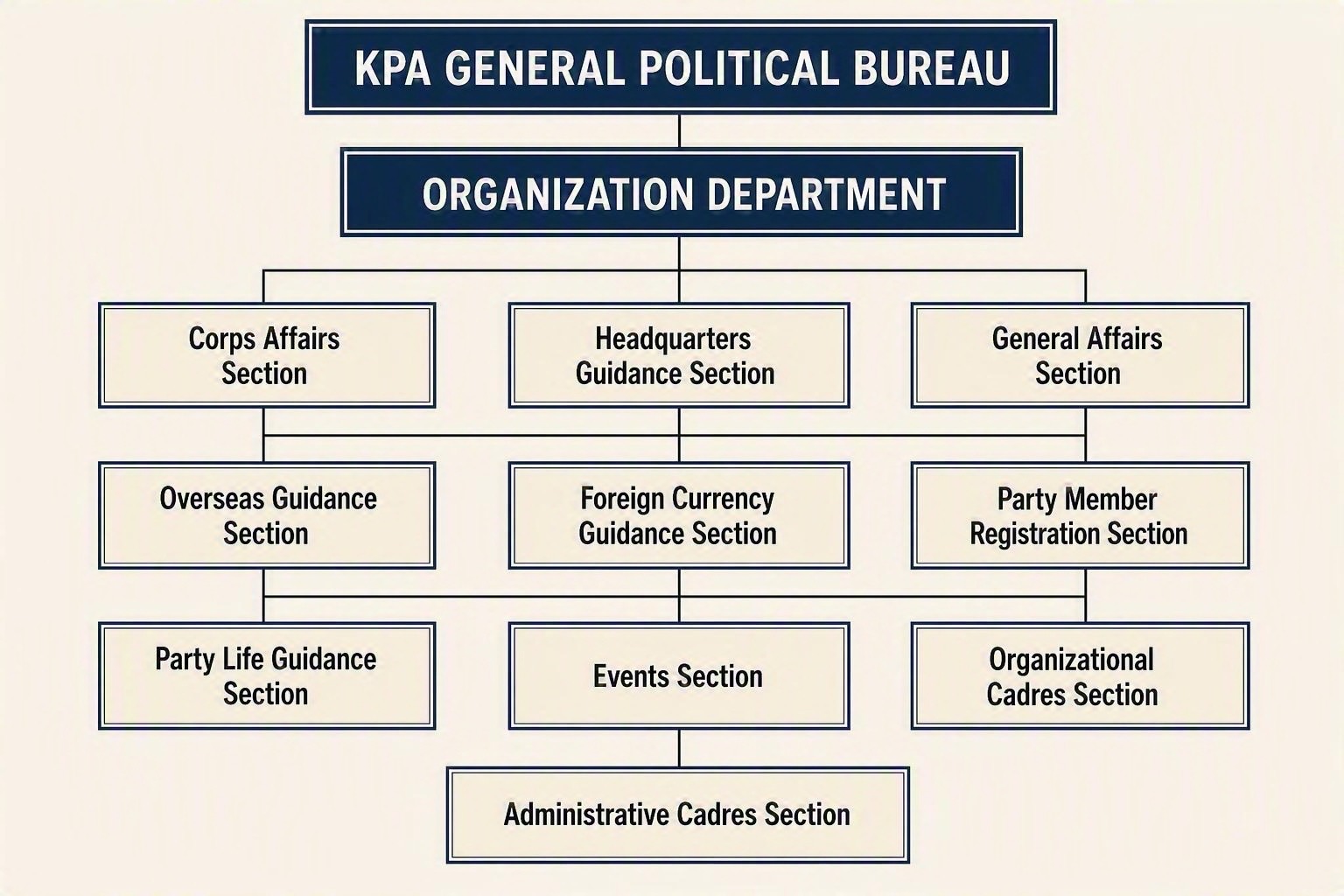
KPA GPB Organization Department
Understanding the Pak Hui Chol case requires a view of the institutions he exploited: the General Political Bureau (GPB) and its Organization Department (OD). These bodies form the core of the Party’s political control over the Korean People’s Army (KPA), and their structural vulnerabilities shaped both the scale of Pak’s network and the severity of the regime’s response.
The GPB is the Party’s political command inside the armed forces. It maintains a nationwide network of political instructors and commissars who oversee ideological compliance, personnel management, and political reporting. GPB cadres operate down to the company level — often one political officer for every 75–150 troops — giving the Party a granular presence in daily military life.
Within the KPA, the GPB’s authority spans four broad areas:
• Political oversight — indoctrination, Party Life, ideological instruction
• Cultural and morale functions — parades, media, cultural programming
• Administrative control — personnel assignments, promotions, party member registration
• Audit and compliance — monitoring contracts, production units, foreign trade, and materials management
This confers enormous administrative reach on the GPB, but also creates opportunities for embedded patronage networks, self-policing, and corruption — problems that have recurred across five decades of DPRK leadership.
The OD is the GPB’s most sensitive component. It decides some personnel appointments, but more often the OD’s recommendations are highly influential and often determinative. The OD:
• Refers and vets personnel assignments
• Manages political officers from KPA headquarters down to company-level units
• Oversees administrative and logistical cadres
• Maintains and amends personnel files and party member records
• Operates branch offices that audit KPA production units and materials management
Historically, the OD also exercised informal control over the General Logistics Department and support missions under the Ministry of National Defense (MND). Although those authorities have since reverted to the MND, the OD retains broad influence over resource flows, personnel placement, and political oversight.
This combination of political authority, administrative reach, and personnel leverage made the OD the ideal platform for Pak Hui Chol’s corruption network.
It should be noted that Pak Hui Chol got his OD position in 2022 because of a different resource misappropriation scandal in GPB. In addition to exploiting transitional reporting and guidance gaps, Pak assumed office over an already troubled institution.
Both the GPB and OGD have been undergoing long-term transitions under Kim Jong Un:
• The 2019 creation of the Political Guidance
of the Military (PGM) stripped the GPB of some policy compliance functions.
• Kim Jong Un has diversified his channels of military control, reducing GPB’s centrality compared to the Kim Jong Il era.
• The OGD’s role has shifted, especially after Kim Jong Un ceased serving as de facto director — reducing its dominance over personnel gatekeeping.
• The rise of the General Affairs Department and the expansion of the SAC Secretariat have further diluted OGD’s bureaucratic primacy.
These transitions created gaps in oversight, ambiguities in reporting chains, and weakened cross-checking mechanisms, vulnerabilities Pak exploited.
Pak’s position as deputy director of the OD gave him access to:
• Personnel placement
• Resource allocation
• Political reporting channels
• Administrative oversight nodes
• Regional GPB offices
• Sensitive military units through political officer assignments
This allowed him to build a network that fused the OD’s administrative cohort with the GPB’s political cohort — a structural breach that undermined the Party’s ability to monitor the military and maintain command discipline.
Pak’s corruption was not novel; it was the scaling and systemization of preexisting behaviors—misappropriating money and resources, filing deceptive reports and selling positions. However, because it occurred inside the GPB–OD nexus — the Party’s primary mechanism for controlling the KPA — it became a structural threat, not an ethical lapse.
Pak’s Network
As deputy director of the GPB Organization Department (OD), Pak sat at the intersection of:
• Personnel placement
• Political oversight
• Administrative control
• Resource allocation
• Reporting channels to OGD and the Central Committee
This position gave him access to both sides of the GPB system:
• The political cohort — commissars, political instructors, regional GPB officers
• The administrative cohort — accountants, logistics managers, inventory controllers, housing allocation officials
Pak’s corruption network fused these two cohorts, breaking the Party’s internal checks-and-balances inside the military.
Rather than some vast sprawling conspiracy, Pak needed five or six strategically placed nodes inside the GPB–OD–MND nexus.
Those nodes probably included:
• One OD personnel officer to manage recommendations, referrals, and file-cleaning
• One OD administrative officer to manipulate inventory, requisitions, and materials
• One GPB regional political officer to supervise local political cadres and suppress complaints
• One GPB logistics auditor to falsify reports and mask resource diversion
• One MND or General Staff liaison to influence manpower allocation and sensitive unit assignments
• One provincial or military district party official to coordinate paperwork and approvals outside GPB channels
With these nodes in place, Pak was open for business and his network was fully operational. He could assign cadre positions, revise or falsify reporting and records, divert or swindle money and materials, suppress whistleblower complaints and manipulate the GPB’s routine reporting. Pak and his associates probably expanded the network horizontally through units under their control and clogged vertical reporting channels into the Party.
This is why the network scaled so quickly: the GPB–OD system is designed for political control which in the KPA can suppress reporting or data showing theft or misappropriation. Once Pak fused the political and administrative cohorts, the system became self‑protecting.
Pak and his associates sold:
• Political officer posts
• Administrative cadre positions
• Favorable recommendations
• Clean personnel files
• Light-duty conscription assignments for elite families
Because OD recommendations are highly influential, Pak could effectively “sell” posts without formally appointing anyone. The administrative cohort diverted construction materials, clothing and household goods, military supplies, funds earned by KPA production units or earmarked for infrastructure projects and housing assignments.
The political cohort then protected these diversions filing deceptive reports, suppressing complaints and whistleblowers, contradicting or revising administrative reporting, manipulating accounting and inventory control software and falsifying audits.
This is what state media called “irregularities.” Pak’s greed — emphasized repeatedly in state media—drove his network and activities to grow. According to state media, Pak partnered with other elites and “received numerous bribes by unhealthy individuals driven by greed and ambition.” This created two revenue pressures. First, continuing revenue for personal enrichment for Pak and his closest associates. Second, maintaining payments to network operatives. To sustain the network, Pak had to escalate:
• More posts sold
• More sensitive posts sold
• More resources diverted
• More cadres implicated
• More reporting channels corrupted
This escalation transformed routine corruption into a structural threat. It penetrated sensitive units. Based on OD authorities, Pak could have influenced personnel in:
• KPA Headquarters
• Division and corps-level political offices
• Strategic Forces
• Nuclear Forces
• Pyongyang Defense Command
• III Army Corps
Even if only a fraction of this occurred, it undermined command-and-control and coup-proofing mechanisms. It also corrupted the Party’s military oversight system, breaking the GPB’s core function: political supervision of the military.
When political cadres protect administrative corruption, the Party loses accurate reporting, personnel integrity, resource accountability, political discipline and, most critically, early warning signals. This constitutes the structural failure Kim Jong Un had to acknowledge.
Pak Hui Chol’s network transcended the GPB into the wider elite system. It is highly probable that personnel assignment bribery roped in General Staff personnel offices, provincial party military departments and commissions, OGD and Cadres’ Affairs staff and manpower allocation units. At its most insidious, the Pak Hui Chol network could have encompassed hundreds of GPB cadres and thousands of elites across the regime seeking favorable assignments for themselves or their family members.
What began as a GPB OD corruption scheme became a multi-institutional patronage network.
State media framed Pak as:
• Greedy
• Debauched
• Abusive
• Systematic
• Threatening to national security
This framing served two purposes:
• Internal discipline — warning elites that corruption will be publicized
• Institutional signaling — showing that GPB and OGD failures will be corrected through structural intervention
Pak’s case was not unprecedented, but its scale, systemization, and location inside the GPB–OD nexus made it uniquely dangerous.
The Pak Hui Chol case can be understood along an impact spectrum. At the minimum, it represents a systemized version of familiar elite corruption. At the maximum, it constitutes the most serious internal challenge to Kim Jong Un’s authority since the purge of Jang Song Thaek. The truth likely lies between these poles, but the regime’s unusual public handling of the case suggests it views the upper end of the spectrum as plausible enough to warrant structural intervention.
At the low end, Pak’s case fits a long-standing pattern of DPRK elite behavior. Resource diversion is endemic in KPA logistics networks. Personnel sales occur routinely at the conscription and manpower allocation level. Administrative–political collusion has existed for decades. Enterprise corruption has become a chronic feature of North Korean governance.
From this perspective, Pak did not invent new methods; he scaled and organized existing ones. His network exploited known enforcement gaps in GPB and OD oversight. The case is serious but not unprecedented and does not pose an existential threat. The regime’s public handling is primarily didactic — a model case to warn elites.
This minimum scenario explains the case as a high-profile corruption breach, not a structural failure. The mid-range scenario recognizes that Pak’s network operated inside the GPB–OD nexus, the Party’s primary mechanism for controlling the military. This elevates the case beyond routine corruption. Mid-level corruption impact compromised political reporting from GPB cadres and distorted personnel assignments across KPA units. Falsified audit and inventory data reached OGD and suppressed complaints from military units. It may have caused contagion into MND, General Staff, and provincial party organs,
From this perspective this created a structural failure in the Party’s ability to supervise the KPA. This created a loss of fidelity in political and administrative reporting and breakdown in cross-checking mechanisms between GPB, OD, and OGD. It most likely triggered the need for direct intervention, such as Jo Yong Won’s return to OGD. At this point, the regime had to act to restore command discipline and political control.
At the mid-to-upper end of the spectrum, Pak’s network constituted a shadow hierarchy. Under this scenario, Pak and his associates embedded in sensitive KPA units such as the Strategic Forces or units protecting Kim Jong Un and/or Pyongyang and other core elites. Even a minuscule presence could affect regime coup-proofing, command and control integrity or Kim Jong Un’s personal security escort. This might have required the CMC’s intervention.
Pak Hui Chol’s shadow hierarchy corrupted the GPB’s control tower function through neutralizing it. Deceptive administrative reporting established blind spots which tainted OGD’s supervisory role and enabled a multi-vector patronage network. This may have become a structural failure which suppressed whistle-blower reports, conceal failures and/or embolden coordinated misconduct.
Pak’s pay-to-play scheme probably pulled in a diverse DPRK elite population whose activities, when taken together, could be credibly interpreted as an existential threat to Kim Jong Un’s authority. Whatever the actual impact of Pak Hui Chol’s shadow hierarchy, the regime opted to treat it as having maximum impact.
Showcase
The initial analytical reaction by Pyongyang watchers was to note Jo Yong Won’s return to OGD and question the motivation for the high visibility (Central Committee plenum, unique special-call meeting) the regime gave the Pak case.
It initially publicized the case during the June 2026 Central Committee plenary session. During that meeting, the GPB’s prior nominal supervisor in the party apparatus, Jo Yong Won, returned to that post. And yet, state media did not explicitly link Jo’s personnel migration to the contretemps at GPB; this connection was made by Pyongyang watchers. State media detailed nothing about Pak’s corruption at that time.
Three weeks later, Kim Jong Un convened an extraordinary special-call joint meeting of North Korea’s party, government and security leadership. State media reporting on that meeting detailed Pak Hui Chol’s network and its activities.
In its official reporting, the regime took the maximum-impact scenario. The staggering interval between the Pak case released to the public and the details underlying added a degree of melodrama. These high visibility events elevated the Pak case, via the regime’s propaganda filters, from corruption to a showcase model for other elites. As such, the regime’s image makers sweetened the Pak case with a bit of propaganda showmanship.
Corruption and abuse of power investigations usually fly under the state media radar. Publicizing the Pak case, Kim Jong Un is once again publicizing elite misbehavior, as he did in 2025. Pak’s case referral out of the CMC is similar to the May 2025 CMC referral of defense industry personnel to civilian law enforcement after the navy ship Choe Hyon capsized.
Pak Hui Chol becomes another model for how the core leadership will respond to graft, deceptive reporting, incompetence and other acts of misrule. First, no elite affiliation is above the law—Pak and his network come from the GPB-OGD nexus while personnel involved in the capsizing of the Choe Hyon are from the defense industry. Both are traditionally given a wide berth and have been treated above the law, but that special status has been revoked. Secondly, officials are being told that they run the risk of having their activities investigated through the disciplinary and Party channels outside their home agencies. Police, prosecutors and courts are driven to make cases and, as such, may not appreciate the context or nuance a home agency investigation might entertain. Finally, Kim Jong Un is once again demonstrating a willingness to publicize elite corruption and misbehavior. In addition to facing legal consequences and Party investigations, elites risk the embarrassment and humiliation of having their misconduct disclosed in public. Public critique and shaming are no longer confined to Party Cell meetings. Two months after the Pak case was publicized a report surfaced about shadow stockpiles and stealing food supplies at the North Hamgyo’ng orphanage in Chongjin. While as yet unreported by state media, it is reasonable to assume those under investigation do not wish to have their names associated with stealing food from orphans.
Calendar and personnel impact
There was a three week interval between the Central Committee plenum publicized the Pak case and the special meeting that detailed the activities of Pak and his network. On August 29, Kim Jong Un convened a CMC meeting mostly dealt with senior personnel changes.
The final phase of Pak Hui Chol-related personnel changes that began at the June Central Committee plenum culminated in a 65 day process. The first came with Jo Yong Won’s return to OGD and the appointment of former Pyongyang Defense Command Political Commissar Kim Yong Ul to replace Pak Hui Chol at the GPB OD, effective at the June Central Committee plenary session.
In July, the CMC met and made changes to “key posts” of the KPA. It is all but certain some of these positions involved replacing officials installed by Pak Hui Chol. It also finds the CMC making direct personnel selections, possibly as a response to the Pak case.
At the second CMC meeting on August 29, Kim Jong Un tendered a series of personnel changes in both the institutions tainted by the Pak Hui Chol network along with the positions and institutions which failed to deal with Pak and his associates.
GPB Director Kim Song Gi was appointed defense minister. This was the first time since the 1990s that a core elite held these positions concurrently. Military Security Command director Yu Kwang U was appointed senior deputy director of the KPA GPB. Yu was also given Political Bureau status as a full member which is the first time a GPB Senior Deputy Director had Political Bureau status since 2010. Om Ju Ho, KPA Air Force Political Commissar was appointed MSC Director.
If we follow these personnel changes chronologically, the time and order of these personnel changes represents a phased plan to address the problems from the Pak Hui Chol case.
- Kim Yong Ul was appointed to replace Pak at the GPB OD—this eliminated Pak from leadership, replacing him with an elite that has close ties to the Kim Family.
- At the same time, Jo Yong Won returned to the OGD. This placed one of Kim Jong Un’s closest aides in a position to formulate and implement an effective response to the damage Pak and his network did. This most likely included personnel decisions along with process and protocol changes.
- The July CMC meeting made several unknown personnel changes, some of which were connected to the Pak case and formed a personnel architecture to address the damage.
- With a plan and lower-level personnel in place, the August CMC meeting made three personnel appointments to mitigate the damage caused by Pak and his associates and formulate and implement administrative and guidance changes to prevent the recurrence of a similar situation.
- Kim Song Gi’s concurrent MND/GPB appointment might indicate that the Pak Hui Chol shadow hierarchy was so influential it altered reporting and guidance processes between MND and GPB that it requires a dual-hatted office-holder in order to be effective.
- Placing an MSC Director as GPB Senior Deputy Director is a major structural intervention. Yu Kwang U has two key tasks. First, to ensure adjustments to the GPB align with its role as articulated in the WPK Charter adopted at the Ninth Party Congress and prevent another Pak Hui Chol network from forming. Second, the MSC’s normal surveillance and reporting channels failed to catch Pak and his network which means part of Yu’s new job will be investigating the GPB. There is a very good chance that the regime still does not know the depth of Pak’s corruption and its influence.
These personnel moves represent a structural institutional and personnel reset in the GPB-MND-OGD nexus.
Conclusion
The Pak Hui Chol case compelled Kim Jong Un to confront a structural breach. He undertook an effective response by making personnel changes and formulating a processes and protocol to prevent a recurrence of an embedded patronage network led by a savvy senior elite like Pak Hui Chol.
There are two dynamics to highlight as the regime turns the page. First, North Korean political culture doesn’t have a deep personnel bench. This is most likely because Kim Jong Un does not trust the reliability and integrity of a large cohort of elites, not due to lack of qualified candidates.
The personnel Kim Jong Un selected to deal with the fallout from Pak Hui Chol and his network are all individuals with whom Kim Jong Un has direct contact and a standing relationship. This is a demonstration of in-group bias by Kim Jong Un. That means he is only willing to accept reporting and advice from elites he already knows and with whom he is accustomed to interacting. Things like the Pak Hui Chol case rule out new blood being admitted to the Suryo’ng’s inner circle.
Finally, Kim Jong Un is continuing elite discipline trends from 2025. Pak’s case was publicized and detailed and discussed. With the Pak case, Kim Jong Un is probably issuing two final warnings about elite behavior and discipline. The first is that elite networks operating at a similar capacity as Pak Hui Chol’s need to scale down in size and not subvert routine reporting and guidance. Secondly, and perhaps most critically, Kim Jong Un is likely to escalate his response if major corruption or incompetence is uncovered.
This would take the form of a major, regime-wide anti-corruption drive with investigations, public meetings and increasing scrutiny on elite behavior. If one engages in the most cursory reading of state media, one finds emphasis on DPRK college and high school students contributing to economic and development projects. Another resurgence of corruption or incompetence combined with the labor contributions of North Korea’s young people has the potential to turn an anti-corruption effort into a form of cultural revolution.
View Original Article