

Future Missile/Space Developments Presaged; WMD Possession Underscored
This article is from the second edition (July-September 2025) of 38 North’s new quarterly product, North Korea Briefing, that monitors key internal developments in North Korea. For the full series, click here.
Developments during the third quarter reflected ongoing efforts to support future ballistic missile and space-launch systems as well as the achievements of North Korea’s WMD efforts over many years. A new solid-propellant strategic missile was presaged, and Pyongyang may be furthering preparation for a new, large space-launch vehicle. Russia deemed the North’s nuclear weapons program an “understandable” method of protecting national security. New alleged references to the North’s chemical weapons (CW) program also surfaced.
New Hwasong-20 Solid ICBM Flagged
A September 2 North Korean press report noted for the first time the development of a Hwasongpho (Hwasong)-20 intercontinental ballistic missile (ICBM) that is to be the “next-generation” follow-on to the Hwasong-19 solid-propellant road-mobile ICBM flight-tested once in October 2024. Both missiles reportedly will have a “new-type solid-fuel engine using the composite carbon fiber material” that has been static (ground)-tested eight times over the past two years. A ninth such test, termed “the last one in the development process,” reportedly occurred on September 8.
Context and Implications
Finalizing ground testing may mean the first Hwasong-20 flight test will occur within a few months, although the status of its other subsystems is unknown. Photos of the September 8 test suggest the new motor is at least the same size as that flown on the Hwasong-19. It remains to be seen whether the Hwasong-20 will be longer, consistent with a longer road-mobile missile launcher chassis revealed in September 2024. The two press articles claimed the new motor has a maximum thrust of 1,960-1,971kN, akin to that of the first stage of the 1980s US Peacekeeper ICBM. Carbon fiber motor cases will permit the missile to have greater range and/or payload than equivalent-sized ICBMs using heavier steel, fiberglass, or kevlar cases. That greater boost capability probably would be most useful for lofting the multiple, independently targetable reentry vehicle (MIRV) payload the North is in the early stages of developing. MIRVs also would be consistent with the press claim that the new motor “heralds a significant change in expanding and strengthening the nuclear strategic forces.”
New Jetty at Sohae Satellite Launching Station
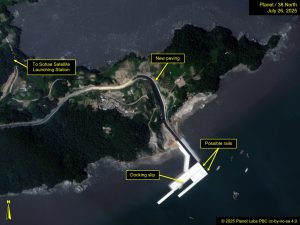
Commercial satellite imagery from July 9 indicates a large jetty has been completed at the Sohae Satellite Launching Station after some 28 months of construction. Work on the pier-like structure picked up in April 2025, according to separate analysis in 38 North, and includes a docking slip for large vessels, what appear to be rails for a crane, and the surfacing of a dirt road from the dock area to the rest of the launching station.
Context and Implications
The addition of the jetty suggests that the North intends to send cargo to the launch facility that is larger than what can be accommodated by the existing rail link. Such cargo could be related to a new, large space-launch vehicle (SLV) for which the North probably has been preparing a launch pad at Sohae since March 2022. A larger SLV could be intended for future, larger low-orbit reconnaissance or weather satellites, multiple launches of low-orbit satellites on a single booster, or geostationary launches of communications satellites.
Russia “Understands” North Korea’s Nuclear Weapons Program
In a July 12 press conference after a “strategic dialogue” with North Korea, Russian Foreign Minister Sergei Lavrov said that “It is precisely because” the North Korean leadership’s conclusions regarding national defense “were made in a timely manner that no serious actor contemplates a military strike against the DPRK today.… The technologies applied by the Democratic People’s Republic of Korea are a result of efforts by North Korean scientists. We respect the DPRK’s actions and understand the reasons why they carry out their nuclear program.”
On September 26, Kim Jong Un “guided an important consultative meeting related to the production of nuclear materials and weapons” that reviewed “the plan for 2025 to increase the capacity of the nuclear-material production field” as well as next year’s plan according to North Korean state media. Kim stated that “steadily evolving the state’s nuclear response posture is an essential top priority task.”
Context and Implications
Lavrov’s “understanding” of North Korea’s nuclear weapons program is consistent with Russia’s vetoes of UN Security Council actions to ramp up sanctions against North Korea in May 2022 and to extend the mandate of the UN Panel of Experts on North Korea in March 2024. It also reflects Moscow’s many years of varied noncompliance with existing UN sanctions. These public remarks underscore that Russia will not be part of the solution to the North Korean nuclear problem, at least in the absence of Pyongyang’s own agreement to nuclear limitations, and the threat that Moscow might become, if it has not already, part of the problem by directly assisting North Korean nuclear weapons and delivery programs.
With or without Russian assistance, North Korea clearly intends to continue expanding production of fissile materials and nuclear weapons, consistent with Kim’s January 2023 call for “an exponential increase of the country’s nuclear arsenal.” The North’s development of tactical nuclear weapons and (if successful) MIRV missile payloads, and its ongoing increases in nuclear-armed ballistic and cruise missile deployments, will all drive demand for more fissile material and nuclear weapons.
A Reminder of North Korea’s CW
A July 9 media report claimed that, according to an unnamed “high-ranking” source in North Korea, Pyongyang “is elevating chemical weapons to serve as strategic weapons alongside nuclear weapons” and views “their importance [is] gradually increasing.” This source also said North Korea “considers chemical weapons a strategic deterrent and has exponentially expanded research, development and production,” is “systematically developing them as battlefield weapons in preparation for a full-scale war,” and considers CW “the highest means to respond immediately before the use of nuclear weapons.”
Context and Implications
Although the sourcing and content of this report cannot be corroborated, it serves as a useful reminder in these nuclear-focused times that North Korea is widely assessed to have a longstanding, substantial, weaponized CW stockpile (as well as a biological weapons program). Such a stockpile likely has served, since at least the 1980s, as a “strategic deterrent” against population targets in South Korea and Japan, including US citizens and forces there—well before the North’s acquisition of nuclear weapons starting in the 1990s. North Korean CW also has substantial potential to facilitate a conventional attack against the South by impeding allied ground and air operations, and the flow of reinforcements and supplies.
How the North would sequence or integrate conventional, chemical, and nuclear operations is unknown, but CW would clearly add to its military options and complicate alliance planning. While current open-source data on the size, type, and location of any North Korean CW stockpile is essentially nonexistent, alliance planning needs to take the CW threat fully into account.