

Is North Korea Pursuing a “Juche-Oriented” Nuclear Triad?
Cold War strategic culture has emphasized the importance of having a “triad” of intercontinental nuclear delivery systems with land-, sea-, and air-based “legs” to maximize stability and assure retaliation. The US led the way in the 1960s, closely followed by the USSR/Russia. France later achieved a small triad before dropping its land-based missiles. China waited years to add sea-based nukes to a land-based force, and only recently began to add an air “leg.” India and Pakistan have been working to add sea-based nukes to their original land- and air-based forces, as Israel publicly is reported to have done.
North Korea is the latest nuclear-armed state to diversify its nuclear force’s basing modes. Pyongyang began augmenting its longstanding land-based nuclear delivery systems with shipborne nuclear cruise missiles starting in 2023, has been slowly pursuing ballistic missile submarines yet to be deployed, and assigned nuclear missions to its Air Force in November 2025 (albeit using ground-launched cruise missiles to start).
Given North Korea’s differences in history, geography, and technology, Pyongyang is highly unlikely to develop a triad as balanced as those of the US and USSR/Russia, or even China. The bulk of the North’s intercontinental and theater strategic forces is very likely to remain deployed on road-mobile launchers, which are highly survivable once dispersed to the field. The Navy will probably take on a modest theater nuclear role over time, but its intercontinental prospects depend on nuclear-powered submarines, intercontinental-range sub-launched missiles, and probably multiple warheads that collectively are likely years away if the North follows through with all of them. The Air Force is highly unlikely to take on an intercontinental role and will probably remain the smallest nuclear contributor even in the theater. But this degree of diversification will still allow Pyongyang to deploy a sufficiently large and survivable nuclear force to promote its objectives and challenge those of the Alliance.
Three Currently Uneven “Legs”
A lopsided land-based leg. North Korea’s nuclear force began in the early 1990s exclusively based on road-mobile short- and medium-range ballistic missiles (SRBMs and MRBMs). It has since grown to include road-mobile intermediate-range and intercontinental ballistic missiles (IRBMs and ICBMs), as well as road-mobile theater-range land-attack cruise missiles (LACMs).
The country is generally estimated currently to possess about 60 nuclear weapons. These are almost certainly overwhelmingly mounted on its at least 10 nuclear-only ICBMs and probably a similar number of IRBMs, as well as a fraction of its several hundred dual-capable SRBMs and MRBMs with over 200 launchers, and an unknown number of dual-capable road-mobile LACMs. Pyongyang has made preparations to produce substantially more nuclear weapons, missiles (probably mostly conventionally-armed), and road-mobile launchers in the future. Most of the new nuclear weapon and missile production probably will be for land basing, but more production increasingly will permit further deployments in other basing modes as well.
Most other nuclear-armed states acquired nuclear weapons in the heyday of manned bombers and only the early days of ballistic missiles. But when North Korea acquired nukes, it already had a large and well-established road-mobile ballistic force for non-nuclear delivery, and only an obsolescent manned air force and navy both overshadowed by US-ROK air and naval superiority. It is not surprising, therefore, that Pyongyang vested most of its nuclear strike capability in road-mobile ballistic missiles (later augmented by theater LACMs)—which themselves already fulfilled for North Korea most of the conventional strike roles other countries assigned to manned aircraft.
Moreover, compared to the silo and other fixed-based nuclear missiles the major powers originally built their nuclear forces around, North Korea has good reason to expect that its road-mobile nuclear missiles would be highly survivable once deployed to hide sites in the field. This proved to be the case for Iraq in the First Gulf War despite a dedicated Coalition “Scud-hunting” effort and relatively open desert terrain, for the Yemeni Houthis against both Saudi/UAE and later US airpower, and even most recently for Iran, albeit with more apparent Israel/US success. North Korea is highly likely to take steps to further improve its mobile missile survivability in the wake of the Iran war, and highly unlikely to deemphasize road-mobile missiles, although it has experimented in the past with rail-mobile (2021-22), probably lakebed-based (2022), and even silo-launched (2023) KN-23 SRBMs.
A slow-moving sea-based leg. North Korea has been intermittently pursuing submarine-launched ballistic missiles (SLBMs) since at least 2012. It flight-tested the 1200 km range Pukguksong-1 in first liquid- then solid-propellant versions six times (2-3 successful) in 2015 and 2016; the 1900 km range Pukguksong-3 solid missile once in 2019 (successful); and the “Hwasong-11S” naval version of the KN-23 SRBM from a test submarine in 2021 and 2022. The North also has paraded (but not yet test-flown) three progressively larger (and thus longer-ranged) SLBMs: the Pukguksong-4 in October 2020, the Pukguksong-5 in January 2021, and what is presumably the Pukguksong-6 in April 2022.
Development of ballistic missile submarines has been even slower.
- After unveiling the GORAE-class single-tube conventionally-powered ballistic missile submarine (SSB) test platform in 2014, the North rolled out of its construction hall in 2023 a “Korean-style tactical nuclear attack submarine” converted from an existing old ROMEO-class conventionally-powered sub (SS). The conversion started in about 2014 but then the sub probably was further modified since mid-2019 to carry four probable SRBM or MRBM-class ballistic missiles and six probable LACMs. This Hero Kim Kun Ok-class SSB still has yet to begin sea trials. Although Kim Jong Un suggested all the North’s remaining Romeo-class SS’s (up to 19 more boats) would be converted to SSBs, it is unclear whether any other conversions currently are under way.
- Finally, after mentioning the goal of developing a nuclear-powered ballistic missile submarine (SSBN) in 2021, the North revealed in March 2025 what it claimed to be an SSBN under construction. Further photos in December 2025 suggested the new sub would carry 5-10 SLBMs longer (and thus longer-range) than the putative Pukguksong-6. This may be the intercontinental-range solid SLBM mentioned by Kim as an objective in 2021, but no other sign of such a missile has been seen thus far. There is no open-source reporting that North Korea has yet built or tested a submarine nuclear reactor; even if the sub being built is reactor-equipped, a year or two of fitting out probably would be required before it rolled out of the construction hall ready to begin sea trials, with additional time required to reach operational status.
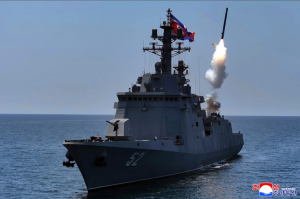
In the meantime, the North has been equipping surface combatant ships since 2023 with dual-capable LACMs, some of which it has said are intended to carry nuclear warheads. These include its two Amnok-class and two Tumen-class corvettes, each apparently carrying eight LACMs, and its new Choe Hyun-class 5000 ton destroyers, the first of which was commissioned and the second began sea trials in June 2026. The new destroyers appear to be able to carry some 10-48 LACMs, and Kim stated this June that two large warships (either destroyers or an as-yet-unseen 10,000 ton cruiser, which presumably also will be equipped with LACMs) will be built each subsequent year.
Furthermore, in March 2023 North Korea claimed to have test-launched LACMs from what appear to have been the torpedo tubes of a submerged submarine, opening up the possibility that some of its SS’s may carry a few nuclear LACMs, although there has been no further reporting on this issue. The North will have to decide how many launch tubes for dual-capable naval LACMs on a limited number of ships and subs to devote to conventional- vs. nuclear-armed missiles in a war that may begin conventionally and stay at that level for an uncertain amount of time.
The traditional nuclear powers rely on SSBNs to provide an invulnerable second-strike capability, with the US putting about 54% of its strategic nuclear warheads on subs, Russia about 36%, and China about 15%. Although North Korea may aspire to developing an invulnerable sea leg (notably, it has not stated this explicitly), its current submarines (both SS and SSB) are far too noisy to evade likely US-ROK anti-submarine warfare (ASW) efforts in wartime, and its first-generation SSBNs (assuming they reach deployment) are likely to be quite noisy as well. North Korean surface ships also would be highly vulnerable to any concerted effort by the alliance to target them in wartime.
The North’s best bet for maximizing the survivability of its sea-based missile carriers would be to operate them close to North Korea where its other military assets can try to protect them against alliance attack, akin to the “bastion” concept the USSR and now Russia uses for its SSBNs. Although this approach would allow sea-based targeting of the ROK and Japan, the North’s current SLBMs and LACMs have inadequate range of reach Guam, Hawaii, or the continental US from North Korean waters. Thus, an ICBM-range SLBM would be critical for Pyongyang to obtain a credible capability to threaten these areas from the sea.
Another aspect complicating the North’s ability to field a credible sea-based leg is the need to have enough naval missile submarines and deployed missiles, especially given the longstanding rule of thumb that one sub can be on operational patrol for every three subs in inventory. This is especially important for North Korea, which would need to account for any platform losses prior to nuclear launch (which could be substantial given its noisy subs), potential launch and in-flight failures, and attrition from alliance air and missile defenses. But adding new subs—especially nuclear-powered ones—is an expensive and time-consuming way to add more launch tubes, especially compared to churning out more road-mobile launchers (essentially big trucks each carrying 1-6 missiles depending on type). Deploying SSBNs with multiple independently-targetable reentry vehicle (MIRV) payloads would allow more nuclear warheads to be carried per sub and make SSBNs more cost-effective, but the North’s only known MIRV test apparently failed in June 2024. At least several successful flight tests over a minimum of a few years would likely be required to make MIRV deployment possible (as well as deployment of both an ICBM-range SLBM and an SSBN).
An air-based leg from the ground up. It was only in November 2025 that Kim Jong Un announced “that the Air Force will be given new strategic military assets and entrusted with a new important duty,” and “will play a role in the exercise of the nuclear war deterrent.” Up to now, the only sign of this nuclear role is the apparent subordination of some land-based, road-mobile launchers for dual-capable LACMs to the Air Force in addition to those under the Strategic Forces. This is probably the most sensible way to give the Air Force a nuclear role at least for now, since road-mobile LACMs are more survivable both pre-launch and in-flight than Pyongyang’s obsolescent combat aircraft, and have enough range (1,500-2,000 km) to cover all of South Korea from anywhere in the North.
The North is highly unlikely to acquire or produce intercontinental-range manned bombers, which would be highly vulnerable at their bases, require many hours to reach the US whether or not aerial tanker support was also required, and would still have to contend with alliance air defenses near the Peninsula and additional defenses based in the US. Consequently, any air-based leg is highly likely to remain a theater-oriented force. Future air deployment of theater-range LACMs cannot be ruled out, especially if the North can acquire more capable aircraft to carry them; this is much more likely than having North Korean aircraft try to penetrate alliance defenses with nuclear gravity bombs.
But if North Korea obtains more capable combat aircraft, it will have to decide how to allocate them between protecting high-value ground assets against alliance air attack, supporting Pyongyang’s own ground and naval operations (including any missile submarine bastions), and conducting both conventional and nuclear LACM strikes. For all these reasons, air-delivered nukes will likely remain a minor player in a North Korean nuclear force dominated by road-mobile ballistic and cruise missile systems.
Will This Develop into A “Triad”?
In a US-style “triad,” each of the three legs should be independently able to inflict what the adversary regards as “unacceptable damage” on its homeland. North Korea’s road-mobile missile force has long been able to do this vis-à-vis the ROK and Japan, and seems well on track to be able to do it against the continental US, assuming the force is able to deploy to the field prior to conflict. The North’s sea-based systems face significant survivability issues (especially LACM-armed surface ships) but may be able to inflict “unacceptable damage” on the ROK and Japan if enough surface ships and SSBs are deployed and operated in a “bastion” approach. The North Korean Navy is unlikely to meet this standard against the continental US unless an ICBM-range SLBM (probably with MIRVs) is deployed on enough bastion-protected SSBNs, a force that would take many years to build up if Pyongyang decides to pursue this objective. The air-based leg faces the largest challenges, being highly unlikely to be able to pose a credible threat to the US homeland. Its ability to threaten the ROK and Japan probably will be highly dependent on LACMs that offer no real advantages over those the North can already launch from road-mobile platforms (including ones owned by the Air Force) and even naval platforms.
It should be noted that the North Koreans themselves have not apparently talked publicly in terms of a “triad” or an integrated land-sea-air nuclear force, although they often refer to “the state nuclear force” without specifying its components. The idea of a naval nuclear role was first mentioned in the 2021 Eighth Congress report, which referred to “an underwater-launch nuclear strategic weapon” and ICBM-range solid SLBMs. In September 2023, Kim Jong Un called naval nuclear weapons “the most important thing” in strengthening the Navy, terming a naval nuclear build-up “a revolutionary step for ensuring maximum efficiency”—strangely reminiscent of the Eisenhower administration’s “New Look” strategy from the mid-1950s that relied on nuclear weapons as a less economically costly alternative to large conventional forces. As noted above, an Air Force nuclear role was not mentioned publicly by the North Koreans until November 2025.
The Bottom Line: A “Big Wheel,” Not A Three-Legged Stool
It is not surprising given the differences in history, geography, and technology that North Korea is highly unlikely to develop a nuclear “triad” in the sense that the US and USSR/Russia did. Although Pyongyang has made clear it has deployed at least some nuclear-armed delivery systems to the Strategic Forces, Navy, and Air Force so each can have at least some nuclear delivery missions—thereby perhaps meeting the most minimal definition of a “triad”—only the North’s land-based delivery systems are likely to be able to inflict “unacceptable damage” both in the theater and intercontinentally until well into the future. The Navy is likely over time to take on a modest theater nuclear role, but its intercontinental prospects depend on nuclear-submarine, ICBM-range SLBM, and probably MIRV developments that collectively are likely years away. However, the Air Force is highly unlikely to take on an intercontinental role, and will probably remain the smallest nuclear contributor even in the theater.
Regardless, a road-mobile-dominant nuclear force has the survivability, cost-effectiveness, and scalability North Korea probably sees itself as needing—including for important conventional warfighting roles. Sea- and especially air-based nuclear capabilities will almost certainly remain minor players, and it remains to be seen if they develop beyond token nuclear forces. But this degree of diversification will still allow Pyongyang to deploy a sufficiently large and survivable nuclear force to promote its objectives and challenge those of the Alliance.