

North Korea-China Relations Not Yet Fully Restored; North Korea Hints Kim-Trump Talks Possible, Reaffirms Two Koreas Policy
This article is from the second edition (July-September 2025) of 38 North’s new quarterly product, North Korea Briefing, that monitors key internal developments in North Korea. For the full series, click here.
During the third quarter, Kim Jong Un held his first summit with Chinese President Xi Jinping in more than six years, while North Korea issued a series of high-level statements on its relations with the United States and South Korea.[1] Coverage of the Kim-Xi summit and subsequent bilateral developments indicates the relationship has not yet been fully restored. Kim Yo Jong and Kim Jong Un extended diplomatic overtures to Trump, hinting that Kim-Trump talks may be possible if Trump removes denuclearization from the meeting agenda. At the same time, they reaffirmed that Pyongyang has no desire to improve ties or pursue unification with South Korea despite the new Lee government’s appeasement measures, all the while nudging Seoul to take further conciliatory measures.
China
Kim Jong Un stood to Xi Jinping’s left during China’s September “Victory Day” celebrations and held his first summit with Xi since June 2019. According to North Korea’s official report of the meeting, Kim said: “Affirming that the friendly feelings between the DPRK and China can not change no matter how the international situation may change and it is the steadfast will of the WPK and the government of the DPRK to steadily develop the DPRK-China relations….” Since then, Kim has sent two letters to Xi, both reaffirming his commitment to improving ties with Beijing, with much of the cooperation language mirroring the summit readout.[2]
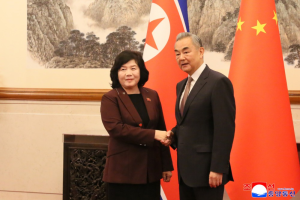
Foreign Minister Choe Son Hui paid a follow-up visit to China later in the month, meeting with the Chinese foreign minister and premier, though not with Xi. North Korea’s readout of her talks with Foreign Minister Wang Yi stated that they had “reached a full consensus of views [완전한 견해일치]” on “international and regional issues,” without elaboration.[3] However, Choe’s congratulatory letter to Wang on China’s founding anniversary on October 1 showed a notable change. She wrote that she was pleased “an important consensus of views [중요한 견해일치] was reached to thoroughly implement the agreement made by the top leaders of the two countries and promote friendly visits and practical cooperation between the DPRK and China.” Within days of the initial meeting readout, Pyongyang watered down the original “consensus” language from “full” to “important,” and changed the scope of consensus from “international and regional issues” to implementing the leaders’ “agreement” and promoting bilateral cooperation.
Context and Implication
North Korea’s coverage of the Kim-Xi summit and its post-summit handling of China suggest the bilateral relationship has not yet been fully restored. Although the summit report included some positive references to the relationship, it lacked the alignment language found in previous Kim-Xi summit reports. It was also the shortest and vaguest of all six official North Korean accounts of past summits.
Pyongyang’s post-summit handling of China—specifically reports on Choe Son Hui’s meetings in Beijing and Kim Jong Un’s two letters to Xi—followed a similar pattern. They reaffirmed Pyongyang’s commitment to improve ties and even indicated some progress, but their lack of warmth suggests persisting distance despite Kim Jong Un’s recent visit to Beijing.
Choe’s letter to Wang Yi—the first since 2018—has somewhat complicated the picture. Pyongyang’s Choe-Wang meeting readout, which stated they “reached a full consensus of views,” appeared to mark significant progress from the Kim-Xi summit, to which North Korea did not apply language suggesting alignment.[4] However, the letter’s softening of that characterization to “an important consensus of views” and its changed scope of consensus just days after the initial meeting readout raises questions about North Korea’s thinking on China. It should be noted that Choe did not meet with Xi, in contrast to her predecessor Ri Yong Ho’s meeting with Xi Jinping in December 2018, as well as her own meetings with Russian President Vladimir Putin in Russia in January and November 2024.
United States and South Korea
Between late July and late September, there was an unusual flurry of North Korean leadership pronouncements on the two countries, including “press statements [담화]” from Kim Yo Jong, the defense minister, and the Central Military Commission vice chairman.[5] Kim Jong Un capped this period with a speech at the Supreme People’s Assembly (SPA) fall session, reaffirming and reinforcing his sister’s earlier comments.
The Kims accused both the United States and South Korea of continuing a “hostile” policy toward Pyongyang but differed significantly in their prescription for each. On the United States, they made their first direct overtures to Trump since his January 2025 inauguration. Kim Yo Jong was the first to hint at a possible Trump-Kim meeting if Washington dropped its denuclearization demand. Kim Jong Un’s SPA speech echoed this but was more explicit. After emphasizing North Korea’s irreversible “nuclear state” status, he said: “If the United States, freeing itself from its absurd pursuit of other’s denuclearization and recognizing the reality, wants genuine peaceful coexistence with us, there is no reason for us not to come face to face with it. Personally, I still have a good memory of the current US President Trump.”
On South Korea, they dismissed Lee’s North Korea policy as a “copy” of previous governments and reiterated that improvement in relations or unification was not on the table. To that effect, Kim Jong Un said: “I make clear that we will not deal with it [South Korea] at all.” On unification, he stated: “Reunification is never needed. … Why should we pursue a reunification which cannot be achieved unless one of them ceases to exist?” He further pledged: “We will enshrine in a national law that we and the ROK [Republic of Korea] are two states sharing the border, which are heterogeneous from each other and which can by no means become one.”
Context and Implications
These statements align with North Korea pattern of avoiding direct criticism of Trump and its disinterest in reconciliation with Seoul since Kim Jong Un’s December 2023 policy declaration defining South Korea as a “hostile” state and renouncing peaceful unification (two Koreas policy). The timing of Pyongyang’s dialogue overtures to Trump and renewed denunciations of Seoul’s North Korea policy suggests that Kim viewed the South Korean leadership transition (June) and the Lee government’s policy coordination with Washington—especially around the Lee-Trump summit (August)—as an opportunity to nudge both capitals to reconsider their approach. Given the consistency of North Korea’s stance on the two Koreas policy, its criticism of the Lee government’s “anti-DPRK policy” and “blind trust to the ROK-U.S. alliance” should be viewed more as pressure for further concessions from Seoul rather than any genuine intent to improve ties even if its demands are met. By sending mixed signals—overtures to Trump and hostility to Seoul—North Korea also seems to be strengthening its stance that South Korea, which it labels “a foreign country and the most hostile state,” should be excluded from any future US-North Korea dialogue.
In his SPA speech, Kim devoted the South Korea section entirely to reaffirming the two Koreas policy. Both his 2023 and 2025 speeches emphasized the “inevitable” nature of Kim’s decision to abandon the country’s decades-old unification policy, framing the shift as a response to South Korea’s actions. In his latest address, Kim focused on the history of Korean division and South Korea’s “hostility” going back to 1948 to emphasize that his decision was not made hastily but was instead a long-overdue acknowledgment of reality. Kim explained: “In fact, we and the ROK have existed in the international community as two states over the last scores of years.… We defined the ROK as a foreign country and the most hostile state, not based on the judgment formed abruptly in recent years. This is nothing new. We simply accepted the hard fact.” Revisiting this nearly two-year-old policy—likely targeting the domestic audience more than South Korea—suggests possible ongoing internal pushback to the policy shift.
- [1]
This chapter covers the period from July 1 to October 2 to ensure continuity with events in late September.
- [2]
“Respected Comrade Kim Jong Un Sends Reply Message to Chinese President,” Korean Central News Agency (KCNA), September 23, 2025, http://www.kcna.kp/en/article/q/ac00b40bb83dd20eda0f11c718c095b4.kcmsf; “Respected Comrade Kim Jong Un Sends Greetings to Chinese President,” KCNA, October 1, 205, http://www.kcna.kp/en/article/q/006b3a1e937746cd768899eb1692f2ba.kcmsf.
- [3]
The Chinese report on the Choe-Wang talks did not say they had reached a “consensus” of any kind. See “Chinese FM holds talks with DPRK FM,” Xinhua, September 29, 2025, https://english.news.cn/asiapacific/20250929/443feb918ecf4d6fa2ec1ba8a58ece1b/c.html.
- [4]
Chinese reports have said Kim and Xi reached an “important consensus [중요한 공동인식]” during their latest summit. However, North Korea’s Kim-Xi summit readout did not use this characterization, and its post-summit reports have been careful to avoid attributing this formulation to North Korea’s own officials.
- [5]
“Press Statement of Kim Yo Jong, Vice Department Director of C.C., WPK,” KCNA, July 28, 2025, http://kcna.kp/en/article/q/8c4b1d1e8a32e3c00798c9612ac1682d.kcmsf; “Press Statement of Kim Yo Jong, Vice Department Director of C.C., WPK,” KCNA, July 29, 2025, http://kcna.kp/en/article/q/f09697cbd57fc50ca8b79a88ccfd9309.kcmsf; “Press Statement by Kim Yo Jong, Vice Department Director of C.C., WPK,” KCNA, August 14, 2025, http://kcna.kp/en/article/q/2ec8d342dc9823b2e99bee90fec206e9.kcmsf; “Kim Yo Jong, Vice Department Director of C.C., WPK, Censures Seoul Authorities for Deceptive Attempt at ‘Appeasement Offensive’,” KCNA, August 20, 2025, http://kcna.kp/en/article/q/1965dc98a212a5781a2b526185da4933.kcmsf; “Press Statement of Kim Yo Jong, Vice Department Director of C.C., WPK,” KCNA, September 14, 2025, http://kcna.kp/en/article/q/5ed01bb21c0b1334a45b33fe01d39a2b.kcmsf.